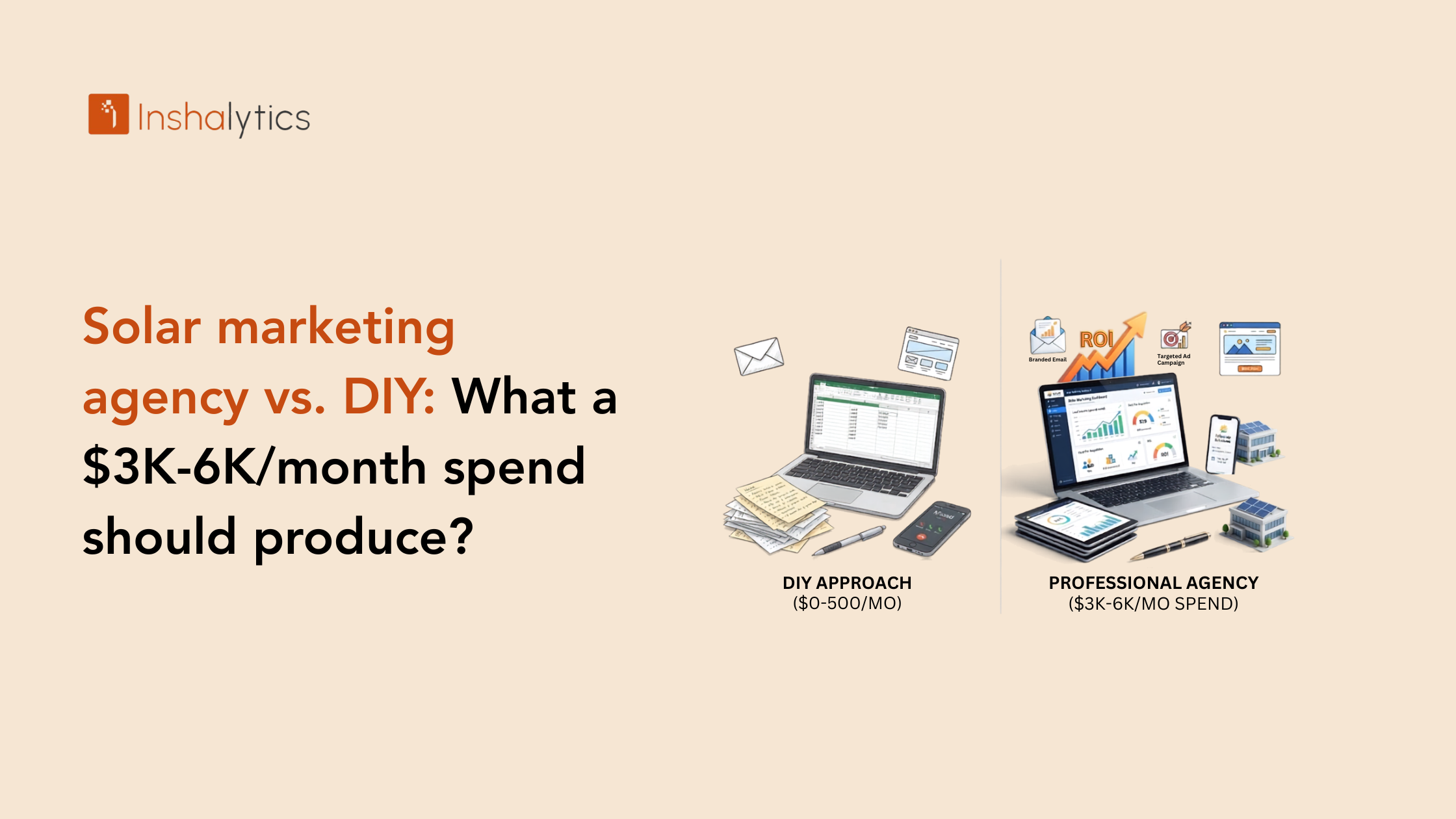
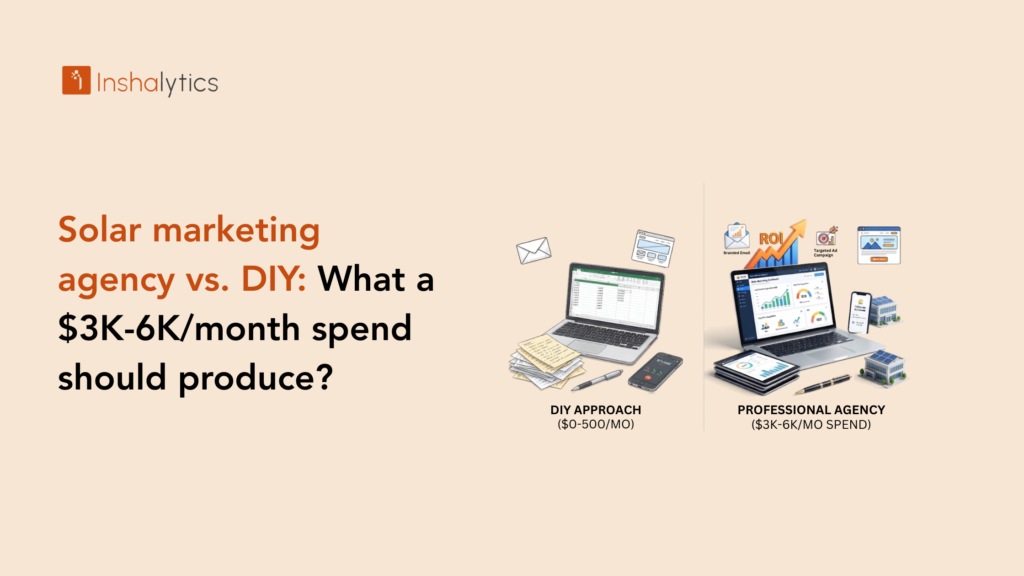
More than half of solar companies recently surveyed on their marketing spend admitted they’re paying over $2,000 in cost per closed deal, often without knowing exactly why, or what a better number should look like for a business their size in their market. If you’re weighing solar marketing agency vs. DIY at a $3,000 to $6,000 monthly budget, the real question isn’t which option costs less on paper. It’s which one actually produces enough closed deals to make that spend worthwhile once every real cost is accounted for, including the ones that never show up on an invoice. This article lays out a realistic, honest framework for making that decision.
The True Cost of DIY Solar Marketing
DIY marketing looks free at first glance, because the monthly bill shows zero for labor. That comparison misses most of the actual cost hiding behind the owner’s own time.
Your Time Isn’t Free: Calculating the Real Opportunity Cost
If running your own marketing takes ten to fifteen hours a week away from sales, operations, or installations, that’s real opportunity cost, hours that could otherwise be spent closing deals or managing crews directly on-site. A true DIY cost comparison has to include the value of the owner’s or team’s time, not just the software and ad spend line items, or the comparison isn’t actually fair to either option.
Why 58% of Solar Companies Report Overpaying for Customers
A recent industry poll found more than half of solar companies spending over $2,000 in marketing cost per closed deal, with the pattern behind the highest spenders consistent: generic landing pages, no clear offer, leads worked cold instead of pre-qualified, and no clear tracking of what was actually converting into revenue. These are exactly the gaps DIY marketing efforts fall into most often, simply from lack of bandwidth to fix them properly.
What Should $3K–$6K/Month Actually Buy You?
At this budget tier, there’s a reasonably predictable range of what good execution should produce, a useful benchmark regardless of which path you choose to pursue.
Realistic Channel Mix at This Budget Level
At this spend level, a realistic channel mix typically includes targeted Google Ads or Local Services Ads, ongoing local SEO investment, and a functioning review-generation system, enough to run multiple channels credibly, though not enough to dominate every channel simultaneously in a competitive metro all at once without stretching the budget too thin. Trying to spread that same budget across five or six channels simultaneously usually produces mediocre results everywhere instead of strong results in the two or three that actually matter most.
Expected Lead Volume and Cost-Per-Acquisition Benchmarks
At well-executed campaigns, cost per lead in the $100 to $250 range and a cost per closed deal well under $1,500 are realistic benchmarks at this spend level, a useful yardstick to hold either a DIY effort or an agency relationship against. See shared vs. exclusive solar leads: real cost-per-closed-deal math for the full math behind these numbers and how they were calculated.
Where DIY Marketing Tends to Break Down
DIY solar marketing doesn’t fail because owners lack intelligence or effort. It fails because the discipline required to execute well competes directly with running the actual business day to day.
Generic Landing Pages With No Clear Offer
Building a landing page is easy. Building one with a clear, specific offer and messaging tested against real conversion data is a different skill entirely, and it’s usually the first thing that gets skipped when time is short and something else feels more urgent, whether that’s a crew scheduling problem or a customer call that can’t wait. Marketing is rarely the thing that feels most urgent on any given day, which is exactly why it’s the thing that suffers most under a DIY approach.
No Systematic Follow-Up or Retargeting
Without dedicated bandwidth, follow-up sequences and retargeting campaigns, both proven to meaningfully improve conversion, are frequently the first things to slip, even when the owner fully understands their importance and intends to get back to them eventually.
Guessing Instead of Tracking Cost Per Closed Deal
Most DIY marketing efforts track cost per lead, if anything, but rarely build the attribution connecting lead source all the way through to closed deal, which means budget decisions end up based on incomplete information rather than a clear picture of what’s actually paying off.
What Does an Agency Actually Add at This Budget Level?
The value of an agency at this spend level isn’t magic. It’s specialization, tested infrastructure, and bandwidth a solo marketing effort simply doesn’t have access to.
Shared Spend Intelligence Across Multiple Solar Accounts
An agency running solar campaigns across multiple clients has visibility into what’s working across markets in real time, creative, offers, targeting, that a single installer’s in-house effort simply can’t access, since they’re only ever testing against their own limited data and limited volume. A single installer testing one offer at a time simply can’t match the pace of learning an agency accumulates by running dozens of parallel tests across a portfolio of clients.
Faster Creative and Landing Page Testing
Landing pages and ad creative that have already been tested and refined across other solar accounts save the weeks or months of trial-and-error a DIY effort typically spends discovering the same lessons from scratch, on someone else’s budget rather than yours.
Full-Funnel Systems Instead of Disconnected Tactics
An agency-built engagement typically connects ads, landing pages, and follow-up sequences into one coordinated system aligned to a single offer, where a DIY effort more often ends up with several disconnected tactics that were never designed to work together in the first place.
A Framework for Deciding Which Path Fits Your Business
Neither option is universally right. The decision usually comes down to a few honest questions about your current stage and available bandwidth.
When DIY Genuinely Makes Sense (Early Stage, Low Volume)
If you’re a very early-stage installer with low lead volume and genuine bandwidth to learn and iterate, DIY can be a reasonable way to build initial marketing literacy before committing budget to an agency relationship, as long as you’re honest about the time cost and hold yourself to real benchmarks along the way, not just optimistic assumptions.
When the Math Favors Bringing in a Partner
Once lead volume, competitive pressure, or the owner’s time constraints make disciplined, full-funnel execution genuinely difficult to sustain in-house, the math typically shifts in favor of a partner, not because DIY is impossible, but because the opportunity cost of doing it poorly usually exceeds an agency’s fee by a wide margin once every hidden cost is finally counted.
How Inshalytics Structures Solar Marketing at This Budget Tier
Rather than pitching a generic retainer, the right approach at this budget level starts with an honest look at what your current spend is actually producing, whichever path you’re currently on.
What We Include and What We Don’t
At this budget tier, we build a focused channel mix, typically paid search or LSAs, local SEO, and review generation working together, rather than spreading spend thin across every possible channel at once. Residential vs. commercial solar marketing covers how this channel mix shifts depending on which segment you’re prioritizing at any given stage.
How We Report Results Against the Benchmarks in This Article
Every engagement gets measured against real cost-per-acquisition benchmarks, not vanity metrics like impressions or click volume, so you always know exactly what your spend is producing, whether that’s with us or evaluating it independently against your own historical numbers.
Making the Decision for Your Business
Whichever path you choose, the goal is the same: knowing your real numbers well enough to make a confident decision instead of a guess based on how busy the phone feels.
Questions to Ask Before Committing Either Way
What’s your current cost per closed deal, honestly calculated? How many hours a week is marketing actually taking from higher-value work? Would a dedicated partner’s tested systems close that gap faster than continuing to build in-house? These questions apply whether you’re evaluating your current DIY effort or a potential agency relationship.
Starting With an Honest Audit of Your Current Spend
Before committing further budget in either direction, get a clear picture of what your current spend is actually producing. Ready for that honest audit? Let’s look at your numbers together and figure out what’s really the best path forward for your business, whichever direction that ends up pointing.