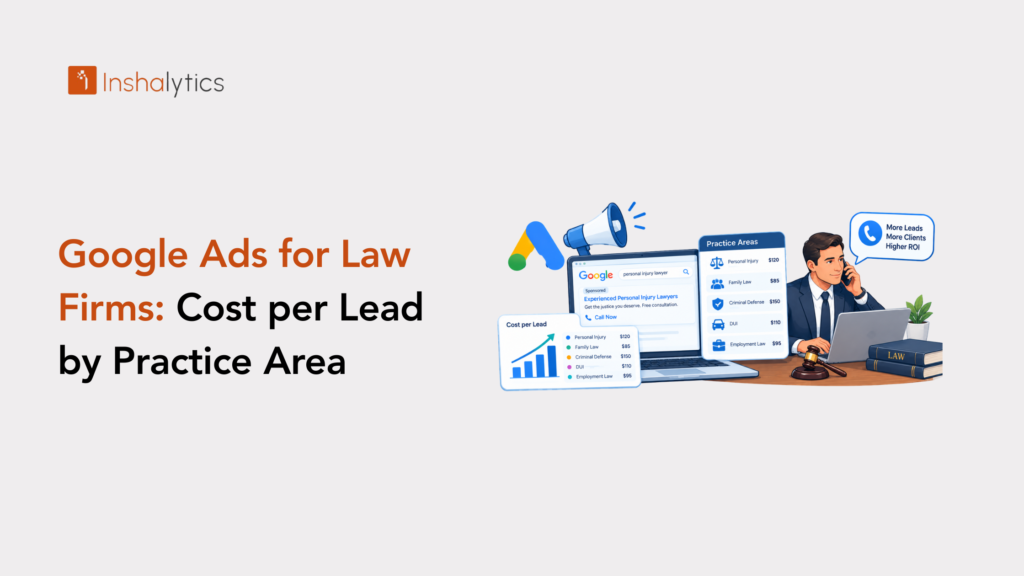
A single signed personal injury case can be worth tens of thousands of dollars, which is why law firms bid hard on legal keywords, and why many overspend. Google Ads for law firms can produce a steady flow of consultations, but only when the account is built around signed cases, not clicks.
This guide covers whether Google Ads work for firms, what they cost by practice area, how to structure campaigns, why landing pages and intake decide results, and what bar advertising rules mean for your ads.
Do Google Ads Work for Law Firms?
Yes, Google Ads can work for law firms because people search for a lawyer at the moment they need one. The ads reach high-intent prospects quickly. Results depend on practice area, market, the quality of your landing pages, and how fast your intake team responds.
Why legal keywords are high-CPC, high-intent
Legal searches such as car accident lawyer or divorce attorney come from people with a serious, urgent problem. Many firms want those clients, so the auction is competitive and clicks cost more than in most industries.
The flip side is value. When a signed case is worth thousands, a high click price can still make sense, as long as you measure what each case costs.
Search ads vs Local Services Ads for lawyers
Search ads give you control over keywords, ad text, and landing pages. Google’s Local Services Ads for lawyers show a screened profile at the top of results and charge per lead, where available for your practice area and location.
Many firms test both. Availability and rules change, so check Google’s current program details for your area.
How Much Do Google Ads Cost for Law Firms by Practice Area?
Costs vary widely by practice area and city. Personal injury is usually among the most expensive categories, while areas such as estate planning or immigration often cost less per click. Judge cost by signed case, not by click or lead.
CPC and cost per lead: personal injury, family, criminal defense, estate, immigration
Personal injury and mass-tort style keywords tend to carry the highest prices. Family law and criminal defense sit in the middle, with urgency driving demand, while estate planning and immigration vary with competition.
Use Google Keyword Planner and your own account data for current local ranges. Published averages go stale quickly.
Cost per signed case, not cost per click
The formula is simple: total ad spend divided by cases signed. An illustration with round numbers, not benchmarks: $9,000 in spend that produces 3 signed cases costs $3,000 per case. If an average case earns the firm far more than that, the program works.
Track the whole path: click, call or form, consultation, signed retainer. Cost per lead alone hides where the money disappears.
Budget by firm size
A solo practitioner may start with a focused budget on one practice area and one city. A mid-size firm can run several practice areas in parallel, each with its own budget.
Begin with enough budget to collect a meaningful amount of data per campaign, then scale what produces signed cases.
How to Structure a Law Firm Google Ads Campaign
Build your account around practice areas and intent, control which searches trigger your ads, and choose a bidding strategy that matches your data.
Campaigns by practice area and intent
Create one campaign per practice area, and split by intent within it. Someone searching car accident lawyer near me is ready to call. Someone searching what to do after a car accident is researching.
Separate budgets let you protect your best cases and cut the weaker ones without rebuilding the account.
Negative keywords and geo targeting
Legal accounts attract many wasted clicks: people looking for jobs, free advice, court forms, and lawyers in other states. Add negatives such as free, jobs, salary, pro bono, forms, and template, and review search terms weekly.
Target only the areas where your attorneys are licensed and willing to take cases, and choose the setting that targets people in those areas.
Bidding: manual, Maximize Conversions and Target CPA
Manual bidding gives control when data is thin. Maximize Conversions lets Google optimize toward more conversions within budget, and Target CPA aims for an average cost per conversion once the account has enough history.
Automated bidding learns from the conversions you report. If you count junk form fills as conversions, the system optimizes for junk, so define conversions carefully.
Why Do Landing Pages and Intake Decide Law Firm Ad Results?
A click costs the same whether the visitor calls or leaves, so the page and the intake team decide how much of your spend becomes cases. Fast, clear pages and a prepared intake process often change results more than keyword tweaks.
Practice-area landing page requirements
Each practice area needs its own page. It should repeat what the searcher asked for, show a phone number and a short form, explain your approach in plain language, and show attorney bios and results you are permitted to share.
Keep the page fast and easy to use on a phone, where many legal searches happen. For more on firm sites, see our guide to law firm website design.
Speed to lead and intake scripts
Prospects often contact several firms. The one that answers first, with empathy and clear next steps, often gets the consultation.
Give intake staff a script that gathers key facts, explains what happens next, and books a consultation before the call ends. After-hours calls need an answering service or a fast callback.
Call tracking and offline conversion import
Call tracking shows which campaigns and keywords produce calls. Offline conversion import sends signed-case data back to Google, so bidding can learn from real outcomes and not just form fills.
This step separates accounts that optimize for cases from accounts that optimize for noise.
What Do State Bar Advertising Rules Mean for Google Ads?
Lawyer advertising is regulated by each state’s bar, and the rules apply to ad text, landing pages, and tracking. Rules differ by state, so confirm your requirements with your state bar or ethics counsel before you launch.
Ad copy claims and disclaimers
Many states restrict claims that promise results, use superlatives you cannot prove, or compare your firm to others without support. Some require disclaimers, firm names, or office locations in advertising.
Write ads that describe what you do and who you serve, and keep a record of the approvals you received.
Call recording and tracking consent
Call recording rules differ by state, and some require consent from everyone on the call. Because legal calls include sensitive facts, many firms use a clear recording notice at the start of the call.
Work with counsel to settle the wording, and store recordings securely.
How Inshalytics Manages Google Ads for Law Firms
We build law firm accounts around signed cases and report on them clearly. Our PPC management pairs campaign work with landing page and intake improvements, so spend does not leak after the click.
Tracking from click to signed case
We set up call and form tracking, and work with your team to feed signed-case outcomes back into reporting, so you see cost per signed case and not only cost per lead.
Landing pages and intake funnel fixes
We build practice-area pages and review your intake process for slow response, weak scripts, and missed after-hours calls. Our law firm lead generation guide shows how paid ads fit with the rest of your marketing.
Monthly reporting by practice area
Each month you see spend, leads, consultations, and signed cases by practice area, plus the changes we plan. If you also want local map visibility, see our guide to local SEO for law firms.
Want a second opinion on your legal PPC? Talk to Inshalytics about an account review.
Plan Your First 90 Days of Legal PPC
Google Ads for law firms succeed when you pick one or two practice areas, track to the signed case, answer fast, and respect bar rules. Ninety days is enough to learn what works.
In-house vs agency: a decision checklist
Manage in-house if you have someone who can review search terms weekly, build landing pages, and track signed cases. Consider an agency if any of these are true:
- You cannot say how many cases your ads signed.
- Nobody reviews search terms or conversions every week.
- Your landing pages are generic or slow.
- You want to add practice areas without adding staff.
90-day scaling plan
In days 1 to 30, install tracking, launch one practice area, and fix intake gaps. In days 31 to 60, trim wasted searches, improve pages, and test ad copy. In days 61 to 90, scale budget on the campaigns that sign cases and cut the rest.
Ready to build a legal PPC program you can measure? Let’s talk about how Inshalytics can help.