
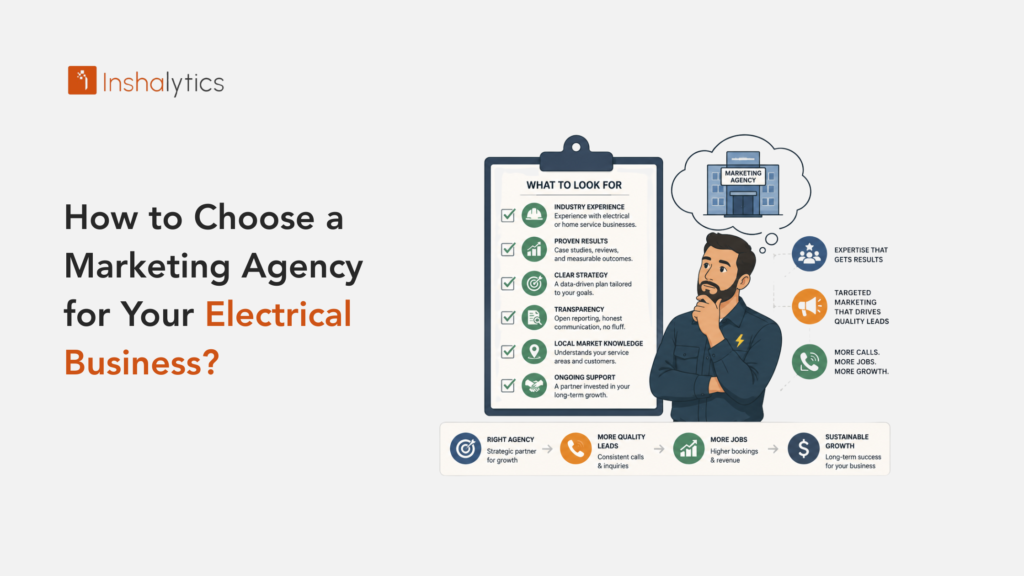
Search for an electrician marketing agency and the results are almost entirely lists of agencies ranking themselves, or each other, as the best option. Useful for browsing names. Not especially useful for actually deciding who to trust with a real marketing budget and, by extension, a meaningful share of next year’s revenue. In this guide, we cover how to choose a marketing agency for electricians and what to do next.
This isn’t another round-up. It’s a straightforward framework for evaluating any agency you’re considering, built around the questions that actually predict whether the relationship will work, not the ones that make for a good sales page.
What Should You Actually Ask Before Signing?
Before signing with any agency, ask exactly how they measure success and exactly what happens to your accounts and data if the relationship ends. Both answers reveal more about how the agency actually operates than anything in their pitch deck.
Do They Report on Booked Jobs, or Just Clicks and Leads?
Clicks and leads are easy to report and easy to make look good. Booked jobs, and ideally cost-per-booked-job, are what actually determine whether the spend is profitable. An agency that can’t or won’t report at that level, or that resists the question, is telling you something important about how closely they’re actually tracking performance.
Ask specifically to see what a monthly report looks like before signing anything. An agency confident in its results usually has no hesitation sharing a sample.
A vague answer to this question, or one that pivots to talking about impressions and reach instead, is usually a sign the agency isn’t set up to track what actually matters.
Do You Own Your Ad Account and Data If You Leave?
Some agencies build and manage campaigns inside accounts they own, not the client’s, which means walking away can mean walking away from years of performance history and audience data too. Confirming in writing that the ad accounts, tracking setup, and historical data belong to the business, not the agency, protects against getting locked in by default.
This question alone eliminates a meaningful share of agencies that structure things this way specifically to make leaving costly, whether or not that’s how it’s framed during the sales process.
Red Flags That Predict a Bad Fit
A few warning signs show up consistently across agency relationships that don’t work out, often visible before a contract is even signed.
Generalist Agencies With No Trade-Specific Experience
A marketing agency that works across dozens of unrelated industries often lacks the specific keyword instincts, seasonal patterns, and buyer behavior knowledge that trade-specific work requires. An agency with real experience in electrical or adjacent trades tends to avoid the expensive early mistakes a generalist has to learn on your budget.
Asking directly how many electrical or similar trade clients they currently manage, and for how long, is a fast way to separate genuine trade experience from a generalist pitch dressed up for the meeting.
A generalist agency isn’t automatically a bad choice, but it means a longer, more expensive learning curve happening on your account rather than on a previous client’s.
Long Contract Lock-Ins With No Performance Exit
A long-term contract with no reasonable way out, even if performance clearly isn’t there, shifts the incentive away from results and toward simply retaining the client. Shorter initial terms, or a clear performance-based exit clause, keep the incentive aligned with actual outcomes.
An agency confident in its ability to perform rarely needs a long lock-in to protect the relationship. The confidence should show up in the results, not in the contract terms.
What Does Pricing Actually Look Like in This Industry?
Electrician marketing services typically run from a few thousand dollars a month for a smaller, focused engagement up to significantly more for full-service management across SEO, ads, and website work. The lowest bid is rarely the best value once lead quality and actual booked-job outcomes are factored in.
Typical Monthly Retainers and What They Include
[STAT NEEDED: verify current typical monthly retainer ranges for electrician marketing services before publishing] Pricing varies significantly based on whether the engagement covers ads management alone, full SEO and content, or a complete package including website and CRM support, and it’s worth asking exactly what’s included rather than assuming a quoted number covers everything.
Two proposals with nearly identical monthly fees can include very different scopes of work, which makes a line-by-line comparison far more useful than comparing the headline price alone.
Why the Cheapest Option Is Rarely the Cheapest Long-Term
A cut-rate retainer that produces poorly targeted campaigns or generic content ends up costing more once wasted ad spend and lost jobs are factored in. The real comparison isn’t the monthly fee. It’s the resulting cost-per-booked-job once the campaigns are actually running.
A slightly higher retainer that produces a meaningfully lower cost-per-booked-job is the better deal every time, even though it doesn’t look that way on the invoice alone.
Evaluating an Agency on Cost-Per-Booked-Job, Not Promises
The strongest way to compare agencies is to ask each one to show, not just tell, how they’d measure success.
What to Ask for in a Sample Report
Asking to see an anonymized sample report from an existing client reveals whether an agency actually tracks performance down to booked jobs, or whether their reporting stops at clicks and leads. This single request filters out a lot of agencies that talk about results without measuring them properly.
A sample report that only shows impressions, clicks, and cost-per-click, with nothing about actual booked revenue, is a clear signal of what to expect once the engagement starts.
How Owned Leads Compare to Agencies That Resell Marketplace Traffic
Some agencies quietly supplement campaign results with leads purchased from shared marketplaces rather than generating them directly, which inflates lead volume while diluting quality. Asking directly whether all leads are owned and exclusive, or whether any are sourced from shared marketplaces, clarifies exactly what’s being paid for.
A marketplace lead shared with several other contractors converts at a fraction of the rate of a lead generated directly for your business alone, which matters enormously once cost-per-booked-job is the number being measured.
Making the Final Decision
Once the questions have been asked and the red flags checked, the final comparison usually comes down to a short list rather than the dozen names a search turned up.
Questions to Ask Past or Current Clients
A quick reference call, asking specifically about responsiveness, reporting honesty, and what happened during a slow month, tells you more in ten minutes than another round of sales calls with the agency itself. HVAC businesses face the same evaluation, and the same reference-check approach applies just as well to electrical.
Pay particular attention to how the agency handled a bad month, since that’s a far better predictor of the relationship than how they describe a good one.
A Simple Scorecard for Comparing Proposals
Scoring each proposal on trade experience, reporting transparency, contract flexibility, and pricing against expected cost per booked job turns a subjective decision into a structured comparison, making it much easier to see which option actually fits, rather than which one made the best first impression.
Even a simple one-to-five rating across these categories, compared side by side, tends to surface a clear front-runner faster than another round of sales calls ever would.
Choosing a marketing agency for an electrical business comes down to a short list of concrete questions: how they measure success, who owns the data, what their trade experience actually looks like, and whether they’ll show real numbers instead of promises. Ignore the round-up lists and ask these questions directly. The answers will tell you more than any ranking ever could.
Want to compare a proposal against a transparent, booked-job-focused sample report first? Get in touch and see exactly how the numbers would be tracked.