You paid for the click, answered the call, and sent a quote. Then nothing. For most electrical contractors, the biggest leak in the business is not lead generation, it is what happens in the days after the first conversation. A CRM for electricians exists to close that exact gap, turning a quote you sent once into a booked job you actually collect payment for.
This article walks through why leads go cold after the first call, what a CRM actually does differently than a notebook or a shared spreadsheet, how often you should follow up depending on the job type, and how to choose a system that fits a business running one to five trucks rather than a national franchise.
Why Electricians Lose Leads After the First Call
Most lost jobs are not lost to a competitor’s better price. They are lost to silence, where the customer simply forgets about the quote or assumes you are not interested enough to follow up.
The gap between “sent a quote” and “booked the job”
Sending a quote feels like progress, but it is only the midpoint of the sale, not the end of it. Homeowners get quotes from two or three electricians and often wait to see who follows up before deciding, which means the contractor with the best follow-up process frequently wins jobs they were not even the cheapest bid on. Without a system tracking who has been quoted and when, that follow-up either happens inconsistently or does not happen at all.
This gap widens as your business grows, since a solo electrician might remember three open quotes without much effort, but that same memory-based approach breaks down completely once you have a full week of estimates outstanding across multiple technicians. The busier you get, the more this invisible gap costs you, precisely at the moment you can least afford to lose booked work.
Why emergency leads and planned-project leads need different follow-up
An emergency call that goes unanswered is lost within minutes, since the customer will simply call the next name on the list. A planned project like a panel upgrade or a remodel wiring job has a longer decision window, sometimes weeks, which means the follow-up needs to be spaced out and informative rather than urgent. Treating both types of leads the same way, either too aggressively on planned work or too passively on emergencies, is one of the most common reasons booked-job rates stay flat even as lead volume grows.
A useful habit is tagging every new lead by type the moment it comes in, so your follow-up schedule is decided upfront rather than improvised later based on whoever happens to remember the job. This small step at intake saves considerable confusion further down the pipeline and makes it much easier to spot which lead type is currently underperforming.
What a CRM Actually Does for a Small Electrical Business
A CRM is not just software for enterprise sales teams. For a small electrical contractor, it is the difference between remembering follow-up by accident and having a system that reminds you automatically.
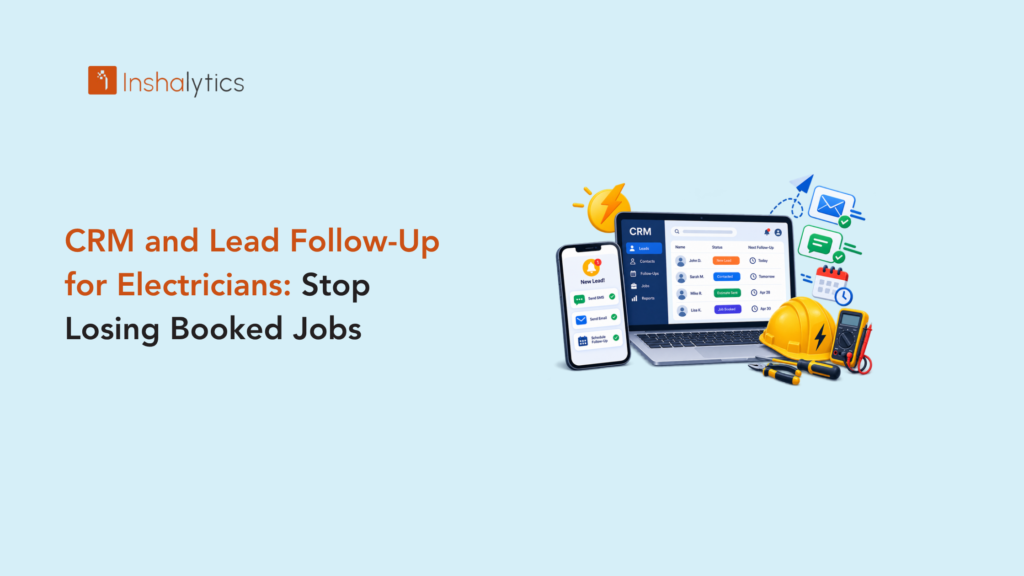
A CRM for electricians centers on tracking every quote, every follow-up touch, and every job’s current status in a single place, so nothing depends on one person’s memory or a sticky note on a truck dashboard.
Tracking quotes, follow-ups, and job status in one place
Instead of quotes living in email and job status living in someone’s head, a CRM puts both in a shared view your whole team can see. This matters most when more than one person answers calls or sends quotes, since without a shared system, two technicians can easily assume the other one already followed up. A simple pipeline view showing “quoted,” “followed up,” and “booked” prevents leads from falling through organizational cracks.
Automating the follow-up you’re currently forgetting to do
Most CRMs built for home service businesses let you set an automatic text or email reminder a set number of days after a quote goes out, without requiring anyone to remember to send it manually. This is the single highest-value feature for a busy contractor, because it means follow-up happens on schedule even during your busiest week of the year. Automation does not replace a personal call for bigger jobs, but it guarantees the smaller, easy-to-forget follow-ups still go out.
How Often Should You Follow Up With an Electrical Lead?
The right cadence depends heavily on what kind of job you quoted, and using the same schedule for everything wastes effort on some leads while abandoning others too early.
A follow-up cadence for quoted jobs (panel upgrades, rewires, remodels)
For larger, considered jobs, plan on a follow-up within two to three days of sending the quote, a second touch around the one-week mark if there has been no response, and a final check-in near the two to three week point before moving the lead to a longer-term nurture list. Each touch should add something new, such as answering a common question or mentioning financing options, rather than simply asking if they have decided yet. This keeps the outreach useful instead of repetitive.
A follow-up cadence for missed emergency calls
If you miss an emergency call, a text back within minutes stating you saw the call and asking about the issue can still recover the job, since the customer may not have connected with anyone else yet. If there is no response to that text, a single follow-up call an hour or two later is reasonable, but emergency leads that go cold rarely come back after that window closes. The lesson here is less about a long cadence and more about speed on the very first response.
Choosing a CRM That Fits a One-to-Five-Truck Electrical Business
The CRM market is full of options built for sales teams with dozens of reps, and most of that complexity is wasted on a small electrical contractor.
Features worth paying for vs. features you won’t use
Prioritize a mobile app your technicians will actually open in the field, automated follow-up reminders or messages, and a simple pipeline view over advanced reporting dashboards or complex sales forecasting tools built for much larger teams. If a platform’s core sales pitch is about managing a multi-department sales organization, it is probably more system than a one-to-five-truck business needs. Simpler, cheaper tools that get used consistently outperform powerful tools that sit half-configured.
Before committing to a platform, ask for a trial period and actually run your next two weeks of real quotes through it, rather than judging a tool purely on a sales demo. A system that looks impressive in a demo but feels clunky when your technician is standing in a customer’s driveway trying to log a quote will simply stop getting used within a month.
How Inshalytics helps clients connect CRM data to their marketing spend
Once follow-up data lives in a CRM, it becomes possible to see which marketing channel, Google Ads, local SEO, or referrals, actually produces leads that turn into booked jobs after follow-up, not just leads that show up at the top of a report. We help clients build this connection so budget decisions are based on cost-per-booked-job rather than cost-per-lead alone, which is often a very different number once follow-up data is factored in. That shift in measurement is frequently what turns a marketing budget that felt like it was underperforming into one that clearly is not.
If your team is currently tracking quotes and follow-up in email or on paper, talk to Inshalytics about how a connected CRM and marketing strategy can recover jobs you are already paying to generate.
Common Questions About CRM for Electricians
Is a CRM worth it for a solo electrician?
Yes, even a solo operator benefits from a CRM, because a single person juggling calls, quotes, and fieldwork is the person most likely to lose track of a follow-up during a busy week. A basic CRM with automated reminders effectively acts as a second set of hands for something that otherwise depends entirely on memory. Even a free or low-cost tier of a mobile-friendly CRM is usually enough to close this gap for a one-person operation, so cost is rarely a valid reason to skip this step.
What’s the difference between a CRM and a scheduling app?
A scheduling app manages when a job happens once it is booked, while a CRM manages everything before that point, tracking the lead, the quote, and the follow-up needed to get to a booked job in the first place. Many home service platforms now combine both functions, but it’s worth confirming a tool actually handles pre-booking follow-up rather than just calendar management before you commit to it. If you already use a scheduling tool you’re happy with, check whether it has CRM-style lead tracking built in before adding a second, separate system your team has to juggle.
Fixing your follow-up process is one of the fastest ways to increase booked jobs without spending another dollar on new leads, since the leads are often already sitting in your inbox waiting for a second touch. Start by counting how many open quotes you currently have with no scheduled follow-up, and you will likely find your next several bookings already there.