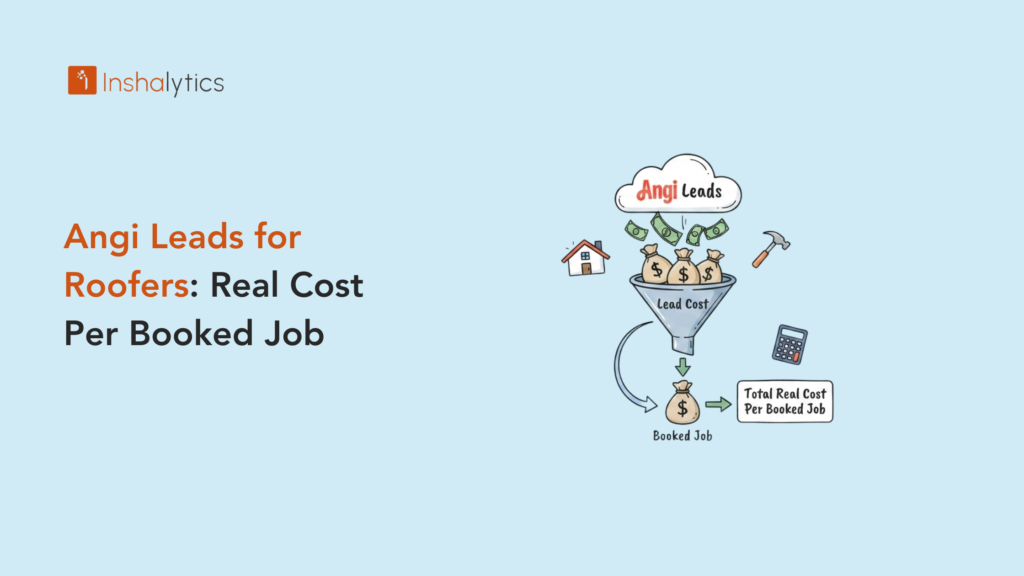
A $50 Angi lead sounds manageable until you realize four other roofers just bought the exact same one. That’s the piece the pricing page never puts in bold: cost per lead and cost per booked job are two different numbers, and for roofers, the gap between them is often the widest of any trade on the platform. If you’re weighing Angi against Google LSA, SEO, or your own referral network, the lead price isn’t the number that matters. This guide breaks down what roofers actually pay to win a job through Angi, why the shared-lead model inflates that number so much, and how to decide whether it still belongs in your marketing mix.
How Angi’s Shared-Lead Model Actually Works for Roofers
Understanding Angi’s roofing economics starts with understanding who else is on the call.
Why the Same Lead Gets Sold to 3–8 Contractors
When a homeowner submits a roofing request on Angi, that contact information typically goes out to several contractors in the same category and zip code at once, sometimes as many as six to eight for roofing specifically, since job values are high enough to support more bidders. Every contractor who buys the lead pays full price for it, regardless of whether they’re the one who ends up winning the job. First-to-call wins the majority of the time, which turns every purchased lead into a race before it turns into a sale.
What Roofers Actually Pay Per Lead in 2026
Roofing leads run higher than almost any other trade on Angi, generally landing in the $40 to $120+ range, depending on market and job type. Full replacement prices are higher than repair or inspection requests. Competitive metros and storm-season spikes push the top of that range even further.
The Annual Membership and Deposit Fees Nobody Mentions Upfront
Beyond per-lead pricing, most roofers also carry an annual membership fee (commonly cited around $300/year) and an upfront lead-credit deposit that can run into the hundreds or low thousands. Both are due before a single lead converts into a signed job, which means you’re already in the red the day you sign up.
[INTERNAL LINK: Angi pricing fees → What Angi Actually Charges HVAC Contractors Per Lead]
The Real Math: Cost Per Lead vs. Cost Per Booked Job
Cost per lead is the number Angi shows you. Cost per booked job is the number that actually determines whether the platform is profitable for your business.
The Formula Roofers Should Be Using
The math is simple once you isolate it: cost per lead ÷ close rate = cost per booked job. A $75 lead that closes at 10% costs you $750 to win the job before materials, labor, or drive time. Most roofing-specific breakdowns land in a similar range, generally somewhere between $500 and $1,250, depending on close rate.
Worked Example at a 10% Close Rate
Say you’re buying $60 roofing leads and closing 1 in 10. That’s $600 spent to win one job. If your average ticket is $12,000, the acquisition cost eats 5% of revenue before you’ve touched materials manageable on paper, but it compounds fast once you factor in the leads that never even answer the phone.
Worked Example at a 20–25% Close Rate
Roofers with strong speed-to-lead discipline and a tight qualification process can push close rates meaningfully higher into the 15–25% range on shared leads. At 20%, that same $60 lead drops to a $300 cost per booked job. The difference between the two scenarios isn’t the lead source. It’s how fast you call and how well you screen.
[INTERNAL LINK: qualification process → Spotting a Bad Roofing Lead Before You Quote It]
What Is a Good Cost Per Booked Job for a Roofing Company?
There’s no single right number, but there is a useful comparison point: what would the same job cost through a channel you own instead of rent.
Benchmark Ranges by Job Type (Repair vs. Full Replacement)
Repair and inspection leads tend to be cheaper per lead but also cheaper per job, since ticket size is smaller. Full replacement leads cost more upfront but justify a higher acquisition cost given the ticket size. The same $500–$800 cost per booked job that feels expensive on a $1,500 repair looks very different against a $15,000 replacement.
How Angi Compares to Google LSA and SEO on the Same Metric
Several independent analyses put SEO-driven roofing leads at a meaningfully lower cost per booked job than Angi, largely because those leads are exclusive rather than shared, and because a homeowner who found you organically has already self-selected toward your business rather than shopping four contractors at once.
Cutting Angi’s True Cost Without Cutting Lead Volume
If you’re staying on Angi, there are concrete levers that move the cost-per-job number without touching your ad spend.
Speed-to-Lead as a Direct Lever on Close Rate
Because leads are shared, the contractor who calls first has a structural advantage. Building a process where every Angi lead gets a call within minutes, not hours, is the single highest-leverage change most roofers can make to their close rate on the platform.
Disputing Bad or Fraudulent Leads
Angi does offer credit disputes for invalid leads, though the process can be limited and slow. Track every lead that turns out to be fake, a wrong number, or clearly outside your service area, and file disputes consistently rather than writing off the loss.
Building an Owned Pipeline Alongside Angi
The strongest long-term position is treating Angi as a supplement, not a foundation, using it to fill capacity gaps while building a website, review base, and local SEO presence that produces leads you don’t pay for every time the phone rings.
Next Steps: Is Angi Worth It for Your Roofing Business?
The honest answer depends on where your business is right now, not on whether Angi is “good” or “bad” in the abstract.
When Angi Makes Sense as a Short-Term Play
A newer roofing company with open crew capacity and a fast, disciplined callback process can use Angi to generate volume while other channels are still ramping up. In that scenario, even a $500–$800 cost per booked job can pencil out against an empty schedule.
Signs It’s Time to Shift Budget to SEO and PPC
If your close rate on shared leads is consistently under 10%, if you’re spending more on Angi than you would on a managed SEO and Google LSA program, or if you’re simply tired of subsidizing five competitors on every lead you buy, those are the signals that it’s time to redirect that budget toward channels you own.
Related reading: Storm Damage Leads for Roofers: Paid vs. Organic Strategy for Peak · Lead Generation for Roofers: SEO, Google Ads & Facebook All in One · Roof Replacement Leads — The Complete Guide for Roofing Contractors
The real cost of an Angi lead isn’t the number on the invoice. It’s what you pay after the shared-lead math plays out, and for most roofing companies, that number is high enough to justify building a pipeline that doesn’t reset to zero the moment you stop paying for it. We help roofing companies run this exact comparison, pulling real cost-per-booked-job numbers across Angi, LSA, and SEO so you can see where your marketing dollars actually go the furthest. Get a free cost-per-booked-job audit and find out what your roofing leads really cost you.