Angi’s pricing page won’t tell you the number that matters. It’ll show you a per-lead range and let you assume that’s the whole story. For HVAC contractors, the real story is in the gap between a $25 service-call lead and a $60 install lead because those two leads have completely different math behind them, and treating them the same is how contractors end up losing money on a month that looked successful on paper.
This breaks down what Angi actually charges HVAC contractors, why the number moves so much by job type, and what the margin looks like once you run it honestly.
Angi’s HVAC Pricing Structure, Broken Down
Angi doesn’t publish a fixed price list. Pricing is auction-based, which means it moves with demand, season, and how much your competitors are willing to bid at any given moment.
Service-Call Leads vs. Install/Replacement Leads
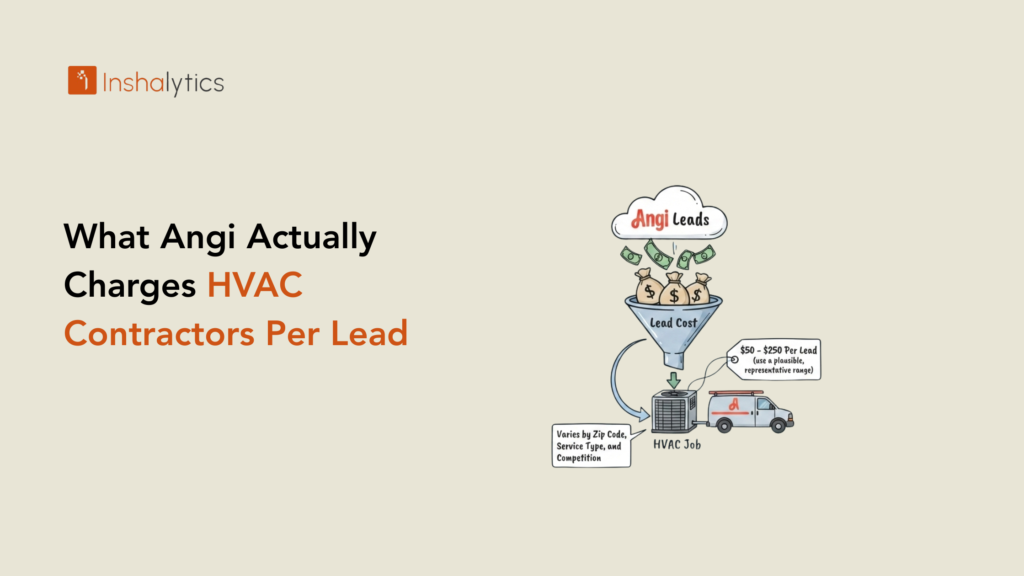
The spread is wide. According to TradeBridge’s Angi pricing breakdown, non-exclusive HVAC service-call leads in a major metro typically run $15 to $40, while install leads a new system, not a repair run $30 to $80. Roofing-adjacent categories push even higher because job value is higher, but for HVAC specifically, the service-call and install tiers behave like two different products entirely.
Treating them with the same qualification process, the same follow-up speed, and the same budget expectations is where a lot of contractors go wrong, because a $25 lead that doesn’t close costs you almost nothing, while a $60 lead that doesn’t close is a much bigger miss against a much bigger potential payoff.
Annual Membership, Deposits, and Auction-Based Bidding
Beyond per-lead cost, most contractors report an annual membership fee around $300, a lead-credit deposit typically between $300 and $1,500, and the option to bid extra for priority placement or “Top Pro” status, according to LeadTruffle’s 2026 pricing guide. Contractors willing to pay more for placement get first access to leads everyone else gets what’s left over once the top bidders have had their pick.
How Metro Size and Season Move the Price
HVAC leads that cost around $40 in 2022 are running $65 to $85 in major metros today, according to Pipeline On’s breakdown of Angi’s hidden costs, and demand spikes during heat waves and cold snaps push prices higher still right when homeowners are most desperate and contractors are most tempted to overspend chasing volume.
Pull last month’s Angi invoice and split it into service-call spend versus install spend. Most contractors have never looked at their pricing this way, and it changes the whole conversation about whether the platform is actually working for them.
Is HVAC Lead Pricing on Angi Worth It?
The honest answer is that it depends entirely on which job type you’re buying leads for, and running the actual margin math on each tier separately tells a story the blended average never will.
The Margin Math on a $25 Service Call Lead
Run the numbers on a realistic month, using the worked example from TradeBridge’s pricing guide: $25 per lead, 80 leads purchased, a 20% close rate, a $450 average ticket, and 30% net margin. That’s 16 jobs and $7,200 in revenue but after $2,000 in Angi spend, net profit lands around $160. That’s razor thin, and it assumes everything else in your operation runs cleanly, with no callbacks and no wasted truck rolls eating into the number further.
The Margin Math on a $60+ Install Lead
Now run install math from the same source: $60 per lead, 25 leads, a 25% close rate, a $7,500 average ticket, 22% net margin. That’s 6 jobs, $45,000 in revenue, and roughly $8,400 in net profit after $1,500 in Angi spend. Same platform, completely different outcome, because the ticket size does the heavy lifting that volume alone can’t on the service-call side.
Why Angi “Barely Breaks Even” on Service Work
The pattern holds across most HVAC contractors who track this honestly: Angi tends to work well for high-ticket installs and barely break even on service work. If your Angi budget is weighted toward service-call leads because they’re cheaper per unit, you may be buying volume that isn’t actually profitable once you account for the platform fee sitting on top of it.
If you’re going to spend on Angi, weight that spend toward install and replacement leads where the margin actually absorbs the cost, and treat service-call leads as a smaller, more tightly capped part of the budget.
How Does Angi Compare to Google LSA for HVAC?
Angi isn’t the only pay-per-lead option, and for HVAC specifically, the comparison against Google Local Services Ads is worth running before you renew your Angi contract for another year.
Exclusive Leads vs. Shared Leads Side-by-Side
LSA leads are exclusive you’re not one of five contractors calling the same homeowner. Angi leads are typically shared with three to eight competitors simultaneously, per LeadTruffle’s contractor guide, and shared-lead conversion rates run 13% to 20% on average compared to roughly 27% to 30% for exclusive leads nearly double. That single difference changes your effective close rate more than almost any other variable in this comparison.
When LSA Wins and When Angi Still Makes Sense
LSA tends to pull ahead as ticket size grows, since a single connected call is worth more and justifies the wait for verification. Angi’s shared-lead model still competes well on high-volume, smaller service work where steady flow matters more than exclusivity. The decision should follow your job mix, not a blanket preference for one platform over the other. For a full breakdown of how this comparison plays out with real numbers for another high-urgency trade, see Angi vs Google LSA for Plumbers: The Real Math, which walks through the exact formula you can apply to your own HVAC numbers.
Reducing Wasted Spend on Angi HVAC Leads
Whether you stay on Angi long-term or use it as a bridge, there are concrete ways to stop overpaying for leads that were never going to close in the first place.
Setting a Hard Weekly Budget Cap
Track true cost per booked job weekly, not monthly. A hard budget cap tied to that number not to how many leads “feel” available on a given day keeps a slow week from turning into an expensive one that erases the previous month’s margin.
Qualifying Leads Before You Dispatch a Truck
Every unqualified truck roll on an Angi lead compounds the cost you already paid for the lead itself. A short qualification script before booking protects both your technician’s time and your actual close rate, and it’s worth building into your intake process regardless of which platform sent the lead. See How to Qualify HVAC Leads Before You Waste a Truck Roll for the exact questions to ask.
Respond to Angi leads within five minutes, every time. Speed is the one lever that improves your close rate on every lead type without spending an additional dollar on lead volume.
Building a Lead Mix That Doesn’t Depend on Angi
The contractors who do best with Angi are usually the ones who aren’t relying on it exclusively for their pipeline.
Where SEO and PPC Fit Into an HVAC Lead Strategy
SEO and Google Ads take longer to build, but they produce exclusive leads without a per-lead invoice once they’re established. Contractors who pair Angi with a growing organic and paid presence typically see their true cost per booked job trend downward over time, even as Angi’s own pricing continues to climb.
A 90-Day Plan to Diversify Away From Shared Leads
Start by tracking your true cost per booked job by lead source for 30 days. Use the next 30 to launch or scale your Google Business Profile, reviews, and a basic SEO foundation. Use the final 30 to shift budget from Angi’s weakest-performing job type toward the channel that’s now producing cheaper, exclusive leads. Response speed matters throughout this process, too a slower channel with a fast follow-up habit can outperform a faster channel with a slow one, which is worth keeping in mind as you shift the mix. For more on why speed matters so much, specifically for HVAC, see Why HVAC Leads Go Cold in Under 5 Minutes.
Angi can be a legitimate part of an HVAC lead strategy but only when you know which job types actually pay for the platform and which ones are quietly draining margin. The contractors who win long-term are the ones tracking cost per booked job by lead type and building an owned pipeline underneath their Angi spend, not the ones hoping the next batch of leads converts better than the last.
Want a clear breakdown of what your Angi spend is actually returning by job type and what LSA or SEO could do instead? That’s the kind of analysis our full-stack marketing team runs for HVAC clients every month.
Related reading: buying HVAC leads vs. generating your own.