
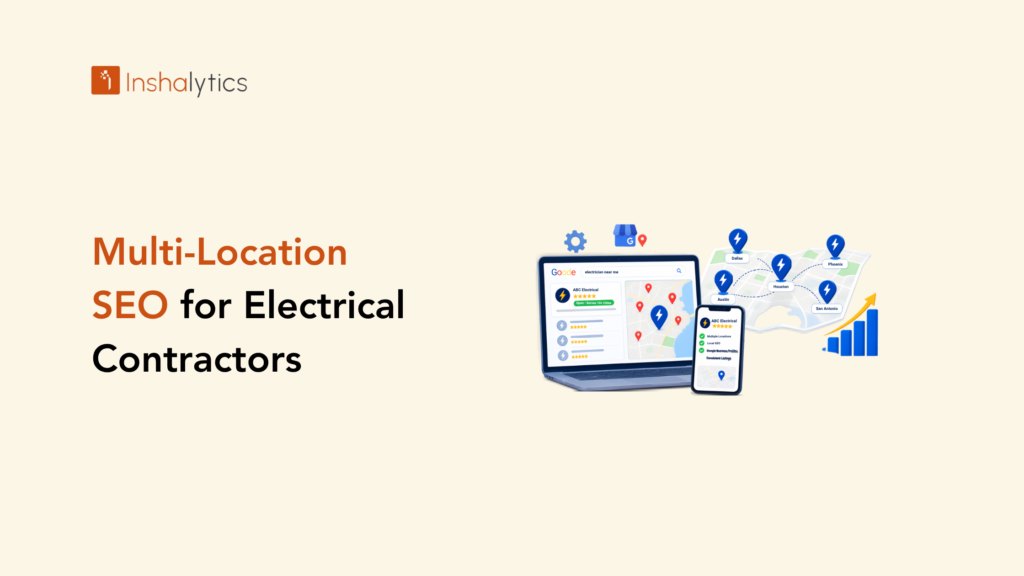
Expanding your service area feels like it should automatically expand your visibility, but Google does not work that way. An electrical contractor who starts serving five new towns without changing anything about their website often finds their rankings barely move, or even weaken in their original core market. Multi-location SEO for electrical contractors is the discipline of building a site structure that earns visibility in every city you actually serve, not just the one where your office happens to sit.
This article covers why Google evaluates relevance city by city, how to build service area pages that rank on their own merit, how to structure internal links across those pages, and the licensing considerations that make electrician expansion different from other trades.
Why One Website Can’t Rank Everywhere You Work
Google’s local ranking system is built around proximity and relevance to a specific searcher’s location, which means a single generic page cannot represent your business well in five different towns at once.
How Google decides which businesses show up for which cities
Local search results weigh how closely a business’s content, name, address, and reviews match the searcher’s specific location alongside the usual relevance and authority signals. A contractor whose only mention of a town is a name buried in a footer service list has almost nothing for Google to match against that search. Meaningful, location-specific content signals to Google that you genuinely serve that area rather than just listing it as an afterthought.
This is why two electricians with similar overall site quality can perform very differently in a specific town. The one with a dedicated, substantive page for that town consistently outranks the one relying on a single shared service-area list, even if their broader domain authority is otherwise comparable.
The mistake of one page trying to serve five service areas
Many electrical contractors list every city they serve on a single “service areas” page, then wonder why they don’t rank in any of them individually. That page might satisfy a human reader scanning a list, but it gives Google nothing specific to rank for a search like “electrician in [specific town].” Each city with meaningful search volume deserves its own page built around that location specifically.
A simple test is checking whether a search for “electrician” plus each of your service towns returns your site anywhere on the first page. If a single shared list page is the only thing representing five different towns, you’ll typically find your site missing entirely from most of those individual searches.
Building Service Area Pages That Actually Rank
A location page needs to do more than swap out a city name in an otherwise identical template, or it risks looking like duplicate content to both Google and human visitors.
A location page that ranks combines unique, location-specific content with consistent business information and enough substance to stand on its own, rather than existing purely as a placeholder for a keyword.
What belongs on a location page beyond the city name
Include details relevant to that specific area, such as common electrical issues tied to the age of housing stock in that town, response time for that service radius, and any local landmarks or neighborhoods you frequently serve. Mentioning a specific subdivision or commercial district you’ve worked in adds a level of specificity that generic pages lack entirely. This content does not need to be long, but it needs to be genuinely different from your other location pages.
If you have completed jobs in that specific town, a brief project mention or a review from a customer there adds real credibility that generic copy cannot replicate. Even two or three sentences of authentic, location-specific detail can be the difference between a page that ranks and one that quietly sits ignored.
Avoiding duplicate content across nearby service areas
If two towns are only a few miles apart, resist the temptation to copy one page and change the city name, since search engines can recognize this pattern and it weakens both pages rather than strengthening either. Instead, vary the specific examples, testimonials if you have location-relevant ones, and the framing of common local electrical needs. Even small, genuine differences are enough to avoid the duplicate content penalty that flat templated pages risk.
NAP consistency and Google Business Profile alignment per location
Your business name, address, and phone number, commonly abbreviated NAP, need to match exactly across your website, Google Business Profile, and any directory listings for each location you claim to serve. Inconsistencies, even small ones like “St.” versus “Street,” can quietly undermine the local trust signals Google relies on. If you operate from a single physical office but serve multiple towns, structure your Google Business Profile service area settings to reflect that accurately rather than creating listings for addresses you don’t actually operate from.
Run a quarterly audit across your website, Google Business Profile, and any directory listings like Yelp or Angi to catch drift before it accumulates. Small formatting differences tend to creep in over time as different people update different platforms, and catching them early is far easier than untangling years of inconsistency later.
Internal Linking Structure for Multi-Location Electrician Sites
How your pages link to each other tells Google which pages matter most and helps distribute ranking authority across your whole site.
Hub-and-spoke structure from your main services to each location page
Build your site so each core service page, like panel upgrades or local SEO-driven emergency service, links out to the specific location pages where that service is offered, and each location page links back to the relevant service pages. This hub-and-spoke pattern helps both users and search engines understand the relationship between what you do and where you do it. Flat sites with no clear linking hierarchy make it harder for any single page to build authority.
How many location pages is too many, too soon
Launching twenty thin location pages at once, each with minimal unique content, tends to perform worse than launching three or four well-built pages and expanding gradually. Search engines are more forgiving of quality over quantity, and a smaller set of substantive pages will typically outrank a large set of shallow ones. Prioritize the towns generating the most inquiry volume first, then expand once those pages are performing, and weigh that pace against your existing marketing budget rather than trying to build every page at once.
Licensing and Compliance Considerations Unique to Electricians
Electrical licensing rules vary in ways that other home service trades, like general handyman work, don’t always face, and this affects what your location pages can accurately claim.
State and county licensing differences that affect page content
Some states require county-specific licensing or permits that don’t automatically transfer across jurisdiction lines, which means a location page should reflect the actual licensing and permitting status for that specific area rather than a blanket statement. Getting this wrong is not just an SEO issue, it can create real compliance problems if a page implies you’re licensed somewhere you’re not yet approved to work. Confirm licensing status for each new service area before publishing a page claiming to serve it.
Why copying one location page for every city creates thin content
Beyond the SEO risk, copying a template across licensing jurisdictions can also produce factually incorrect claims about permits, inspection requirements, or code differences between areas. Each page should be checked for accuracy against the specific jurisdiction it targets, not just uniqueness for search engine purposes. This extra diligence protects both your rankings and your legal standing as you expand.
If you’re expanding into new service areas and need a structure that actually earns rankings in each one, talk to Inshalytics about building out a multi-location SEO plan that starts with your highest-opportunity towns first.
Common Questions About Multi-Location Electrician SEO
Should each location have its own Google Business Profile?
Only if you have a genuine physical presence or a legitimate service address in that location, since Google’s guidelines prohibit creating listings for locations you don’t actually operate from. For most single-office electricians expanding their service radius, the better approach is one well-configured Google Business Profile with an accurate service area setting, supported by individual website location pages.
How long does it take a new location page to rank?
Most new location pages take three to six months to show meaningful ranking movement, assuming the page has unique, substantive content and is properly linked from the rest of the site. Pages in less competitive towns or with strong internal linking tend to see faster results than pages in highly competitive metro areas. Patience matters here, since judging a new location page’s performance after only a few weeks usually leads to premature and unnecessary changes.
Multi-location SEO rewards contractors who treat each new service area as its own small SEO project rather than a line item on a list, and that extra effort compounds into rankings competitors copying a template will struggle to match. Start with your two or three highest-opportunity towns and build those pages properly before expanding further, tracking rankings and lead volume separately for each one so you can see exactly which locations are earning their keep.