Most dental practices running email campaigns know their open rate. Few know how much revenue those campaigns actually generate. That gap, between activity metrics and revenue attribution, is where email marketing budgets quietly disappear without justification. Email delivers an average return of $42 for every dollar spent across industries, but that number only helps you if you know how to measure it for your specific practice. This guide walks through the exact steps to calculate email marketing ROI for a dental practice, which campaigns generate the strongest returns, and how to set up attribution that connects sends to booked appointments.
Why Email Delivers the Highest ROI of Any Dental Marketing Channel
Before calculating ROI, it helps to understand why email consistently outperforms other dental marketing channels on a cost-per-patient basis. The answer is in the audience: email reaches people who already know your practice and have opted in to hear from you. That baseline trust dramatically shortens the conversion path compared to cold advertising.
The $42-Per-$1 Benchmark and What It Actually Means for a Dental Practice
The industry-wide email ROI benchmark of $42 returned per dollar spent reflects the low cost of email delivery relative to the revenue it drives. For a dental practice, the math is even more favorable because the patient you are re-engaging already has a relationship with the practice, has experienced your care, and has an established clinical need (overdue recall, unaccepted treatment plan, annual X-rays) that makes the conversion prompt natural rather than promotional. A reactivation email that brings back one patient for a crown that has been sitting as an unaccepted treatment plan can generate $1,200 to $2,500 in production from a campaign that costs $80 to send.
Why Dentists Underestimate Email Because They Measure It Wrong
The most common reason dental practices undervalue their email channel is that they measure opens and clicks rather than appointments booked and revenue generated. An open rate of 28% looks decent in isolation. When you cannot connect those opens to a specific number of booked appointments, that 28% tells you nothing about whether the campaign was worth running. The practices that get the most from email are the ones that track the downstream outcome, which is the patient sitting in the chair, not the upstream signal of an email being opened. The foundation for doing that correctly is the attribution setup covered later in this guide.
How Email ROI Differs From Other Dental Marketing Channels
Google Ads and local SEO generate new patient leads from people who do not yet know your practice. Email generates revenue from people who already do. That distinction changes the ROI calculation significantly. Email has near-zero media cost (platform fees of $50 to $300 per month depending on list size versus $2,000 to $8,000 per month for paid search). The conversion rate from email to appointment for an existing patient is significantly higher than from a cold ad to a first visit. And the average production value of an existing patient returning for treatment is typically higher than a new patient coming in on a $99 new patient special. For the full picture of how email fits alongside paid channels, see the breakdown of dental marketing ROI by campaign type.
The Dental Email Marketing ROI Formula (Step-by-Step)
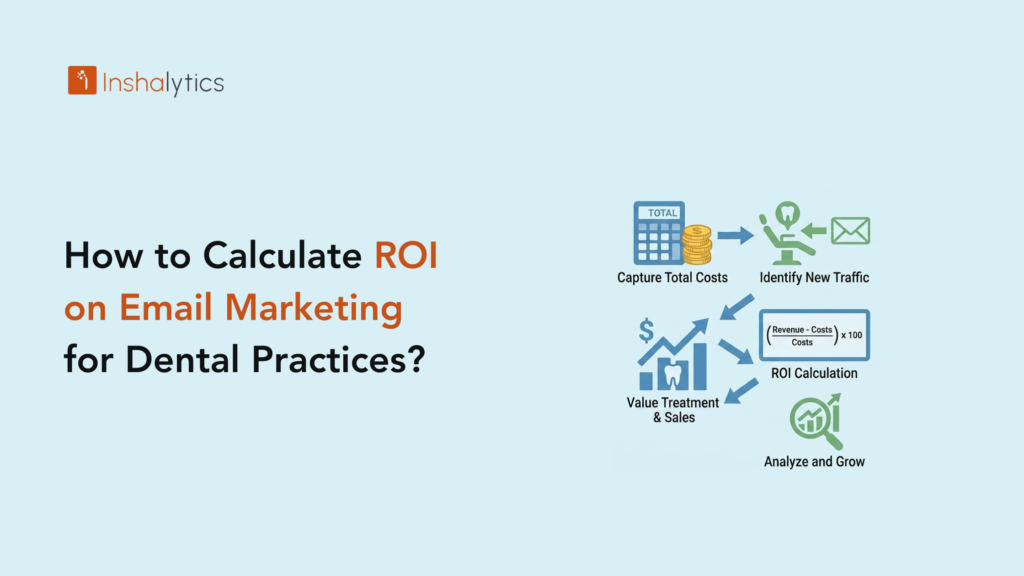
Calculating email ROI requires three inputs: what you spent, what revenue you can attribute to the campaign, and the number of patients that attribution accounts for. Here is the process applied specifically to a dental practice.
Step 1: Calculate Your Total Email Marketing Cost
Your total email cost includes two components. First is your platform fee: tools like Mailchimp, Constant Contact, or Dentistry-specific platforms like Weave or Legwork charge monthly fees based on list size, typically $50 to $300 per month for a practice with 500 to 5,000 contacts. Second is the staff time required to create and send campaigns. If a team member spends 3 hours per month on email at $25 per hour, that is $75 in labor cost. Add these together for your true monthly email investment. For most general dentistry practices, total email cost runs $125 to $400 per month, making it the lowest-cost active marketing channel in the mix.
Step 2: Attribute Revenue to Email Campaigns
Attribution is where most practices fall short. There are three methods, from least to most accurate. The simplest method is asking patients when they call: “What reminded you to call us today?” This is better than nothing but unreliable because patients do not always remember. The second method is using unique booking links in your emails that route through a tracked landing page so you can see exactly how many appointments were booked via email click. The most accurate method is using call tracking software (CallRail, Marchex) to assign a unique phone number to your email campaigns, so every call that comes in from that number is attributed to email without relying on patient recall. Once you have a patient count attributable to email for the month, multiply by your average production value per appointment to get attributed revenue.
Step 3: Apply the ROI Formula and Interpret Your Result
With your cost and attributed revenue in hand, apply the standard formula: ROI = (Revenue Attributed to Email minus Email Cost) divided by Email Cost, multiplied by 100. If your practice spends $200 per month on email and attributes $3,800 in production to email-driven appointments, your ROI is ($3,800 minus $200) divided by $200 multiplied by 100, which equals 1,800%. That is not an unusual number for a well-maintained email list at a practice with a healthy unaccepted treatment pipeline. The dental marketing ROI calculation guide covers the broader formula framework that this channel-specific calculation feeds into.
Which Email Campaigns Generate the Best ROI for Dental Practices?
Not all dental email campaigns return the same ROI. The campaigns that consistently generate the highest returns share one characteristic: they reach patients with a specific, time-relevant clinical need that makes booking the obvious response to the message.
Recall and Reactivation Campaigns: The Highest-ROI Email Type
A recall campaign targets patients who are overdue for their hygiene appointment. A reactivation campaign targets patients who have not visited in 12 to 24 months. Both campaigns are reaching people with an established relationship with your practice and a known clinical need. The conversion rate from these campaigns (patients who receive the email and book an appointment) typically runs 8 to 15%, which is 4 to 7 times higher than the conversion rate of a cold Google Ad. The production value per appointment is predictable because you know what a hygiene visit plus any follow-up treatment recommendation generates in your specific practice. For most practices, reactivation email is the single highest-ROI use of marketing spend available. The email automation workflows that run these sequences in the background are what make the volume consistent.
Treatment Follow-Up Sequences: Converting Pending Cases
Every practice has a pool of patients who received a treatment plan, said they would think about it, and never scheduled. These unaccepted treatment plans represent the most valuable email marketing opportunity in dentistry. A sequence of two to three emails over 30 days, each addressing a different objection (timing, cost, fear), can convert a meaningful percentage of this pool into production without any new patient acquisition cost. If your practice has 40 unaccepted crown cases at an average value of $1,400 and email converts even 10% of them, that is $5,600 in production from an email campaign that costs less than $100 to send.
New Patient Welcome Sequences: Setting Lifetime Value in Motion Early
A new patient welcome sequence is not directly measurable as ROI in the same way as reactivation campaigns, but it is the highest-leverage investment in patient lifetime value that a dental practice can make through email. A patient who receives a well-crafted welcome sequence (practice introduction, what to expect at their first visit, how to prepare for their appointment) shows up better prepared, cancels less frequently, and accepts treatment plans at higher rates. These outcomes compound into significantly higher LTV per patient, which means every dollar spent acquiring that patient through paid marketing returns more over their lifetime.
What Metrics Should You Track to Measure Dental Email Marketing ROI?
Tracking email ROI requires measuring both the email channel signals and the downstream patient and revenue outcomes. These are not the same metrics, and most email platforms only show you the former.
Open Rate and Click Rate: What Good Looks Like for Dental
A healthy open rate for a dental practice email list sits between 25% and 40% for existing patient lists. Click rates for email campaigns with a specific appointment booking link typically run 3% to 8%. If your open rate is below 20%, the most likely cause is either a subject line problem or a list hygiene problem (too many inactive addresses). If your open rate is strong but your click rate is low, the email content or CTA is not giving readers a clear reason to act. These upstream metrics matter, but they are leading indicators, not the measure of success.
Appointment Bookings Attributed to Email: The Revenue Metric
The number that actually measures email ROI is appointments booked that can be traced back to an email campaign. Set up unique booking links in your campaigns. Train your front desk to note email as the referral source when patients mention they received a reminder or offer. Use call tracking on the number featured in your emails. Combining these three attribution methods gives you a monthly patient count attributable to email that you can multiply by average production value for a revenue figure.
Revenue Per Email Sent: The One Number That Summarises Performance
Revenue per email sent divides your total attributed revenue by the total number of emails sent in the period. If you sent 1,200 emails in a month and those campaigns generated $4,800 in attributed production, your revenue per email sent is $4.00. This is the single cleanest benchmark for comparing campaign performance over time and across campaign types. A recall campaign that generates $6.50 per email sent is outperforming a promotional whitening campaign that generates $1.20 per email sent. Knowing this, you allocate more sends to recall and fewer to promotions.
How Inshalytics Builds and Measures Email Campaigns for Dental Practices
The gap between sending emails and knowing what they generated in revenue is a tracking infrastructure problem. Most dental practices do not have the attribution setup required to connect an email open to a booked appointment to a completed procedure and a production dollar amount. Inshalytics builds that infrastructure as part of every dental marketing engagement.
Attribution Setup That Connects Email Sends to Booked Appointments
We configure unique tracked links for every campaign that route through a landing page before reaching the booking system, so appointment sources are recorded automatically. We set up call tracking numbers for each email campaign so phone bookings are attributed correctly without relying on front desk data entry. And we connect your practice management software referral source fields to your email platform so that when a patient who received a campaign books an appointment, that appointment is tagged to email in your reporting. This closes the loop between marketing activity and production revenue. For the full picture of how channel-level attribution fits into dental marketing ROI, see how to calculate ROI on dental marketing campaigns.
The Monthly ROI Report That Tells You Exactly What Your Email Investment Returns
Every month, dental practices we work with receive a report that shows email cost for the period, attributed appointments by campaign type, production revenue from those appointments, and the resulting ROI ratio. This report is not built on open rates or click metrics. It is built on production dollars in your practice management system. That is the number that justifies the investment and guides how much we allocate to email versus paid search and other channels in the months ahead.
Ready to know what your email campaigns are actually generating in production? Talk to Inshalytics about setting up attribution and reporting that connects every send to a dollar outcome.