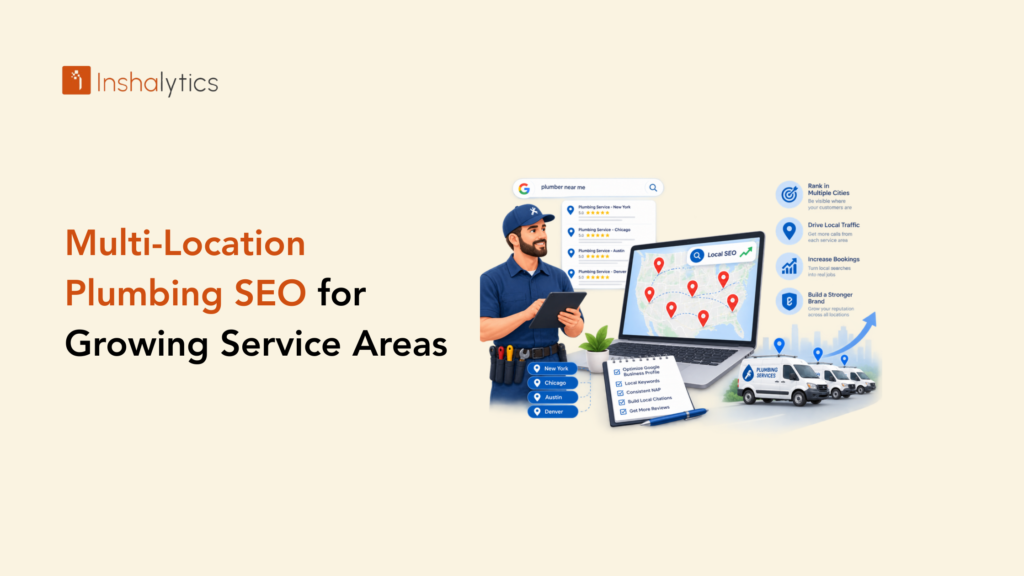
You rank number one in your home city, and then nothing: invisible in the next town over, even though your trucks drive there every week and complete jobs there regularly. If that sounds familiar, you’re dealing with one of the most common growth-stage problems in the industry: multi-location plumbing SEO that never made the leap past your original market. This article walks through why this happens, how to audit what you already have, and how to build a location page architecture that actually ranks in every market you serve, without accidentally undermining the rankings you already worked hard to earn at home.
Why You Rank in One City and Disappear in the Next
The instinct when SEO isn’t working in a new market is to add more: more pages, more content, more listings. For multi-location plumbing businesses, that instinct often makes the problem worse before a proper audit fixes it, because more low-quality pages usually just dilute the authority you’re trying to build.
Google’s Distance Bias and What It Means for Service Area Businesses
Google’s local ranking algorithm weighs proximity heavily, which means a business with no physical presence or content signals in a given city starts at a structural disadvantage there, regardless of how well it ranks at home. You might do excellent work thirty minutes away, but if Google has no signal connecting your business to that city specifically, it won’t show you to searchers there, no matter how strong your reviews or reputation are back at your home base and no matter how long you’ve been serving the surrounding area. This is the part of local SEO most owners find counterintuitive, since it feels like a strong brand should carry weight everywhere, when in practice Google treats each city almost as its own separate competition.
The Two Expansion Models: Physical Branches vs. Service-Area-Only
If you’re opening a second office with a real address in a new market, you can build a full second Google Business Profile tied to that location. If you’re expanding service radius without a physical branch, you’re working within Google’s service-area business rules instead, a meaningfully different setup that changes how your location pages and listings should be structured, and getting this distinction wrong early on can create problems that take months to unwind.
How Do You Audit What You Already Have?
Before building anything new, it’s worth understanding exactly what’s already in place and what’s quietly working against you, since fixing an existing problem is usually faster than building new content on top of a shaky foundation.
Checking Your Current GBP and Location Page Setup
Look at whether you have a dedicated Google Business Profile for each physical location, whether your service areas are correctly configured, and whether your website has any content at all specific to the cities beyond your home market. Most multi-location plumbing sites are missing at least one of these three, and it’s often the one that would have been easiest to fix first.
Spotting Duplicate-Content Traps Before You Build More Pages
A common but costly mistake is copying your home-city location page, swapping the city name, and publishing it across every new market, near-identical content that Google recognizes as duplicate and often refuses to rank at all. Every location page needs genuinely distinct content, not a find-and-replace copy of the last one, which means budgeting real time for each new market rather than treating expansion pages as a quick copy-paste task.
Building a Location Page Architecture That Actually Ranks
A location page architecture is the structured set of individual pages built for each city or service area you operate in, each with unique, locally relevant content that signals real presence in that market. Done correctly, it’s the foundation everything else in multi-location SEO depends on, and it’s usually the single biggest lever available once the basics of your Google Business Profile are in order.
What Makes a Location Page Different From a Doorway Page
A thin page that exists only to swap a city name into a template is exactly what Google’s guidelines penalize. A real location page includes locally specific content, neighborhoods served, local landmarks or service considerations, distinct testimonials or case studies from that market, that couldn’t be copy-pasted onto a different city’s page without it reading as obviously wrong to anyone who actually lives there.
Structuring Content for Each Neighborhood and Zip Code You Serve
For larger service areas, breaking content down further, by neighborhood or zip code cluster rather than just city, captures long-tail search intent that a single citywide page misses, particularly for larger metros where “plumber in [neighborhood]” is a common, distinct search pattern from “plumber in ,” each representing a real, separate opportunity to be found.
Managing Google Business Profiles Across Multiple Markets
Your Google Business Profile setup is arguably more important than your website content for local pack visibility, and it’s also where multi-location businesses make the most costly mistakes, sometimes without realizing it until rankings quietly start slipping.
Physical Location Listings vs. Service-Area Listings
A physical branch with a real, staffed address should get its own full Google Business Profile listing at that address, configured accurately from day one. A service-area-only expansion into a city without a physical office should not attempt to create a fake address listing there. That violates Google’s guidelines and risks suspension of your entire profile, home market included, which is a far more expensive mistake than simply not ranking in the new city yet.
Keeping NAP Consistency Across a Growing Footprint
Name, address, and phone number consistency across every listing, citation, and directory becomes exponentially harder to manage the more locations you add, and exponentially more important, since inconsistency is one of the clearest signals Google uses to distrust a business’s location data and hold back rankings as a result. A single mistyped suite number on a directory listing can quietly undermine months of otherwise solid content work.
How Long Does It Actually Take to See Results?
Expansion SEO moves on a different, generally slower timeline than most owners expect, which is worth planning for before you commit budget to it and set expectations with anyone tracking results internally.
The Realistic 90-Day Timeline for New Location Pages
Most new location pages start showing meaningful movement around the 90-day mark, with markets where you already have some presence, past jobs, existing reviews, prior citations, often moving faster than a genuinely brand-new territory. This isn’t an overnight fix, and campaigns built around a shorter timeline typically get abandoned before they’ve had a real chance to work, which is exactly the outcome you want to avoid after investing in the content buildout.
Tracking Performance by Location, Not Just by Domain
A single blended traffic number across your whole domain hides exactly what you need to see: whether each individual market is actually converting into leads. Location-level tracking is essential to knowing where the expansion is working and where it needs more investment, rather than assuming overall growth means every new market is pulling its weight equally.
How Inshalytics Builds and Scales This for Plumbing Clients
Multi-location SEO is a structured, repeatable process once you’ve built it once. The challenge is usually the first buildout, not maintaining it afterward, which is exactly where most in-house efforts stall out.
Our Location-Page Framework and Citation-Building Process
We build genuinely distinct location pages for each market you serve, backed by a structured citation-building process that avoids the duplicate-content and NAP-inconsistency traps that stall most DIY expansion attempts. Competing with the big regional plumbing brands as an independent shop covers how this same local SEO advantage plays out against national chains entering your markets, since the same location depth that beats a thin national page also beats a thin DIY expansion effort.
Reporting That Shows Lead Volume by Market
Every market you expand into gets its own reporting, so you can see clearly which new territories are producing booked jobs and which need additional investment before you commit to further expansion, letting you make each next expansion decision with real data instead of a hunch.
Expanding your plumbing business into new markets should compound your existing SEO authority, not dilute it or start from zero in every new city. If your growth has outpaced your website’s ability to rank where your trucks actually drive, let’s build the location architecture that catches your marketing up to your expansion once and for all.