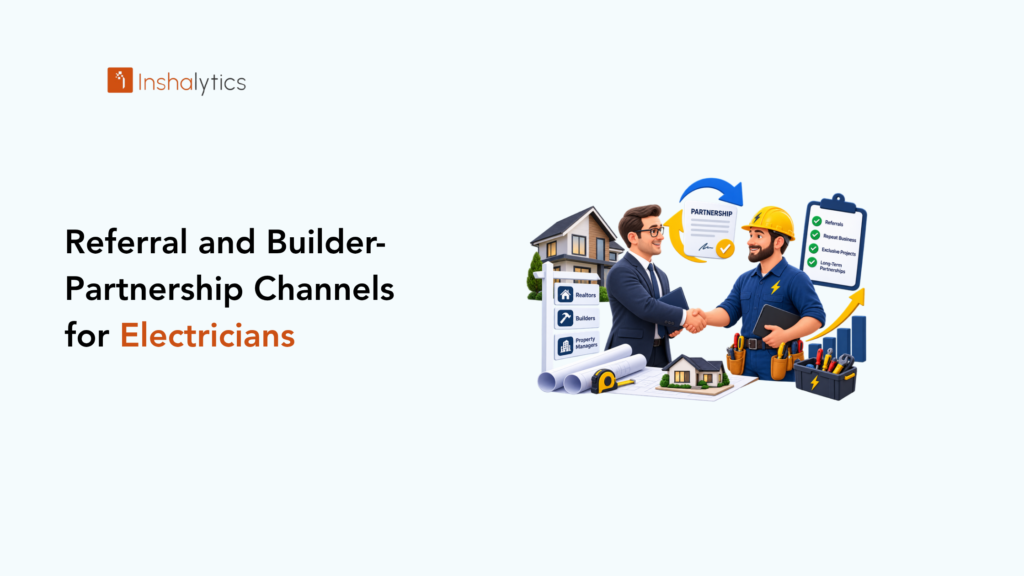
Every electrician chasing leads through Google Ads is competing against every other electrician doing the same thing in the same market. Referral and builder-partnership channels sidestep that competition entirely, routing work to you through relationships instead of auctions. For contractors willing to build these relationships deliberately, this channel often produces the highest-margin, lowest-cost-per-booked-job work in the entire business.
This article covers why referral channels outperform paid ads for certain job types, how to find the right builder and general contractor partners, how to formalize those relationships so referrals keep flowing, and how to turn occasional referrals into a repeatable pipeline you can count on.
Why Referral Channels Outperform Paid Ads for Certain Job Types
Not every job type suits every lead source, and builder relationships tend to produce work that paid advertising rarely reaches at all.
The jobs builders and GCs send you that Google Ads never will
New construction wiring, remodel work tied to a larger renovation, and commercial buildouts often never surface as individual homeowner searches, since the general contractor or builder controls the decision of who does the electrical work. A homeowner searching Google for an electrician has no idea their GC already has three electrical subs they trust and rotate between. Building relationships with those GCs is the only realistic path into that specific category of work.
This category of work also tends to be more consistent in scope and easier to schedule around, since builders typically plan projects months in advance rather than calling with same-day urgency. That predictability is valuable on its own, separate from the cost advantages, because it lets you plan crew capacity with more confidence than emergency and homeowner-driven work usually allows.
Lower cost-per-booked-job when the relationship does the selling
A referred lead from a trusted GC typically closes faster and with less price negotiation than a cold lead from an ad, because the GC’s endorsement has already done most of the trust-building work for you. This means your effective cost-per-booked-job on referral work can be dramatically lower than paid channels once you account for the time invested in the relationship rather than an ongoing ad spend. Compare this to the shared lead economics of platforms like Angi, where you’re often competing against several other electricians for the exact same lead.
Referral work also tends to come with fewer no-shows and cancellations, since a homeowner or property owner working through their GC’s recommended sub has already committed to the project in a way a homeowner casually browsing quotes online hasn’t. That reliability compounds the cost advantage beyond just the initial acquisition cost.
Finding the Right Builder and GC Partners
Not every builder is worth pursuing, and the ones actively building in your area are often easier to identify than most electricians assume.
Using public permit records to identify active builders in your area
Building permits are public record in most jurisdictions, which means you can identify who is actively pulling permits for new construction or major renovations in your service area without guesswork. This gives you a concrete, current list of builders and GCs who need electrical subcontractors right now, rather than a cold list of names with no active projects. Checking permit records on a regular cadence, monthly or quarterly, keeps this list current as new projects break ground.
Most county or municipal building departments publish this data online, and some make it searchable by project type or issue date, which makes it easy to filter specifically for the kind of construction work that would need an electrical sub. Cross-referencing this list against builders you already know by reputation can also help you prioritize outreach toward the ones most likely to be a good fit.
What GCs actually look for when choosing an electrical sub
General contractors prioritize reliability and speed above almost everything else, since a delayed electrical sub can hold up an entire project timeline and cost the GC money and reputation. Being the sub who shows up on schedule, communicates clearly about any delays, and does not require constant follow-up will earn repeat work faster than being the cheapest bid. Price matters, but GCs who have been burned by unreliable subs before will often pay slightly more for someone they can count on.
It also helps to understand the GC’s world a little, knowing roughly how their payment schedules work, what documentation they typically need from subs, and how they prefer to communicate about schedule changes. Showing up prepared for how a GC actually operates, rather than expecting them to adapt to how you’re used to working with homeowners, makes you noticeably easier to work with than subs who haven’t made that adjustment.
Formalizing the Relationship So Referrals Keep Coming
A single successful job with a GC does not guarantee future referrals unless you actively work to formalize and maintain the relationship afterward.
A referral relationship becomes durable once both sides have clear expectations about response time, communication, and reciprocity, rather than relying on goodwill alone to keep the work flowing.
Setting response-time expectations GCs can rely on
Tell your GC partners directly what response time they can expect from you for both quotes and active job issues, and then consistently meet that standard. A GC who knows you’ll respond within a set window is far more likely to call you first the next time a project comes up, because uncertainty is exactly what drives them to shop around other subs. This clarity is worth establishing explicitly rather than assuming it’s understood.
Simple ways to reciprocate without cutting into your margin
Reciprocity does not have to mean discounting your rates. Referring homeowner clients who need general contracting work back to your GC partners, mentioning them when appropriate, or simply being the sub who makes their job easier all build goodwill without touching your pricing. Over time, these small gestures often matter more to the relationship than any formal referral fee arrangement.
Turning One-Off Referrals Into a Repeatable Channel
The goal is not a single good relationship with one builder, it’s a channel that continues producing work even as individual projects and contacts change over time.
Staying visible between projects
GCs work with dozens of subs across different trades, so staying visible between active projects, through occasional check-ins, sharing when you have capacity, or simply showing up at local trade association events, keeps you top of mind when the next project starts. Electricians who disappear between jobs are easy to forget when a GC is quickly assembling a team for a new build. A brief quarterly check-in costs little and keeps the relationship warm.
Consider also sharing useful information that isn’t a direct sales pitch, such as a heads-up about a code change that might affect their upcoming projects. This kind of low-pressure value keeps the relationship active without making every interaction feel like you’re asking for work.
Tracking referral sources the same way you’d track ad sources
Treat your GC and builder referral pipeline with the same tracking discipline you’d apply to paid lead generation, noting which relationships are producing work and which have gone quiet. This data helps you decide where to invest relationship-building time, the same way ad performance data helps you decide where to invest ad budget. Without this tracking, it’s easy to lose sight of which partnerships are actually paying off.
If referral and builder channels are an underused part of your lead mix right now, talk to Inshalytics about how to build tracking for this channel alongside your existing paid and organic marketing.
Common Questions About Contractor Referral Partnerships
Should you pay a finder’s fee to a GC for referrals?
Formal finder’s fees are less common in electrical subcontracting than in some other industries, and many GCs prefer reciprocal referrals or simply reliable performance over a direct cash arrangement. If you do consider a fee structure, check your state’s contractor licensing regulations first, since some jurisdictions restrict or require disclosure of referral payment arrangements between contractors. When in doubt, reliable performance and clear communication tend to earn more repeat referrals over time than a one-time financial incentive ever will.
How do you protect the relationship if a GC wants you exclusively?
Exclusivity can provide steady, predictable work, but weigh it against the risk of relying too heavily on a single relationship if that GC’s project volume slows down. A middle ground many electricians use is prioritizing a key GC’s projects without formally committing to full exclusivity, which preserves flexibility while still building a strong, favored relationship. Whatever arrangement you agree to, put the basic terms in writing, even informally, so both sides have a clear shared understanding of expectations.
Related reading: Facebook Ads for Electricians: Are They Worth the Budget
Referral and builder-partnership channels reward patience and consistency more than any single clever tactic, and the electricians who invest in these relationships early typically end up with a lead source that is far more resilient than any single ad platform. Start by pulling recent permit records in your area and identifying three builders worth reaching out to this month.