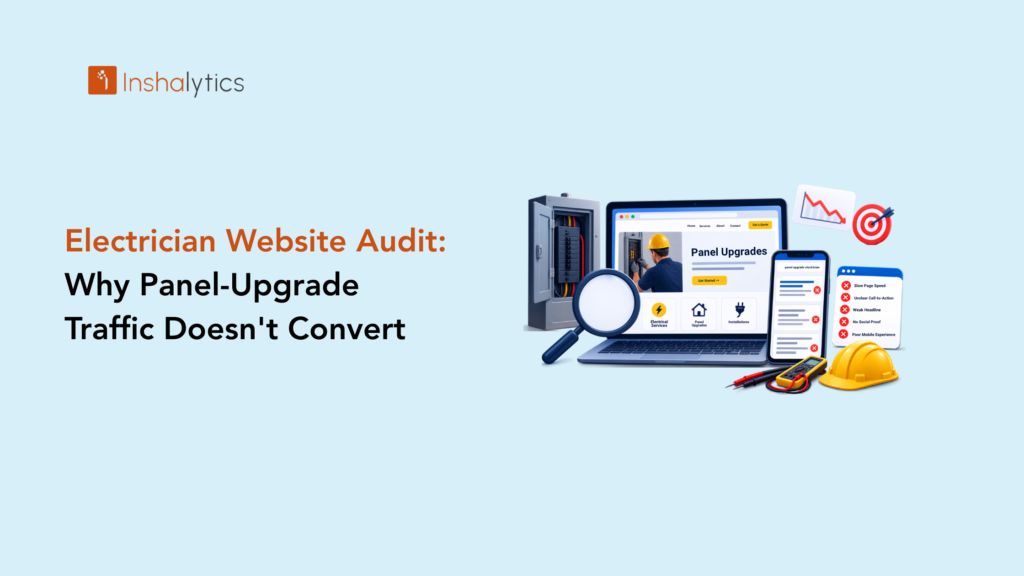
Panel upgrade searches are some of the highest-intent traffic an electrician can attract, since nobody searches “200 amp panel upgrade cost” out of idle curiosity. Yet many electrical contractors watch that exact traffic land on their site and leave without calling. This electrician website audit focuses specifically on why that happens and what to fix, looking only at what occurs once someone is already on your page, not how they got there.
We will walk through what separates panel-upgrade search intent from casual browsing, the five most common conversion killers hiding on electrician websites, what a page built to convert that traffic actually needs, and a checklist you can run yourself before paying for a professional audit.
Panel Upgrades Are High-Intent Traffic, So Why Aren’t They Converting?
A visitor who typed “panel upgrade” into Google has already decided they likely need the work done. The job of your page is not to convince them electrical work matters, it is to convince them you are the safe, clear choice to do it.
The difference between browsing traffic and panel-upgrade search intent
Someone searching general terms like “electrician near me” might just be gathering information for later. Someone searching specifically for a panel upgrade has usually already identified a problem, an inspection flag, an insurance requirement, or a renovation need, and is actively evaluating who can solve it. That distinction matters because a page written for the browsing searcher, vague and general, badly underserves the panel-upgrade searcher who needs specifics.
Treat this keyword as its own dedicated landing page rather than folding it into a general electrical services page. A visitor who typed “panel upgrade” specifically should land somewhere that speaks directly to that need, not a broad page listing every service you offer alongside it.
What a $3,000-6,000 decision requires that a $150 service call doesn’t
A panel upgrade is a considered purchase most homeowners make once every few decades, which means they arrive with more questions and more hesitation than someone booking a quick outlet repair. They want to understand scope, timeline, permit requirements, and price range before they are comfortable calling. A page that treats this decision like a small, impulsive service call, with a generic “contact us” button and no detail, fails to match the weight of what the visitor is actually deciding.
The Five Most Common Conversion Killers on Electrician Websites
Most panel-upgrade pages lose visitors to a small, repeatable set of mistakes rather than one dramatic failure.
The most common conversion killers on electrician panel-upgrade pages are missing pricing context, a generic contact form, slow mobile load times, and missing trust signals, and fixing even two or three of these often produces a noticeable lift in booked calls.
No financing or price-range information on the panel upgrade page
Visitors researching a several-thousand-dollar decision want at least a ballpark before they commit to a call, and a page with zero pricing information forces them to keep shopping elsewhere for that answer. Even a wide range paired with the variables that affect it, panel size, permit costs, or home age, gives visitors enough information to self-qualify and feel confident reaching out. Silence on price at this stage of the funnel usually reads as evasive rather than premium.
A generic contact form instead of a scoped quote request
A form that only asks for name, email, and a message forces the visitor to do the work of explaining their situation from scratch, which many will simply abandon. A form built for this specific job, asking about panel age, amperage, and reason for the upgrade, feels tailored to their exact situation and signals that you specialize in this work. It also gives your team better information before the first call, which speeds up the quoting process on your end.
Keep the form itself short, even though it’s more specific, since asking too many questions upfront can reintroduce the friction you’re trying to remove. Three or four well-chosen questions usually strike the right balance between gathering useful information and not overwhelming a visitor who’s already somewhat anxious about the decision.
Slow load times on mobile, where most of this traffic originates
Most panel-upgrade research happens on a phone, often while a homeowner is mid-conversation with a spouse or contractor about next steps. A page that takes several seconds to load on mobile loses a meaningful share of visitors before they even see your content, regardless of how good that content is. Compressing images and minimizing heavy scripts on this specific page is one of the highest-leverage technical fixes available.
Missing trust signals (licensing, insurance, warranty) above the fold
For a job this significant, homeowners look for proof of licensing, insurance, and warranty coverage before they scroll far, and if that information is buried at the bottom of the page or missing entirely, hesitation sets in immediately. Placing these signals near the top of the page, not just in a footer, answers the safety question before it becomes an objection. This is especially important for panel work, where safety concerns are already elevated compared to smaller electrical jobs.
What a Converting Panel-Upgrade Page Actually Needs
Once the conversion killers are addressed, the page needs a structure that actively guides a considered buyer toward booking.
Structuring the page around the homeowner’s decision process
Order the page to answer questions in the sequence a homeowner actually asks them: what is a panel upgrade, do I need one, what does it cost, who should do it, and what happens next. This sequence mirrors how someone thinks through a big decision rather than forcing them to hunt for the answer they came for. Pages that jump straight to a sales pitch without addressing the earlier questions tend to lose visitors before the pitch even lands.
Before/after photos and past project examples
Real photos of completed panel upgrades, ideally with a brief description of what the job involved, give visual proof that reduces uncertainty in a way text alone cannot. This is particularly effective for panel work, since most homeowners have never seen the inside of an electrical panel and don’t know what “old” versus “up to code” actually looks like. A few well-captioned examples do more persuasive work than a paragraph describing your experience.
A clear next step that matches the size of the decision
The call-to-action for a panel upgrade should invite a scoped consultation or free assessment, not a vague “contact us,” since that language matches the seriousness of the decision the visitor is making. Make the next step feel low-risk and specific, such as “Get your free panel assessment,” rather than open-ended. This small wording change often measurably increases form completions on high-ticket service pages.
How to Audit Your Own Site Before Hiring Anyone
Before paying for a professional audit, most electrical contractors can catch the biggest issues themselves with a short, honest self-check.
A quick 10-minute self-check checklist
Pull up your panel-upgrade page on your own phone using mobile data, not office WiFi, and time how long it takes to load. Check whether pricing context, licensing information, and a clear next step are all visible without scrolling past the first screen. Finally, fill out your own contact form as if you were a customer and note anything confusing or unnecessary in the process.
Ask a friend or family member unfamiliar with your business to look at the page cold and tell you, in their own words, what it would cost and what happens after they submit the form. If they can’t answer either question quickly, that’s a clear signal the page needs clearer, more prominent information rather than a full redesign.
When it’s time to bring in a professional CRO audit
If your self-check reveals multiple issues, or if you have already fixed the obvious ones and traffic still isn’t converting, a professional conversion audit can identify subtler friction points like form field order, page structure, or messaging clarity that are harder to spot from the inside. This is also the right move if you are running paid traffic to this page, since ad spend on panel-upgrade keywords magnifies the cost of every conversion issue left unresolved. A page that already converts well is also the foundation that makes Google Ads spend actually pay off rather than just generating clicks.
If you’ve checked your Google Maps visibility and your ad performance and the page itself still isn’t converting, the page is likely the missing piece. Talk to Inshalytics about a focused conversion audit on your highest-intent service page.
Common Questions About Electrician Website Conversion
Does adding pricing scare away high-ticket leads?
No, a well-framed price range typically increases conversions on high-ticket pages because it filters out visitors who were never going to afford the work while reassuring qualified visitors that you have nothing to hide. The visitors who do reach out after seeing a range tend to be more serious and further along in their decision.
How long should a panel-upgrade landing page be?
Long enough to answer the sequence of questions a homeowner has before deciding, typically somewhere between 800 and 1,200 words of actual content plus supporting visuals, rather than a short generic page or an overly long one padded with unrelated information. The right length is determined by whether every section earns its place in the decision process, not a fixed word count target.
A panel-upgrade page that finally converts the traffic it already attracts is one of the highest-return fixes available to an electrical contractor, since the traffic itself is not the problem. Run the ten-minute self-check today and you will likely find at least one or two issues worth fixing this week.