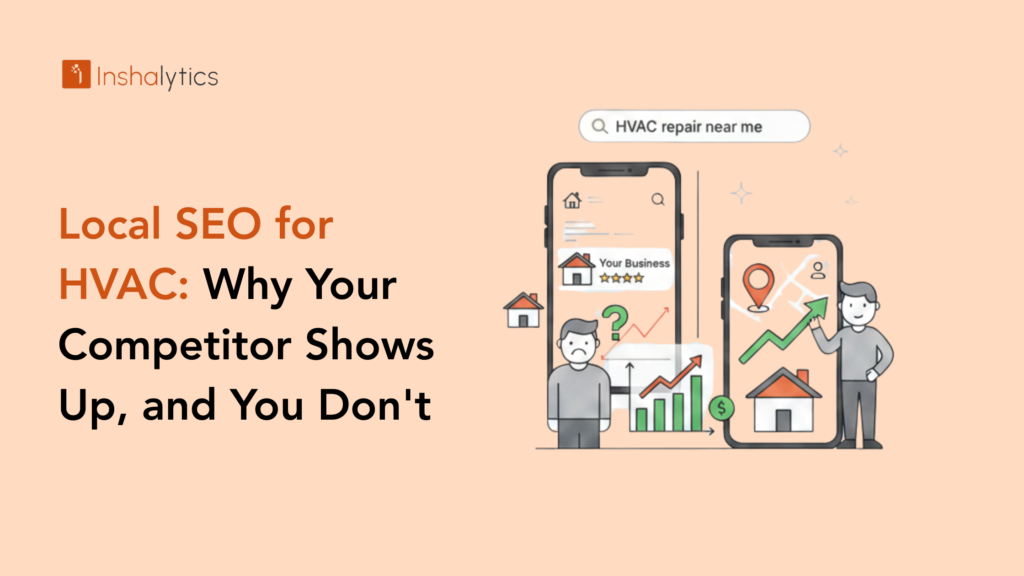
You do better work. Your customers love you. Your Google reviews are glowing. And yet, when a homeowner in your city searches “AC repair near me,” a sketchy competitor with worse service and fewer credentials shows up above you every single time.
It’s frustrating. It’s unfair. And it’s costing you real revenue every week they keep getting your calls.
Here’s the uncomfortable truth about local SEO for HVAC companies: Google doesn’t rank contractors by skill. It ranks them by signals. Your competitor isn’t better at HVAC; they’re better at the system that decides who appears in the Map Pack. The good news is that the system is learnable, and the gap between you and them is closable. This guide walks through exactly why they rank higher, the six factors driving the difference, and a 90-day plan to overtake them.
The Uncomfortable Truth About HVAC Local Rankings
HVAC local rankings aren’t a meritocracy. They’re a signal race, and the contractors winning that race built systems you can replicate or keep ignoring at the cost of your lead flow.
Why “Better Service” Doesn’t Beat “Better SEO” in the Map Pack
Google can’t see your five-star installation work. It can see your review count, your review velocity, your citation consistency, and your website architecture. If a mediocre competitor invests in local SEO and you don’t, they win the rankings regardless of actual service quality.
This isn’t a moral failure of the algorithm. It’s a mechanical reality: Google ranks what it can measure. Your job is to make sure it can measure your signals.
The Frustrating Math of Losing Leads to Worse Companies
The top three Map Pack listings capture the majority of emergency-intent clicks. If you’re ranking fourth or fifth, you’re not splitting leads with your competitors; you’re getting almost none. Industry data shows less than 1% of searchers click to page two, so even position five is functionally invisible for local search.
Do the math on your market. If “AC repair [your city]” sees 1,200 searches per month, the top three listings share roughly 700 of those clicks. You’re not.
How Much Revenue the Top 3 Listings Actually Capture
A typical HVAC job averages $400–$600 for repair and $6,000–$15,000 for replacement. Even if only 10% of Map Pack clicks convert to jobs, the top three listings in a mid-size market are producing six-figure revenue every month from Google Maps alone. That’s the revenue you’re missing.
Why Does My Competitor Rank Higher on Google Than Me?
Your competitor ranks higher on Google because they’ve accumulated stronger local SEO signals than you, more reviews, a more complete Google Business Profile, a better-optimized website, and more consistent citations across the web. Rankings don’t come from one factor; they come from the combined weight of dozens of signals Google evaluates together.
They Have a Longer, Stronger Review History
A competitor with 200+ reviews averaging 4.7 stars outranks a competitor with 25 reviews at 5.0. Volume, velocity (how fast reviews accumulate), and keyword content within reviews all feed the algorithm. If you’re not collecting reviews systematically, you’re losing ground every week your competitor is.
Their Google Business Profile Is More Actively Maintained
Top-ranking HVAC companies post to their Google Business Profile weekly, add photos regularly, respond to every review, and keep their categories and services updated. A dormant profile drops in rankings over time because Google interprets inactivity as declining relevance.
Their Website Reinforces Their Map Pack Signals
Your Google Business Profile doesn’t operate alone. The website linked to your profile directly impacts your Map Pack rankings. Studies show the overwhelming majority of top-ranking HVAC profiles are linked to dedicated, optimized websites. If your competitor has a better website built for local SEO, they’re winning rankings your profile alone can’t earn.
They Built Citations and Backlinks Before You Started
Citations (mentions of your Name, Address, and Phone across the web) and backlinks (other sites linking to yours) take time to accumulate. A competitor who started building these two years ago has a head start you can’t close in a weekend. But you can close it in 90 days with the right focus.
The 6 Ranking Factors Google’s Local Algorithm Actually Uses
Google’s local algorithm evaluates six primary factors when ranking HVAC companies in the Map Pack.
Proximity: What You Can (and Can’t) Control
Proximity measures how close your business is to the searcher’s location. You can’t move your customers, but you can optimize what you control, registering a verified address, expanding your service area settings, and building content that signals coverage for specific neighborhoods.
Relevance: Category, Services, and Content Match
Relevance measures how well your business matches the query. Your primary category (“Air Conditioning Contractor” vs. “HVAC Contractor”), secondary categories, listed services, and website content all feed relevance scoring. Most HVAC companies pick one primary category and stop leaving secondary category relevance on the table.
Prominence: Your Digital Authority Stack
Prominence measures how well-known your business is across the web. It combines review volume, citation consistency, backlinks to your website, and overall web presence. This is the category where most HVAC companies can make the biggest gains because prominence compounds over time.
Engagement: The Signal Most Contractors Ignore
Engagement metrics, such as how often people click your listing, call from it, ask for directions, or view your photos, all feed ranking signals. Profiles with higher engagement rates outrank profiles with lower engagement, even at similar review counts. Post regularly, add fresh photos weekly, and encourage happy customers to engage with your listing after every job.
Reviews: Velocity and Volume Beat Star Rating
A contractor with 15–20 new reviews per month typically outranks a competitor with 200 reviews dumped in one week. Google values consistency and authenticity. Build a review collection system that produces steady, organic growth rather than burst campaigns.
Activity: Why Dormant Profiles Slide Down
Profiles with no recent photos, posts, or review responses lose rankings over time. Google’s algorithm treats dormancy as a signal that the business may be closed or inactive. Weekly posts and regular photo uploads keep your profile alive in Google’s eyes.
How to Audit Why Your HVAC Business Isn’t Ranking
Before you can fix the gap, you need to know exactly where it is. A proper audit compares your signals against the top three listings in your market.
Running a Side-by-Side Competitor Teardown
Pull up the top three HVAC listings ranking for “[your primary service] + [your city].” For each, note:
- Total review count and average rating
- Number of photos on the profile
- Post frequency (check the “Updates” tab)
- Primary and secondary categories
- Services listed
- Linked website
Compare each data point against your own listing. The biggest gaps are your highest-leverage opportunities.
Identifying Citation and NAP Inconsistencies
Search your business name on major directories, such as Yelp, Angi, HomeAdvisor, BBB, Facebook, Bing Places, and Apple Maps. Note every variation of your name, address, and phone number. Inconsistencies (different suites, old phone numbers, misspelled street names) weaken your prominence signals. Fix or remove duplicate and outdated listings.
Checking Your Review Velocity Against the Top 3
Count the reviews each top competitor has received in the last 90 days. That’s your review velocity target. If they’re averaging 15 reviews per month and you’re averaging two, you have a systematic collection problem, not a customer satisfaction problem.
The Website Mistakes Making Your HVAC Local SEO Weaker
Your website either reinforces or undermines your Map Pack rankings. Most HVAC sites undermine them without their owners realizing.
Generic Homepage Copy With No Local Signals
If your homepage says “We provide quality HVAC service to homeowners” without naming your service area, equipment brands, or local specifics, you’re leaving local signals on the table. Homepages that include city names, neighborhood references, and local climate details feed Google’s local relevance scoring.
One “Service Areas” Page Instead of Individual City Pages
A single “Service Areas” page listing 15 cities is nearly worthless for local SEO. Google needs dedicated pages for each city you want to rank in with unique content addressing that city’s climate, average home sizes, and specific rebate programs. A Phoenix metro HVAC company should have separate pages for Scottsdale, Tempe, Mesa, Gilbert, and Chandler.
Thin Service Pages That Don’t Answer Buyer Questions
Service pages with 200 words of generic copy don’t rank. Robust service pages answer common buyer questions, explain the service process, address pricing considerations, and include FAQ sections targeting featured snippets. Aim for 800–1,500 words per service page, written for actual homeowners.
Missing Local Schema and Technical SEO Basics
Local business schema markup tells Google exactly what your business is, where it operates, and what services it offers. Most HVAC sites skip this entirely. Combined with slow load times, missing sitemaps, and unoptimized images, these technical gaps can drop rankings by several positions.
The 90-Day Comeback Playbook: Outranking Your HVAC Competitor
Closing the ranking gap takes focused effort, but it’s achievable in 90 days with a structured plan.
Weeks 1–2: Foundation Fixes (GBP + Website Basics)
Audit and fully optimize your Google Business Profile categories, services, description, hours, and attributes. Upload 25+ photos of your team, trucks, and completed work. Fix every NAP inconsistency across major directories. Install the local business schema on your homepage and contact page.
Weeks 3–6: Content, Citations, and Reviews
Build out service pages for every primary offering and location pages for your top three cities. Submit to 25+ industry-relevant directories with consistent NAP. Launch a review collection system and push for 15+ new reviews in this window. Start publishing weekly Google Posts.
Weeks 7–12: Authority Building and Measurement
Build local backlinks through community sponsorships, local business partnerships, and industry directory listings. Expand your location page coverage to additional cities. Track your rankings weekly for your top 10 target keywords. By week 12, you should see measurable movement in the Map Pack and organic rankings.
How Inshalytics Reverse-Engineers Your Competitors to Help You Win Locally
Local SEO isn’t magic; it’s a system of deliberate signals stacked in the right order. Most HVAC companies don’t have the time to run a 90-day sprint while also running a business. We do.
Our Local SEO Competitive Intelligence Process
Every Inshalytics engagement starts with a full competitive teardown. We identify every signal gap between your profile and the top three competitors in your market, prioritize the highest-leverage fixes, and build an execution plan tied to measurable ranking targets.
The Owned-Leads Difference: Stop Renting From Google Ads
Google Ads produces leads only as long as your card is charged. Local SEO produces leads whether you’re spending on ads or not. Companies that over-rely on paid ads hit a ceiling the moment ad spend pauses, and lead flow stops. Map Pack rankings compound over time and generate owned leads that don’t disappear.
Real Client Results: From Page 2 to Map Pack
[CASE STUDY/TESTIMONIAL PLACEHOLDER] Our HVAC clients typically see measurable Map Pack movement within 60–90 days and top-three rankings for primary service-plus-city keywords within 4–6 months.
Your Next Move: A Free HVAC Local SEO Audit
Ninety days from now, you’ll either be ranking in the Map Pack or you’ll still be watching your competitor get calls that should be yours. The decision point is today.
What You’ll Learn From Your Audit
A free Inshalytics local SEO audit covers:
- Where do you rank today for your top 10 target keywords
- The exact signal gaps between your profile and the top three competitors
- A prioritized 90-day action plan tied to ranking outcomes
- Estimated revenue recovery from closing the ranking gap
Why Waiting 90 More Days Costs You Real Revenue
Every month you delay, your competitor builds more reviews, more citations, more content, and a bigger ranking lead. The math compounds against you. Starting now means you’re catching up while they’re still relaxed. Waiting three months means you’re starting from a deeper hole.
Local SEO isn’t a mystery; it’s a system, and your competitor figured it out before you did. The gap is closable, but only with focused execution. If you want help reverse-engineering what your competitors are doing right (and what you can do better), Inshalytics builds HVAC local SEO strategies that turn Map Pack rankings into owned leads. Book your free competitive audit and find out exactly what it takes to overtake the competition that’s been eating your lunch.