A single full-arch dental implant case generates $15,000 to $30,000 in production. A practice that converts two full-arch cases per month from a $5,000 marketing budget has generated $60,000 in production against $5,000 in spend, a 12:1 return before accounting for patient retention, referrals, or additional treatment. The math on dental implant marketing ROI is compelling when it works. The problem is that most implant marketing campaigns underperform because the economics are misunderstood, the attribution is broken, or the tracking setup cannot connect marketing spend to the specific cases being accepted. This guide gives you the real numbers, the calculation methodology, and the tracking setup that makes implant marketing ROI measurable and optimisable.
Why Dental Implant Marketing ROI Operates on Different Economics
Implant marketing is not a scaled-up version of general dentistry marketing. The patient profile, the decision cycle, the production value, and the acceptable cost per acquisition are fundamentally different from any other dental marketing category.
Single Implant vs. Full-Arch: The Revenue Math That Changes Everything
A single implant case (one tooth replacement) typically generates $3,000 to $6,000 in production depending on the implant system, crown material, and whether bone grafting or extractions are included. A full-arch case (All-on-4, All-on-6, or full-mouth reconstruction) generates $15,000 to $30,000 per arch and $25,000 to $60,000 for both arches. These production figures change what CPA is acceptable, what channel CPCs are justifiable, and what marketing investment is proportionate. A practice focused on single implants should evaluate marketing spend against a $4,000 average case value. A practice focused on full-arch cases should evaluate it against a $20,000 to $30,000 average case value. The ROI math looks very different depending on which case mix your marketing is targeting.
Why a Higher CPA Is Justified for Implant Patients
Industry benchmarks show that acquiring a single implant patient costs $200 to $500 in marketing spend. Acquiring a full-arch implant patient costs $1,000 to $2,000, reflecting the longer decision cycle, more expensive search keywords ($25 to $60 per click for “dental implants near me” in competitive markets), and higher nurture investment required to convert a consultation request into a case acceptance. Against a full-arch revenue of $25,000, a $1,500 CPA represents a 16.7:1 first-case ROI. Against a single implant revenue of $4,500, a $400 CPA represents an 11.3:1 ROI. Both are exceptional by any marketing standard. The reason many implant practices think their marketing ROI is poor is that they are measuring CPA against general dentistry standards and not against the actual case values their campaigns are generating.
The Long Decision Cycle: How Implant Patients Behave Before They Book
The average implant patient research period before contacting a practice is 3 to 6 months for single implants and 6 to 12 months for full-arch reconstruction. Patients visit multiple websites, read reviews, watch before-and-after videos, research pricing, and frequently restart their search multiple times before committing to a consultation. This long cycle has two important implications for ROI measurement. First, attribution is complex: a patient who first encountered your practice through a Facebook ad 4 months ago, visited your website twice via Google search, and then booked after seeing your Google Maps listing will appear as a Google Maps attribution in most tracking systems, hiding the Facebook ad contribution. Second, cutting implant campaigns at 60 days because “no implant patients have booked” misunderstands the timeline: the patients who saw your ads in month one may book in month four.
What Does Dental Implant Marketing Actually Cost?
Implant marketing costs vary significantly by channel, market, and campaign structure. The following figures reflect realistic costs for a well-managed program targeting implant patients in the US market in 2026.
Google Ads for Implants: CPC and CPA Benchmarks
Google Ads is the most direct channel for capturing implant-intent patients who are actively searching for a solution. The keywords that signal buying intent (“dental implants near me,” “how much do dental implants cost,” “same day dental implants”) are also among the most expensive in dentistry. CPC for these terms runs $25 to $60 in standard markets and $40 to $80 in major metro areas. A well-structured implant Google Ads campaign with a dedicated landing page (not the practice homepage) typically achieves a landing page conversion rate of 5% to 12%, which at a $50 CPC translates to a cost per lead of $415 to $1,000 before front desk conversion is applied. After a 30% to 40% lead-to-consultation conversion rate, CPA for a booked implant consultation runs $1,000 to $3,300. Against a $15,000 to $25,000 case value, this CPA range produces a 5:1 to 25:1 first-case ROI depending on case type. The dental Google Ads strategy guide covers the landing page and campaign structure that produces the lower end of this CPA range.
Meta and Facebook Implant Campaigns: Lower CPA, Higher Nurture Requirement
Facebook and Instagram ads for dental implants operate differently from Google Ads: instead of capturing existing buying intent, they create demand from patients who may not have been actively searching but who respond to visual before-and-after content showing the transformation implants provide. Meta ad CPL for implant content runs $15 to $45 per lead, which looks dramatically cheaper than Google Ads CPL. The trade-off is lead quality and conversion timeline. Meta implant leads require 7 to 10 nurture touchpoints on average before a consultation is booked, versus 2 to 3 touchpoints for a Google Ads lead. The lead-to-consultation conversion rate for Meta implant campaigns runs 8% to 20%, compared to 25% to 40% for Google Ads. After accounting for the lower conversion rate, Meta CPA often converges with Google Ads CPA in the $500 to $1,500 range for single implants. The advantage of Meta is volume: you can generate significantly more leads at a lower per-lead cost and nurture them through the longer decision cycle. The two channels work best together, with Meta building the top-of-funnel awareness that Google Ads then captures when patients search after seeing your ads. The Facebook ads strategy for dental practices covers the creative and targeting setup for implant-specific campaigns.
SEO for Implant Keywords: Timeline and Long-Term Cost Advantage
The long-term most cost-efficient channel for implant patient acquisition is local SEO targeting implant-specific keywords. A practice that ranks on page one for “dental implants ,” “how much do dental implants cost ,” and “All-on-4 dental implants ” receives consistent, high-intent organic traffic at zero per-click cost. The challenge is the timeline: ranking for competitive implant keywords typically takes 9 to 18 months of content and technical SEO work. During that period, Google Ads must carry the implant patient acquisition load. Once rankings are established, the organic CPA for implant patients compresses to $100 to $300 per patient, which is 80% to 90% lower than paid channel CPA. The local SEO guide for dental practices covers the content architecture (pillar pages, topic clusters, FAQ content) that builds implant keyword rankings most efficiently.
What ROI Can a Dental Practice Realistically Expect From Implant Marketing?
Realistic implant marketing ROI depends on your case mix, your market, your channel investment, and the maturity of your campaign. The following benchmarks are drawn from industry data and reflect achievable outcomes for a well-managed implant marketing program.
The 12x Return Benchmark: What It Takes to Hit It
A practice spending $5,000 per month on implant-focused Google Ads that generates 10 consultation bookings per month, converts 30% of those consultations to case acceptance, and closes cases at an average of $20,000 (full-arch mix) is generating $60,000 in monthly implant production from $5,000 in marketing spend, a 12:1 return. Hitting this benchmark requires: a landing page conversion rate above 8% (achievable with a dedicated implant landing page with before-and-after imagery, financing information, and immediate booking capability), a consultation show rate above 75% (achievable with confirmation systems and pre-consultation educational content that builds commitment), and a case acceptance rate above 28% (achievable with a structured consultation process and financing options). These are not exceptional benchmarks for a well-run implant program. They are the baseline that makes the 12:1 return accessible.
Single-Location Practice vs. Multi-Location Group: Different ROI Profiles
A single-location implant practice has a smaller geographic service area and lower monthly implant case volume than a multi-location group or DSO. The ROI calculation is the same, but the scale is different. A single-location practice realistically targets 2 to 6 full-arch cases per month from a $3,000 to $6,000 marketing investment, generating $30,000 to $120,000 in monthly implant production at strong ROI ratios. A multi-location group running $15,000 to $40,000 per month in implant marketing across locations can generate proportionally higher case volume with better average CPA due to brand recognition effects and campaign learning across multiple markets. Both scenarios can achieve strong ROI ratios. The single-location practice should set realistic volume expectations that reflect its geographic reach rather than benchmarking against regional group practices.
When Implant Marketing ROI Underperforms and Why
The most common causes of below-benchmark implant marketing ROI are: (1) Using the practice homepage as the landing page rather than a dedicated implant page. Homepage conversion rates of 1% to 2% versus implant landing page rates of 5% to 12% represent a 300% to 500% CPA difference for identical ad spend. (2) No financing prominently featured. The single largest barrier to implant case acceptance is cost. A landing page that does not address financing options before the patient reaches the consultation loses a significant percentage of leads at the inquiry stage. (3) Slow follow-up on consultation requests. Implant leads who call and reach voicemail or wait more than 2 hours for a callback convert at dramatically lower rates than those reached within 30 minutes. (4) No nurture sequence for leads who requested information but did not book immediately. A structured email sequence that provides additional information about implants, addresses common concerns, and offers consultation scheduling reminders converts 15% to 25% of initially unbooked implant leads within 60 days.
How to Calculate Your Implant Marketing ROI
The same ROI formula from the dental marketing ROI guide applies to implant marketing, but requires specific inputs for the implant patient profile to produce an accurate result.
Step 1: Define Your Implant Case Revenue (Single vs. Full-Arch Separately)
Pull your implant production data from the last 12 months and separate it by case type: single implant and crown, multiple implants and bridge, All-on-4, All-on-6, full-mouth reconstruction. Calculate the average case value for each type. If your practice does a mix, weight the average by case volume. A practice doing 60% single implants at $4,500 average and 40% full-arch at $22,000 average has a weighted average implant case value of ($4,500 x 0.6) + ($22,000 x 0.4) = $2,700 + $8,800 = $11,500. Use this weighted average as the revenue input in your ROI formula. If you are calculating ROI by campaign type (single implant campaign vs. full-arch campaign), use the case value for that specific treatment type.
Step 2: Track Cost Per Implant Lead and Cost Per Booked Consultation
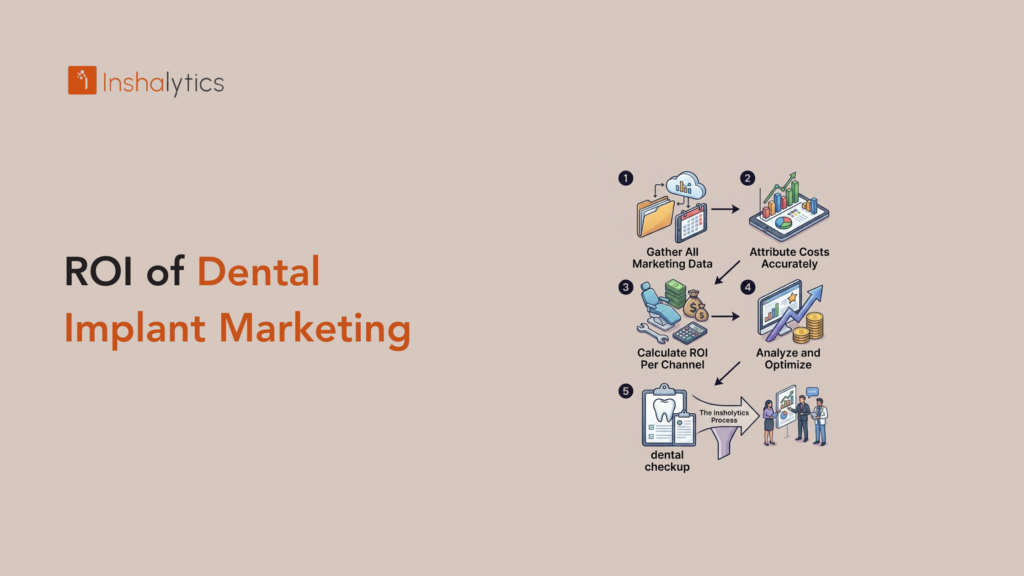
Using call tracking and form submission tracking, record every implant inquiry by source (Google Ads, organic search, Facebook, referral, Google Maps). Divide your channel spend by the number of implant inquiries from that channel to get CPL by channel. Then track how many of those inquiries become booked consultations. Divide channel spend by booked consultations for cost per consultation. Track consultation show rate and case acceptance rate separately. Your true CPA is channel spend divided by accepted cases, not by consultations booked. This calculation reveals the full conversion funnel from lead to case and identifies exactly which stage has the biggest efficiency opportunity.
Step 3: Apply the LTV-Adjusted ROI Formula for Implant Cases
For implant patients who accept treatment, calculate LTV beyond the initial case. An implant patient who accepts a full-arch case and remains in the practice for ongoing maintenance visits, potential soft-tissue treatment, and referrals has an LTV significantly higher than the initial case value. Use the patient LTV calculation method to estimate the total practice relationship value of an implant patient, then add this to the initial case value as the revenue input in your ROI formula. The LTV-adjusted implant ROI is almost always significantly higher than the first-case ROI calculation, which further justifies the higher CPA that implant marketing requires.
The Tracking Setup That Makes Implant Marketing ROI Measurable
Implant marketing attribution is more complex than general dentistry attribution because of the longer decision cycle, the multiple touchpoints involved, and the need to track through from initial contact to case acceptance (which may happen weeks after the initial inquiry). Standard marketing attribution captures the last touch. Implant attribution needs to capture the full journey.
Why Implant Patients Need a Dedicated Attribution Path
An implant patient who saw your Facebook ad in January, searched Google in February, clicked your Google Ads listing, and visited your website three times before calling in March will be attributed to the March Google Ads click in most standard tracking systems. The Facebook ad contribution is invisible. This multi-touch attribution problem is most acute in implant marketing because the decision cycle is long enough that multiple marketing touchpoints are almost guaranteed. Implement UTM parameters on every ad and every email so that every website visit is labelled with its source. Use call tracking numbers specific to implant campaigns. Review call recordings to understand which marketing messages patients reference when they call, providing qualitative insight into which channels are influencing the decision even when last-touch attribution does not capture them.
Landing Pages, Call Tracking, and CRM Integration for Implant Campaigns
Every implant marketing campaign should have its own dedicated landing page. Not a page linked from the main navigation but a standalone page designed specifically to convert implant-intent visitors into consultation requests. The page should include: before-and-after imagery, a clear explanation of the implant process, transparent discussion of cost range and financing options, patient testimonials specific to implants, and a prominent, low-friction call-to-action (book a free consultation, call now). Link a unique call tracking number to this page. Connect form submissions to your CRM or practice management software with the campaign source tagged. This creates a complete attribution path from ad click to consultation booking to case acceptance.
How Long to Measure Before Drawing Conclusions on Implant Campaign ROI
Given the 3 to 6 month average decision cycle for implant patients, measuring implant marketing ROI at 30 or 60 days produces misleading data. The leads you generated in month one may not accept cases until month four or five. Set a minimum 6-month evaluation window for any implant marketing campaign before making budget reallocation decisions. Within that window, track leading indicators (consultation request volume, consultation show rate, consultations completed) to confirm the pipeline is building even before cases are accepted. A campaign generating consistent consultation bookings at benchmark cost per consultation is on track to deliver acceptable CPA once case acceptance data accumulates over the evaluation period.
How Inshalytics Builds and Measures Implant Marketing Campaigns
Dental implant marketing requires a higher level of specialisation than general dentistry marketing because the economics are different, the decision cycle is longer, and the attribution requirements are more complex. Inshalytics manages implant marketing programs with channel structures, attribution setups, and reporting frameworks designed specifically for the implant patient journey.
The Channel Mix We Use for Implant-Focused Practices
For practices with a significant implant focus, we typically structure the channel mix with Google Ads as the primary immediate-intent capture channel (targeting “dental implants near me,” “All-on-4 cost,” and “same day dental implants” keyword groups with dedicated landing pages), local SEO building authority for implant-related searches over a 12 to 18 month horizon, and a Facebook or Instagram retargeting campaign that serves implant content to website visitors who did not convert on their first visit. Email sequences nurture implant consultation requests who asked for information but did not immediately book. This multi-channel approach addresses all three stages of the implant patient journey: awareness (Meta), intent (Google Ads), consideration (retargeting and email), and conversion (consultation booking). The dental marketing ROI calculation guide covers how to track ROI across all channels in this type of integrated program.
A Real-World ROI Framework for a Single-Location Implant Practice
For a single-location practice investing $4,500 per month in implant marketing (across Google Ads, SEO, and a retargeting component), generating 25 implant consultation inquiries per month, converting 35% to booked consultations (9 per month), achieving an 80% show rate (7 attended consultations per month), and closing 35% of consultations to case acceptance (2.4 accepted cases per month at a $14,000 average), the monthly production from implant marketing is approximately $33,600. Against a $4,500 marketing investment, the monthly ROI is ($33,600 minus $4,500) divided by $4,500 = 6.5:1 on first-case production. On an LTV-adjusted basis, this ratio extends significantly further. This framework is the starting point we use for implant marketing ROI projections at Inshalytics, adjusted for your specific market competition, average case value, and consultation conversion rates.
Ready to build an implant marketing program that you can measure and scale? Talk to Inshalytics about a channel strategy and ROI framework specific to your implant case mix.