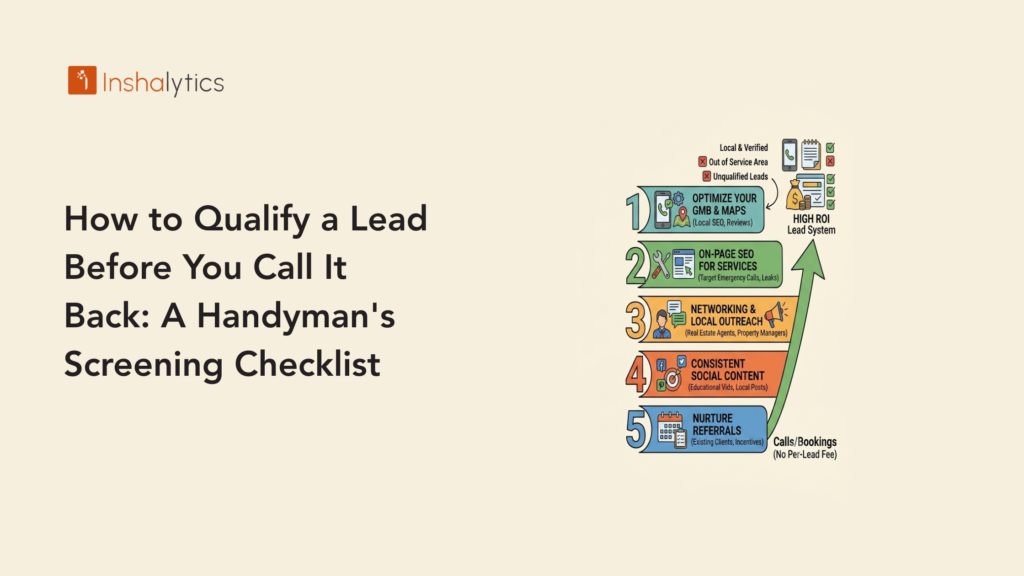
You have a lead notification. Before you call it back, you have about 60 seconds to decide whether this lead is worth your time. Not all leads are. A missed-the-minimum-budget homeowner, an out-of-area inquiry, a job type you do not cover, or someone three quotes deep who is using you to justify the price they already want to pay: these are not bad callbacks just because they failed to convert. They are bad callbacks because they were predictable failures that consumed time that could have gone to qualified prospects. The existing lead qualification guide covers the full qualification process for on-site work. This checklist focuses specifically on the pre-callback screening moment, the 60 seconds before you dial, and the 90 seconds after the call starts that determine whether the rest of your time is well spent.
Why Pre-Callback Screening Is Different From General Qualification
General qualification determines whether a prospect is worth pursuing through the full sales process: estimate, quote, follow-up. Pre-callback screening determines whether the prospect is worth the initial phone call. These are different decisions made at different stages with different information available. At the pre-callback stage, you typically have: the platform or source of the lead, the job description as submitted, the location, sometimes the job timeline, and sometimes previous contact attempts by other contractors. That is enough information to screen out the clear non-fits before investing any more time.
What the Lead Source Tells You Before You Even Read the Description
The channel a lead arrived through tells you something about its likely quality before you read a word of the job description. A call from your GBP number indicates a homeowner who was on Google, searched for a handyman, found your specific listing, and chose to call you. That is high-intent behaviour. A lead notification from a shared platform at 11:47 PM on a Sunday indicates a homeowner who submitted a multi-platform quote request form during off-hours, possibly with minimal consideration. These two contacts arrive in the same notification tray but represent very different conversion probabilities. Filter your callback urgency accordingly: GBP, website, and LSA contacts warrant immediate callback within five minutes. Platform leads from off-hours submissions can be called back during business hours without meaningful conversion impact.
The Job Description Red Flags to Check Before Calling
Before calling any lead, read the submitted job description for these red flags. Budget language that signals they are researching prices rather than hiring: phrases like “just want to get an idea,” “exploring options,” “what would something like this cost,” or “comparing quotes.” Scope language that indicates they want more than you offer: references to licensed electrical or plumbing work that requires a separate licence in your state, structural or load-bearing work, specialised equipment operation. Location signals: is the address or city within your actual service area, not just your broadly set platform radius? Job size signals: does the description suggest a job below your minimum fee (very minor repairs described in one sentence, one-off small tasks)? Flag any of these before calling and adjust your opening approach or decline to call back entirely.
The Pre-Callback Screening Checklist
Run through this checklist in under 60 seconds before returning any lead call. It takes one minute and saves hours.
Check 1: Is the Job Location in My Real Service Area?
Map the lead address against your actual service radius. Not your platform-set radius. Your real service area: the distance you will drive for a standard job at your standard rates. If the location is beyond your real service radius, a callback is only worthwhile if the job value is high enough to justify the drive (large project, high-ticket work) or if you can combine it with other jobs in that area. Otherwise, decline immediately with a brief text: “Thanks for reaching out. Unfortunately, your location is outside the area we currently serve. Hope you find a great handyman soon.” Send this within 15 minutes. Homeowners appreciate quick responses, even if the answer is no, and a quick decline preserves your reputation better than silence.
Check 2: Is the Job Type Something I Do?
Does the job description match your actual service offering? If you do not do electrical panel work, HVAC service, foundation repair, or licensed plumbing, and the job description is primarily those things, decline. Many homeowners use “handyman” loosely to describe any home repair task, regardless of whether a handyman licence or a specialist trade is appropriate. A brief text clarifying what you do and do not cover serves the homeowner and protects your time: “Hi, we specialise in general repairs, carpentry, and fixtures. The work you described sounds like it may need a licensed [trade]. Happy to help with anything in our wheelhouse, though.” Leave the door open for adjacent work.
Check 3: Is There Enough Information to Gauge Job Value?
Can you estimate the minimum job value from the description? If the job sounds like it will be below your minimum service fee (a single light bulb swap, a ten-minute furniture assembly task), call back with your minimum fee upfront before agreeing to drive out: “Happy to help with that. Just to give you an accurate picture, our minimum service fee for a visit is $150, which covers the first 45 minutes. For a quick job like that, it may be close to or at that minimum. Does that work for you?” Stating the minimum fee on the callback filters out homeowners who will object to the price before you waste a site visit.
Check 4: Does the Timeline Signal Hire Mode or Research Mode?
If the platform includes a timeline field, use it as a pre-screening signal. “Ready to hire immediately” and “within the next week” are hire-mode signals. “Planning for 2 to 3 months from now” and “just exploring” are research-mode signals. Research-mode leads are not worthless, but they do not warrant the same urgency as hire-mode leads. For research-mode leads, your callback goal shifts: rather than scheduling an estimate, offer to send them your services overview, ask them to save your number, and follow up with a friendly text in 30 days. Convert them to future opportunities without burning current-week time on a prospect who is not ready to book.
Check 5: Has This Lead Already Hired Someone?
Check the timestamp on the lead notification. Platform leads submitted 4 or more hours ago during business hours have often already been called by two to three faster-responding contractors. A lead submitted at 9:15 AM that you are seeing at 1:45 PM has had nearly five hours for other operators to reach the homeowner. This does not mean the lead is dead, but your opening should acknowledge that they have likely already spoken to someone: “Hi, I know you probably have gotten a few calls already. I wanted to reach out anyway because we specialise in [their job type] and have some good availability this week.” This approach is more effective than pretending you are the first to respond, and it pre-empts the “I already hired someone” conversation.
The First 90 Seconds of the Callback: Qualifying While Building Rapport
Once you have cleared the pre-callback checklist and decided the lead warrants a call, the first 90 seconds of the conversation have one goal: confirm your pre-call screening was correct and add the information you could not get from the submission.
The Three Questions That Qualify Without Feeling Like an Interrogation
After your introduction, move naturally into these three questions. Question one: “Can you tell me a little more about what you need done?” This opens the description beyond the form submission and reveals scope, complexity, and any hidden work you could not see in the lead text. Question two: “Are you hoping to get this done soon, or is this something you are planning out?” This confirms their timeline and places them in hire mode or research mode based on their own words. Question three: “Have you had a chance to look at what this kind of work typically runs?” This surfaces budget expectations without asking for a budget directly. A homeowner who says “I saw similar work on YouTube for $50 in materials,” is giving you important information about whether their budget expectations align with your professional rates.
When to Suggest a Phone Consultation Instead of a Site Visit
Not every qualified lead needs an immediate site visit. For jobs where the scope is clear from the description (TV mounting, ceiling fan installation, standard faucet replacement), offer a phone consultation with a price range before scheduling a site visit. “Based on what you described, that type of job typically runs between $175 and $280, depending on what I find on-site. Does that fit your budget? If so, I can come take a look and give you the exact number.” This one-step pre-qualification on price eliminates the scenario where you drive 20 minutes to give a quote that the homeowner considers too expensive. Combining this approach with a professional estimate process produces a significantly higher estimate-to-close rate.
How Inshalytics Helps Handyman Businesses Improve Lead Quality at the Source
Pre-callback screening is a defence against bad lead sources. Building the right lead sources reduces the need for extensive screening in the first place. When your primary leads come from your GBP, local SEO, and LSA, the homeowner has already completed significant self-qualification before you receive the lead: they searched specifically for a handyman in your area, found your business, read your reviews, and chose to call you. These leads still benefit from the pre-callback checklist, but they arrive with a far higher baseline conversion probability than shared platform leads that require defensive screening to protect your time.
Inshalytics builds the owned-channel lead infrastructure that generates high-intent, pre-qualified inbound contacts. Combined with the screening habits in this checklist, the result is a pipeline where the majority of your callbacks produce booked estimates, and the majority of your estimates produce booked jobs. The full lead generation guide for handyman businesses covers how the complete acquisition and qualification system fits together.
Want leads that pass the pre-callback checklist before they even reach your phone? Talk to Inshalytics about building a lead source that sends you high-intent homeowners who have already chosen your business.