
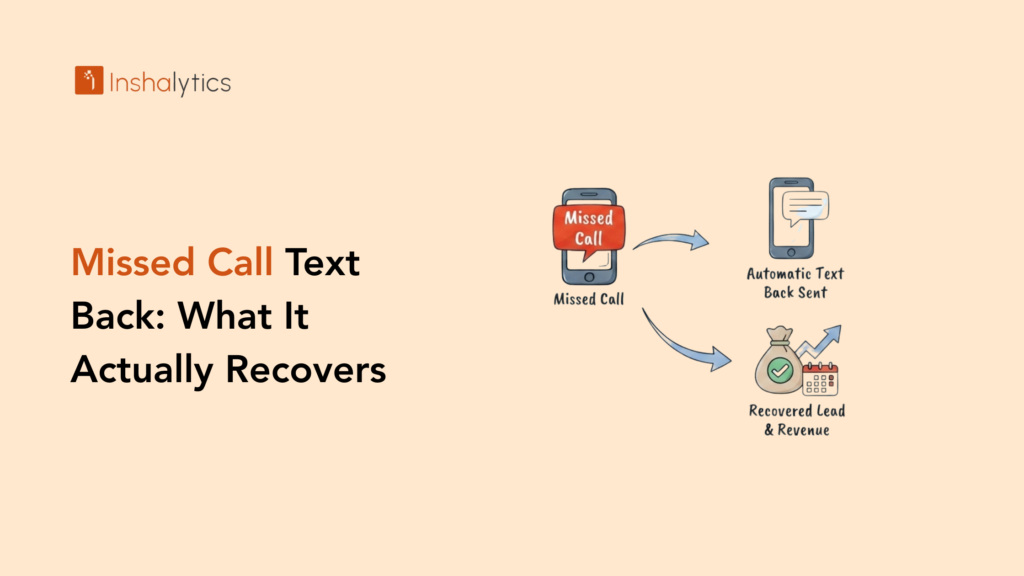
Every missed call text-back vendor claims their tool recovers lost leads. Almost none of them explain what “recovers” actually means in dollars, or why the recovery rate they’re advertising might have nothing to do with what your business will actually see. Missed call text-back is one of the highest-ROI, lowest-effort tools a home service business can set up but only if you understand what it can and can’t fix.
How Missed Call Text Back Works
The mechanic is simple: when an inbound call to your business goes unanswered, an automated system detects the missed call and immediately sends a text message to the caller before they’ve had a chance to move on.
The Trigger-to-Text Timeline
Most systems fire the text within 5 to 60 seconds of the missed call, while the caller is still holding their phone and hasn’t yet dialed the next business, according to setup guides from providers like Snap Flow Solutions. That window matters a text that arrives ten minutes later is responding to a caller who’s already found someone else to answer.
What a Good First Message Says (and What Kills Replies)
An effective first text is short, personal, and asks a direct question something like acknowledging the missed call, identifying who’s texting, and asking what’s going on. A message packed with your tagline, hours, address, and a coupon code gets ignored, according to the guidance in LeadRecover’s complete guide to missed call text-back. The goal of the first text is to restart a conversation, not deliver a brochure the caller never asked for.
Write your first-text template today. If it’s longer than two sentences or doesn’t end with a question, rewrite it before you turn the automation on.
What the Recovery Rate Data Actually Shows
Recovery rate claims across the industry vary widely, and understanding why helps you set realistic expectations for your own business instead of anchoring on a vendor’s best-case number.
Why Estimates Range From 20% to 45%
Published estimates for how many missed callers a text-back system recovers range fairly widely. LeadRecover’s analysis of service businesses puts typical recovery in the 20% to 40% range, while CallMissed’s developer-focused guide cites third-party estimates from Veyri Labs suggesting 25% to 45% is achievable. That’s a wide range for the same basic tool, and the variation comes down almost entirely to execution message quality, response speed, and what happens after the first text not the underlying software itself.
What Separates High-Recovery Businesses From Low-Recovery Ones
Businesses at the high end of that range treat the text as the start of a real conversation, with a person ready to respond quickly and move the caller toward booking. Businesses at the low end set up the automation and then let replies sit unanswered for hours, which defeats the purpose of the entire system almost entirely.
Is It Worth It? The ROI Math for Home Service Businesses
The dollar value of missed call text-back depends heavily on your ticket size and how many calls you’re currently missing every week.
Recovered Jobs at HVAC and Plumbing Ticket Sizes
A business missing 12 calls a week that recovers even 20% to 40% of them with text-back is picking up 2 to 5 extra jobs a week. At a $400 average ticket, that works out to $800 to $2,000 in weekly recovered revenue, according to the worked example in LeadRecover’s guide, against software that typically costs $99 to $200 a month.
Recovered Jobs at Roofing Ticket Sizes
For roofing, where average job values run into five figures, the same recovery percentage represents dramatically more revenue per recovered call. Even recovering a single additional job a month from missed-call text-back can pay for the software many times over, which is worth keeping in mind given how much roofing companies typically miss covered in more detail in The Real Cost of a Missed Roofing Call.
Software Cost vs. Revenue Recovered
Standalone missed call text-back tools generally run $40 to $200 a month. Full lead-capture suites that bundle text-back with follow-up cadences and source tracking run somewhat higher, typically $99 to $399 according to LeadRecover’s pricing comparison. Against the revenue math above, the cost is rarely the deciding factor execution is what determines whether the tool actually pays off.
Estimate your own numbers: missed calls per week multiplied by a conservative 20% recovery rate multiplied by your average ticket. That’s your minimum expected monthly return before you’ve even optimized the message or follow-up process.
What Missed Call Text Back Can’t Fix
Text-back automation solves one specific problem. It’s worth being clear about what it doesn’t solve on its own, because expecting it to fix everything sets up unrealistic disappointment.
When the Problem Is Follow-Up, Not First Response
If your team sends the first text but doesn’t follow up on the reply for hours, you’ve moved the missed-call problem one step downstream instead of actually solving it. Text-back needs a real follow-up process behind it, not just an automated trigger that fires and then goes quiet.
Compliance Basics (Opt-In and TCPA Considerations)
Responding to someone who initiated contact by calling you is generally treated as compliant, since you’re replying to their action rather than cold-texting them out of nowhere. Even so, including clear opt-out language in the first message is standard practice worth building in from the start, both for compliance and for keeping the relationship on good terms. Speed matters here too see Speed to Lead for Plumbers: Turning Calls Into Booked Jobs for how this fits into a broader response strategy.
Setting Up a System That Actually Converts
Getting real value out of missed call text-back is less about the software itself and more about the process wrapped around it.
Choosing Between Standalone Tools and Full CRM Suites
A standalone tool is enough if you just need the missed-call gap closed and already have a CRM or process for everything after that first reply. A full suite makes more sense if you want text-back, follow-up sequencing, and source tracking working together without stitching separate tools together by hand.
Pairing Text-Back With a Real Follow-Up Cadence
The businesses seeing the highest recovery rates pair the automated first text with a defined follow-up cadence a second touch if there’s no reply, a clear path to booking once there is one. Text-back opens the door. What happens next determines whether it becomes a booked job or just a slightly delayed missed opportunity. This same pattern shows up across every trade, and the underlying research on response time is covered more broadly in How Response Time Is Quietly Killing Your Close Rate.
Missed call text-back is one of the cheapest, fastest wins available to a home service business but the software is only half the equation. The recovery rate you actually get depends on how fast your team follows up and how well the process behind the first text is built.
Want us to set up and manage a missed-call recovery system tied into real follow-up automation? That’s exactly the kind of lead-response work our team builds for home service clients.