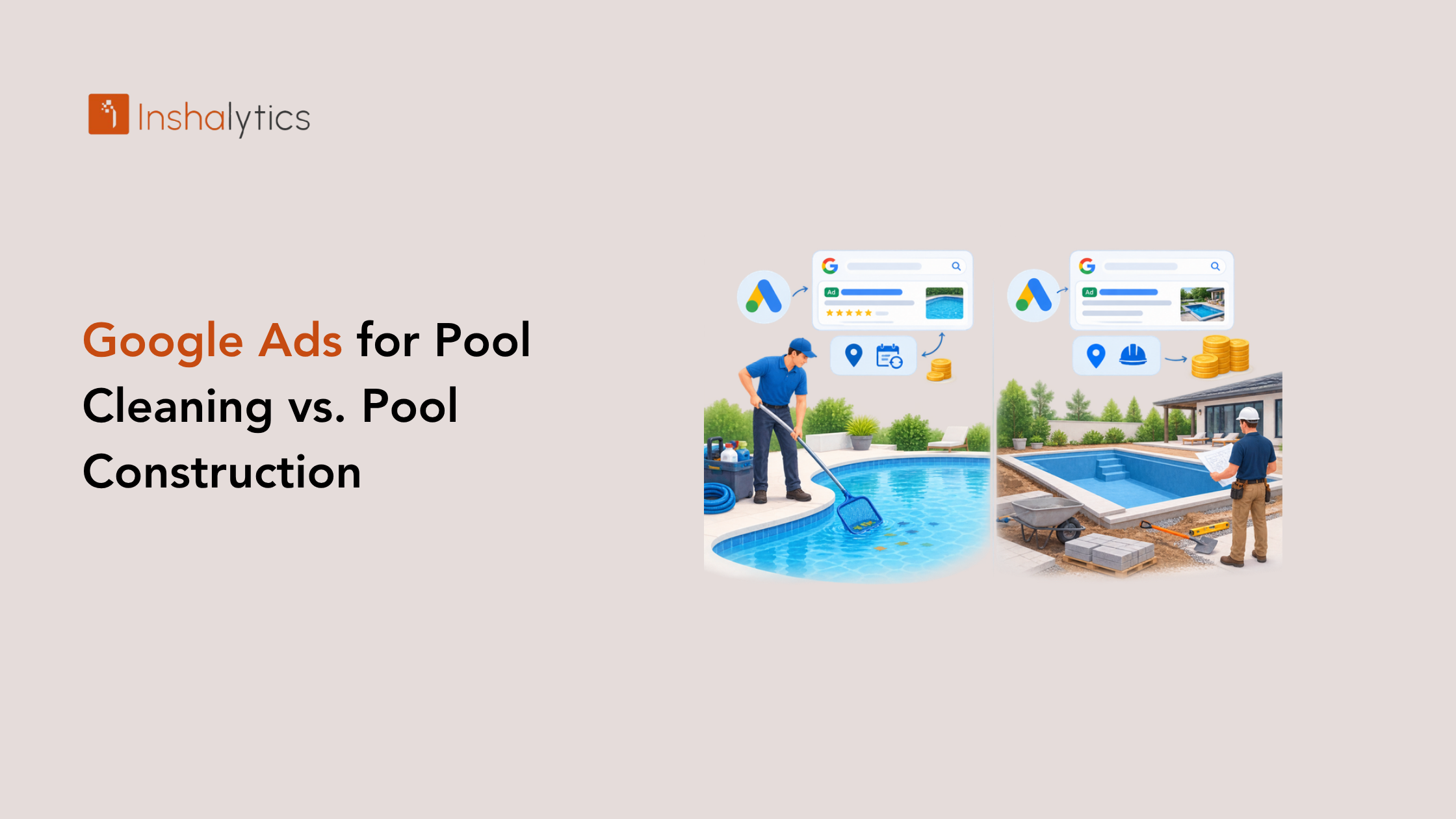
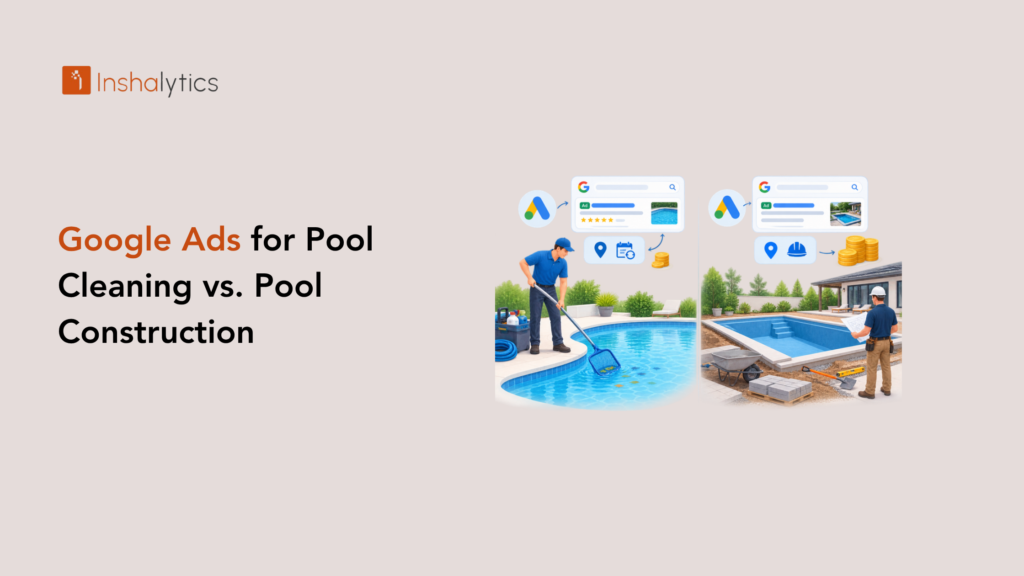
Why does one pool company get a steady stream of weekly-service signups from search while the shop next door burns through its budget on tire-kickers? Most of the time, the answer is that both businesses are sold the same ad strategy for two very different buyers. Google Ads for pool companies works when you treat a homeowner with a green pool and a homeowner planning a backyard remodel as two separate audiences.
This guide breaks down how cleaning and construction differ on intent, budget, and conversion window. You will see how to split spend, how to build one account that serves both service lines, and which mistakes quietly drain a pool company ad budget.
Why Pool Cleaning and Pool Construction Need Separate Google Ads Strategies
Pool cleaning and pool construction share a customer base and a backyard, but almost nothing else. The buyer’s urgency, the value of the sale, and the way you measure success all change. Running one strategy for both forces compromises that show up as wasted clicks and missed calls.
Recurring revenue vs. one-time projects
A cleaning customer is a subscription. You win them once, and they pay every week or every month for as long as your route serves them. A construction customer is a single large project, and the revenue arrives once, with maybe a renovation or equipment upgrade down the road.
That difference changes what a click is worth. A weekly-service lead looks modest on the first invoice, yet its value is the whole run of invoices behind it. A construction lead looks expensive to acquire, yet one signed build can carry the cost of many lost leads. Your bidding and budgeting need to reflect each model separately.
Short decision window vs. a 3-6 month sales cycle
A homeowner staring at a green pool wants help today. They search, call two or three companies, and book whoever answers first. The decision window can close within a single afternoon.
Construction runs on a different clock. The buyer researches designs, compares builders, collects quotes, and sorts out financing, which often stretches across a 3-6 month sales cycle. Your ads must catch them early, stay visible through the comparison phase, and hand them to a sales process built for long follow-up. Judging both campaigns on the same 30-day results window will mislead you.
Cleaning vs. construction at a glance (comparison table)
Use this table as a quick reference when you plan campaigns, set budgets, or review reports. It compares the two service lines on the factors that drive Google Ads decisions.
| Factor | Pool Cleaning and Service | Pool Construction and Builds | |—|—|—| | Search intent | Immediate need, often a problem to fix now | Planned project, researched over weeks or months | | Typical keywords | pool cleaning near me, weekly pool service, green pool cleanup | pool builders near me, inground pool cost, pool installation | | Sales cycle | Hours to days | Months, with multiple touchpoints | | What a lead is worth | Value of the full recurring route stop over time | Value of one large project, with a high margin per sale | | Lead volume | Higher volume, lower value per lead | Lower volume, higher value per lead | | Qualification focus | Service area, pool type, frequency | Property, budget readiness, timeline, permits | | How to budget | Work backward from route capacity and customer lifetime value | Work backward from builds you can deliver and your close rate | | Best follow-up | Fast call-back, same-day quote | Consultation booking, nurture over time |
How Search Intent Differs Between Cleaning and Construction Keywords
Google Ads rewards the match between a search and your offer. Cleaning and construction searches look similar on the surface, since both mention pools, but they signal very different readiness to buy. Sorting keywords by intent is the first step toward a profitable account.
High-intent cleaning terms (weekly service, green pool, pool cleaning near me)
Cleaning searches carry urgency. “Pool cleaning near me,” “weekly pool service,” and “green pool cleanup” come from people who need a provider now and have already decided to hire one rather than do it themselves.
Build your pool service PPC around these terms, and write ads that confirm your service area, your response time, and what a first visit includes. Send clicks to a page with a call button and a short quote form, not a general homepage. Because the decision window is short, speed to answer decides who wins the job.
High-intent construction terms (pool builders, inground pool cost, pool installation)
Construction searches signal a planned project. “Pool builders near me,” “inground pool cost,” and “pool installation” come from homeowners who are budgeting and gathering options, and some are ready to book a consultation.
Pool builder Google Ads should aim at the consultation, not the instant sale. Offer a design conversation, a site visit, or a project walkthrough as the next step. Your landing page needs proof of finished work, a clear process, and an easy way to start, because this buyer is comparing you against several other builders.
Research-phase searches to avoid or isolate
Some searches look relevant but rarely become jobs. Examples include “how to clean a pool yourself,” “pool maintenance checklist,” “how long does it take to build a pool,” and “pool ideas” with no location or buying signal.
You have two options. Block the do-it-yourself terms with negative keywords so they never trigger your cleaning ads. Or isolate the genuine research terms in their own low-budget campaign with a softer offer, such as a planning guide, so they cannot steal spend from high-intent campaigns.
How Much Should a Pool Company Spend on Google Ads?
A pool company should set its Google Ads budget by working backward from capacity and customer value: how many new route stops or builds you can handle, what each is worth over time, and how many leads it takes to win one. Budget the two service lines separately, then adjust after reviewing booked jobs.
Budget logic for a recurring-route cleaning business
Start with capacity. If your crew can absorb a limited number of new stops per month before routes get stretched, that number is your ceiling for new customers. Spending beyond it only creates a waiting list and unhappy leads.
Next, value each new stop by its recurring revenue, not its first invoice. A customer who stays for several seasons justifies a much higher acquisition cost than one visit would suggest. Divide the cost you can afford per new customer by your lead-to-customer close rate to find what a lead is worth. That figure sets your bids and daily budget.
Budget logic for a high-ticket pool builder
Builders should start with the number of projects the crew can deliver in a season, then work backward through the funnel. How many consultations does it take to sign one build, and how many ad leads does it take to produce one consultation? Your own records answer those questions better than any industry average.
Because each build carries high revenue and meaningful margin, a builder can afford a higher cost per lead than a cleaning company. The tradeoff is patience. Budget for a longer feedback loop, and review results over the full sales cycle instead of the first few weeks.
Splitting one budget across both service lines
If you run both services, avoid splitting the budget evenly by default. Divide it by constraint. Fund cleaning up to the number of new stops your routes can serve, then direct the remaining spend to construction, where one signed build can move the year.
Revisit the split each season. Cleaning demand peaks around opening season and summer problems, while construction planning begins earlier. Keep each service line on its own budget so a high-volume campaign never starves a high-value one.
How to Structure Your Google Ads Account for Both Service Lines
A clean account structure is what makes separate strategies possible. When each service line has its own campaigns, budgets, and negatives, you can read results clearly and fix problems fast.
Separate campaigns, budgets, and bidding strategies
Create at least one campaign for cleaning and one for construction, each with its own daily budget. Within each, group ad groups by intent: weekly service, green pool recovery, and one-time cleanings for cleaning; pool builders, installation, and renovation for construction.
Bidding should follow the sales model. Cleaning campaigns can optimize toward calls and form leads at a steady volume. Construction campaigns should favor qualified consultations, even if volume is lower. We use the same one-account, many-services logic in our guide to Google Ads for handyman services, where different jobs also need different campaigns.
Shared and campaign-level negative keywords
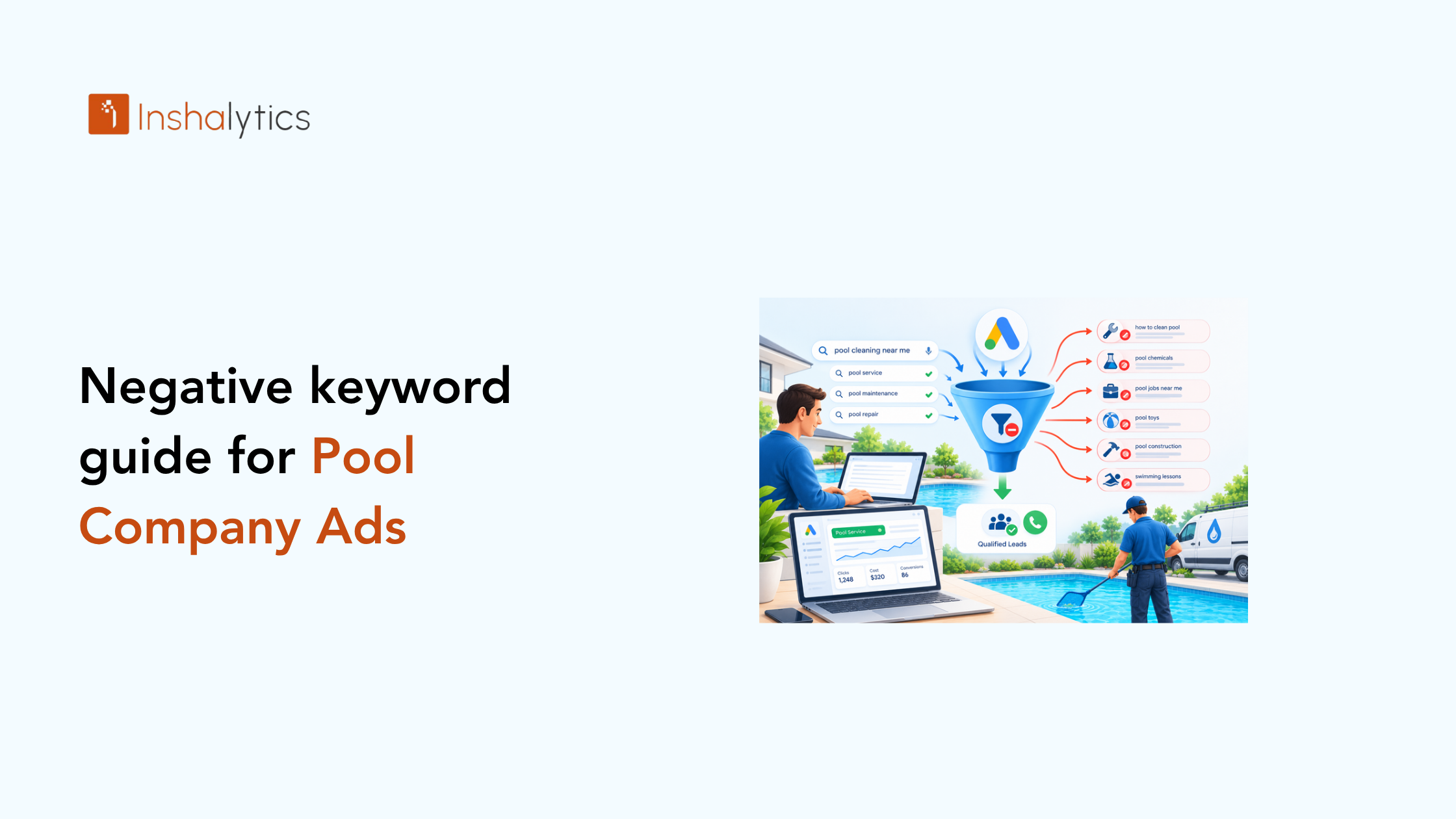
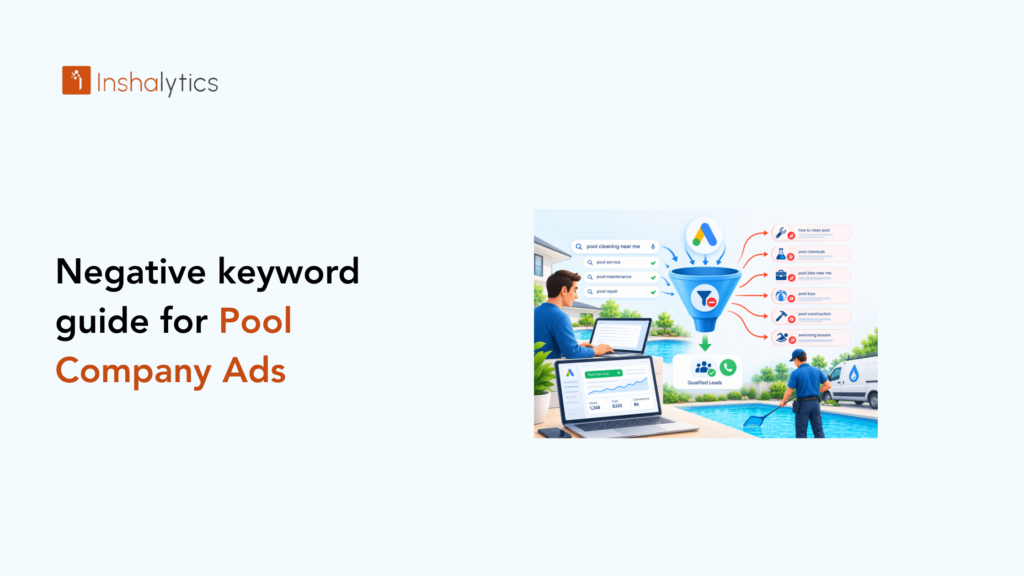
Negative keywords keep each campaign in its lane. Build a shared list of terms that never apply to either service, such as job seekers, DIY phrases, supplies, and free-advice queries, and attach it to every campaign.
Then add campaign-level negatives that separate the two lines. Your cleaning campaign should exclude “builder,” “install,” “cost to build,” and “new pool.” Your construction campaign should exclude “weekly service,” “cleaning,” “green pool,” and “maintenance.” Review the search terms report regularly, because new overlaps appear as you add keywords.
Local Services Ads vs. Search campaigns
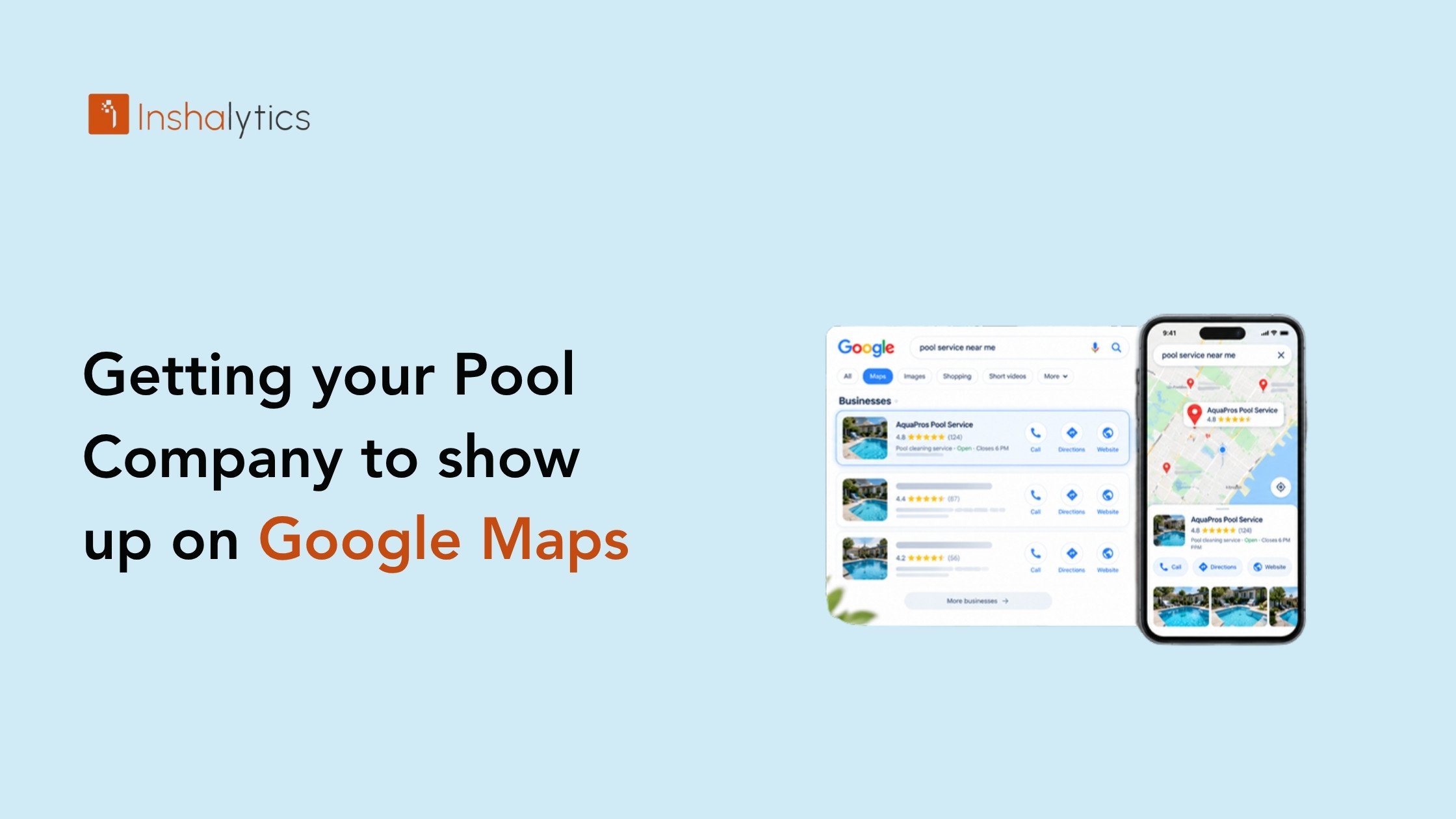
Local Services Ads and Search campaigns both put you in front of local buyers, but they work differently. Local Services Ads appear at the top of results with a pay-per-lead model and a verified profile, which suits fast-decision cleaning leads well. Availability and categories vary by market, so check what Google offers in your area.
Search campaigns give you control over keywords, ad copy, and landing pages, which matters most for construction, where your message and proof carry the sale. Many pool companies run both: Local Services Ads for urgent cleaning demand and Search campaigns for builds and for broader service coverage.
Google Ads Management for Pool Companies: What Inshalytics Handles
Good structure takes ongoing attention. Search terms change, seasons shift, and lead quality drifts without regular review. Here is how we would manage the work as part of our lead generation services, so you spend your time running jobs.
Intent-based campaign builds for service and construction
We start by mapping your services, service area, and capacity. From there we build separate campaigns for cleaning and construction, with ad groups sorted by intent, tailored ad copy, and landing pages that match each search.
We also set up the shared and campaign-level negative lists before launch, so the account does not spend its first weeks learning what you could have blocked on day one. Your input on crew capacity and the jobs you want most shapes every decision.
Call tracking and lead-quality filtering
Many pool leads arrive by phone, so we set up call tracking that ties each call to the campaign and keyword behind it. That shows which searches produce real conversations and which only produce noise.
We also agree on qualification rules with you: the service area you cover, the pool types you service, and the project types you take on. Leads that fall outside those rules are flagged, so your budget decisions rest on qualified leads. Need help getting started? Talk to our team about a setup built around your routes and your build schedule.
Reporting tied to booked jobs, not clicks
Clicks and impressions do not pay your crew. We report on calls, form leads, qualified leads, consultations, and booked jobs, by service line, so you see which campaign earns its budget.
For cleaning, that means new route stops. For construction, it means consultations and signed projects. Pair that reporting with a strong site, and you can see where visitors drop off; our website conversion audit checklist shows what we look for on a page that has to turn visits into calls.
Common Google Ads Mistakes Pool Companies Make
Most wasted pool ad spend traces back to a short list of avoidable errors. These two cause the most damage because they hide inside otherwise healthy-looking accounts.
Mixing service and construction in one campaign
When cleaning and construction keywords share a campaign, they also share a budget and a bidding strategy. The high-volume cleaning terms tend to absorb the spend, and construction leads get starved. Reports blur together, so you cannot tell which service line is profitable.
Ad copy suffers too. A message written for “pool cleaning near me” misleads a person searching “inground pool cost,” and the reverse is equally true. Split the campaigns, give each its own budget and message, and the data becomes readable.
Ignoring seasonality in budgets and bids
Pool demand moves with the calendar, and a flat budget wastes money in slow stretches while it leaves leads on the table in busy ones. Cleaning demand rises with opening season and with summer problems, and construction research begins before the build season does.
Plan your budget and bids around those waves, and raise spend when demand and your capacity both peak. The same principle applies to another outdoor-driven trade, as we cover in our guide to seasonal marketing strategies for deck and fence businesses.
Build Two Campaigns, Not One Compromise
Google Ads for pool companies pays off when each service line gets its own intent, budget, and measurement. Cleaning wins on speed and recurring value. Construction wins on patience, proof, and a long follow-up process.
Separate campaigns, smart negatives, and reporting tied to booked jobs turn a pool company ad budget into predictable growth. Skip the shortcut of a single blended campaign, and you stop paying for clicks that never fit your business.
Related reading: Facebook & Instagram Ads for Pool Companies (2026)
Ready to build an account that treats weekly service and backyard builds as the different businesses they are? Contact Inshalytics and we will map out a plan around your routes, your crews, and your season.