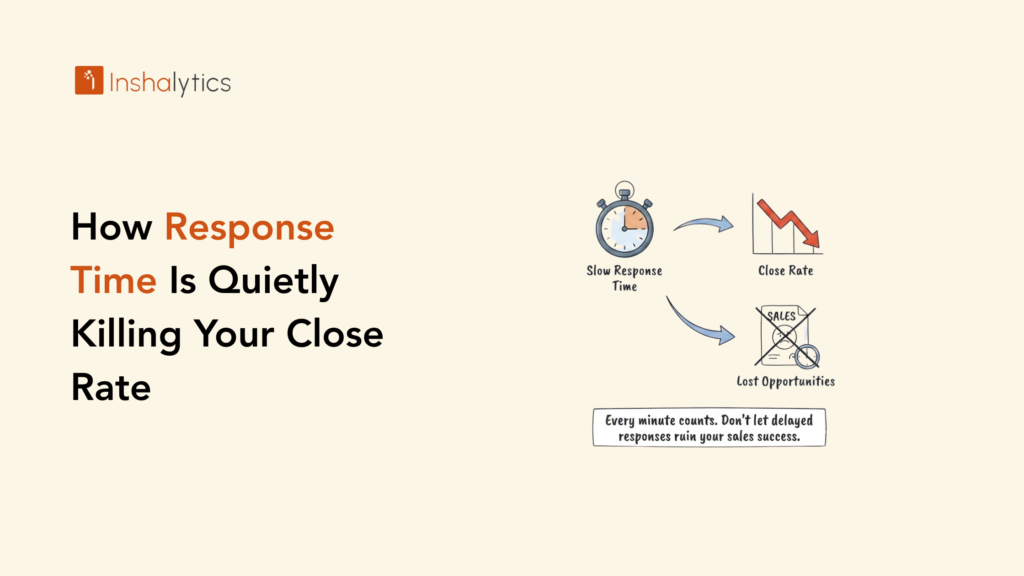
Most home service business owners blame a bad month on lead quality. The leads were tire-kickers, the platform sent junk, the market’s slow. Often, the real problem is sitting in plain sight in the call log: leads that took two hours to get a callback instead of two minutes. Response time doesn’t announce itself as the problem. It just quietly eats into your close rate, month after month, until someone finally measures it.
The Hidden Math Between “Lead Volume” and “Booked Jobs”
Two businesses can buy the exact same leads from the exact same source and end up with wildly different booked-job numbers. The difference usually isn’t the leads themselves.
Why Contractors Blame Lead Quality Instead of Response Time
It’s a natural instinct a lead that doesn’t convert feels like it was never a real opportunity in the first place. But when you actually track response time against outcome, a large share of “bad leads” turn out to be leads that simply never got contacted fast enough to still be interested by the time someone called back.
The 27% of Calls That Never Get Answered
Home service businesses miss roughly 27% of their inbound calls on average, according to Invoca’s research on more than 60 million phone calls, cited in Pipeline On’s speed-to-lead analysis. That’s more than a quarter of every dollar spent generating those calls producing nothing at all not because the lead was bad, but because nobody picked up the phone in time.
Before you diagnose a slow month as a lead-quality problem, check your answer rate and average response time first. It’s usually the faster, more honest explanation, and it’s one you can actually fix without spending more on ads.
What the Research Actually Says About Speed and Conversion
The relationship between response time and close rate isn’t a hunch it’s one of the more consistently reproduced findings in lead-response research across industries.
The MIT/Harvard 5-Minute Threshold
A widely cited MIT and Harvard Business Review study found that responding to a lead within five minutes makes a business roughly 21 times more likely to successfully qualify that lead compared to waiting even 30 minutes. That’s not a marginal edge. It’s the difference between a functioning pipeline and one that’s mostly theoretical on paper.
The Velocify 391% Conversion Lift at Under 60 Seconds
Separate research from Velocify, also referenced in Pipeline On’s breakdown, found that responding within 60 seconds lifts conversion rates by as much as 391% compared to slower response windows. Different study, same pattern: speed is one of the few variables a business fully controls that moves conversion this dramatically, without requiring a bigger marketing budget.
How This Plays Out Across HVAC, Plumbing, and Roofing
The mechanism is the same across trades, but the stakes scale with urgency and ticket size. Plumbing emergencies and HVAC breakdowns get decided within minutes because the homeowner’s discomfort demands immediate action covered in more depth in Why HVAC Leads Go Cold in Under 5 Minutes. Roofing decisions move slower but carry a much larger dollar value per lost job, making a slow response there expensive in a different way, as explored in The Real Cost of a Missed Roofing Call.
Run the Numbers on Your Own Close Rate
Reading about response-time research is useful. Running the numbers on your own business is what actually changes anything about how your team operates.
A Simple Self-Audit: Pull Your Last 30 Days of Leads
Go through your last 30 days of leads and calls. For each one, note the timestamp it came in and the timestamp of your first outbound contact. This alone usually reveals a much wider spread than owners expect some leads answered in under a minute, others sitting for hours without anyone realizing it.
Calculating Your Monthly Revenue Loss From Slow Response
Take the leads that took longer than an hour to get a first response and estimate how many of those should have converted based on your normal close rate. Multiply the shortfall by your average job value. That number is what slow response time is costing you every single month a hidden line item most P&Ls never show directly, but one that shapes the bottom line just as much as ad spend does.
Run this audit before your next marketing spend decision. It’s often cheaper to fix response time than it is to buy more leads to make up for the ones slipping through.
Fixing the Leak Without Adding Headcount
The fix for slow response time rarely requires hiring more people. It requires better systems around the people already answering the phone.
Automation for Instant First Contact
An automated acknowledgment a text or email confirming receipt within seconds of a form submission or missed call buys time before a human follow-up, keeping the lead engaged instead of moving straight to a competitor. This is covered in detail in Missed Call Text Back: What It Actually Recovers.
Routing Rules That Get the Right Person on the Phone Fast
Instead of one phone ringing to one person, build escalation rules if the first person doesn’t answer within a set window, the call or notification routes to a second, then a third. This closes the single point of failure that turns one busy afternoon into a string of lost jobs nobody notices until the monthly numbers come in lower than expected.
Making Speed a Measurable Part of Your Marketing ROI
Response time shouldn’t live outside your marketing reporting. It belongs directly alongside it, on the same dashboard your team already reviews.
Reporting Response Time Alongside Ad Spend
When you review monthly ad or lead-platform performance, response time should sit next to cost per lead and close rate on the same report. A channel that looks underperforming might simply be a channel where response time has been slipping without anyone noticing the connection.
Why Speed Should Be a Line Item in Every Marketing Review
Treating response time as a tracked, reported metric not an assumed strength is what turns a vague “we’re pretty responsive” into a real competitive advantage. The businesses that consistently outperform their competitors on close rate are rarely the ones with the best leads. They’re the ones who never let a lead sit, whether it came from Angi, Google LSA, or their own website. For the platform-specific version of this comparison, see Angi vs Google LSA for Plumbers: The Real Math.
Response time is one of the few variables in home service marketing that’s entirely within your control, doesn’t cost more ad spend to fix, and has a research-backed, dramatic impact on close rate. Before you spend another dollar chasing more leads, make sure the leads you already have are getting answered fast enough to still want you.
Want a clear picture of your actual response times across every lead source? Let’s build the reporting and automation that turn speed into a measurable part of your marketing ROI.