A recent poll of solar company owners found a striking split: some were closing deals at roughly $900 in marketing cost, others at over $3,000, while running similar ad budgets and closing similar-sized systems in comparable markets. The difference almost always comes down to one decision most installers get wrong: evaluating leads by cost-per-lead instead of shared vs. exclusive solar leads’ real cost-per-closed-deal. This article runs that math in full, so you can see exactly what each option actually costs you once you factor in close rate, not just sticker price, and stop making purchasing decisions based on the number that looks best on a vendor’s landing page.
Why Cost-Per-Lead Is the Wrong Number to Optimize
Cost-per-lead feels like the obvious metric to track, because it’s the number every vendor leads with. It’s also the number most likely to lead you to a bad decision, since it ignores everything that happens after the lead actually lands in your CRM.
The Metric That Actually Determines Profitability: Cost Per Acquisition
Cost per acquisition, total marketing spend divided by the number of deals actually closed, is the only number that tells you whether a lead source is actually profitable. A $30 lead that never converts is objectively more expensive than a $100 lead that closes, even though the sticker price says the opposite, and most owners only discover this once they finally sit down and run the real math.
58% of Solar Companies Are Overpaying: Here’s Why
A recent industry poll found that more than half of solar companies were spending over $2,000 in marketing cost per closed deal, a number that, at typical solar deal sizes, represents a meaningful and often avoidable drag on margin. The pattern behind the overpayers was consistent: generic landing pages, no clear offer, and leads worked cold instead of pre-qualified, which compounds the underlying lead-quality problem rather than fixing it.
Shared Leads: The Real Math
Shared leads look cheap on the surface. The real cost only shows up once you factor in how many competitors you’re fighting for the same homeowner at the exact same moment.
What You’re Actually Paying ($25–$100) vs. What You’re Actually Winning
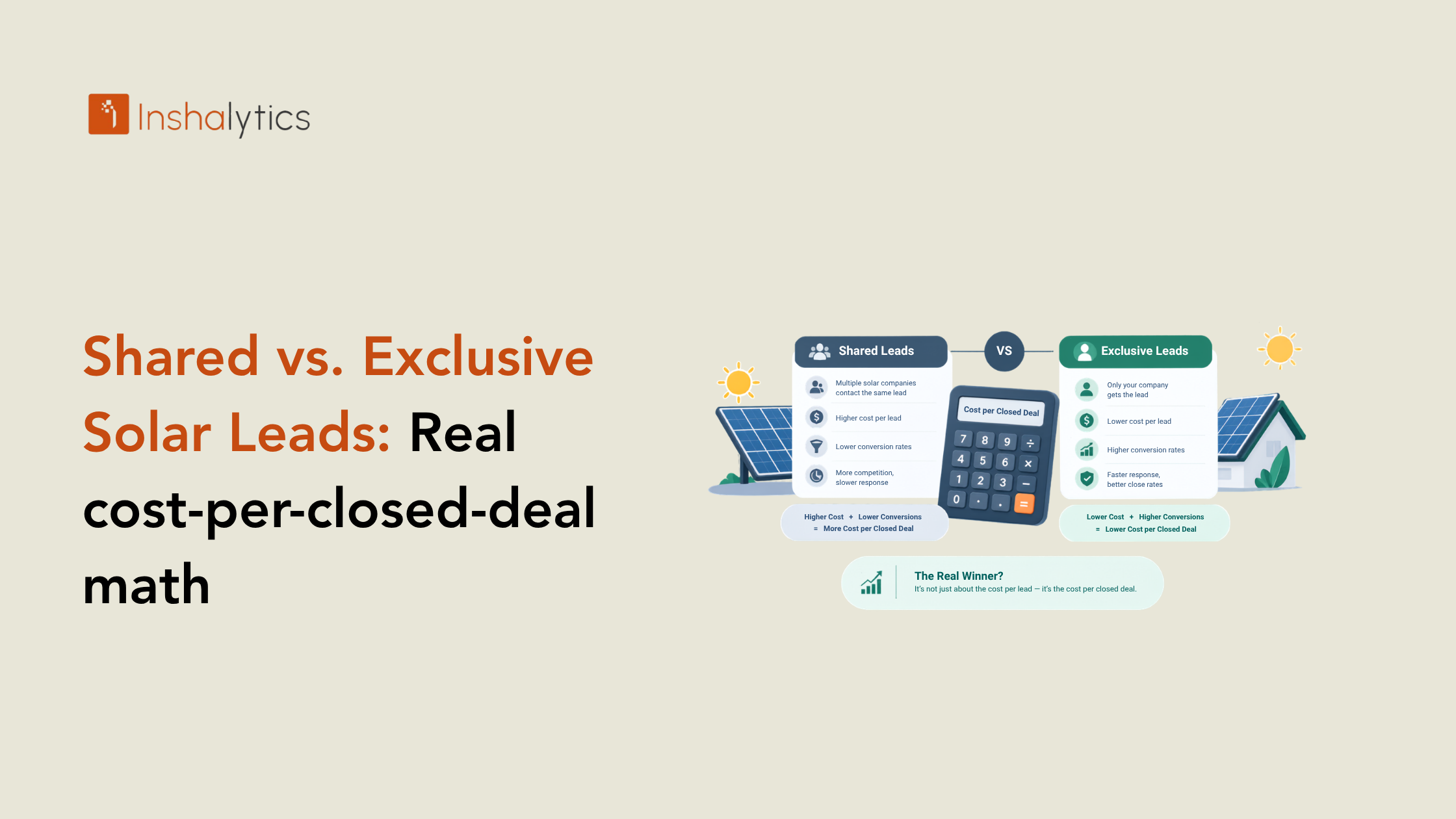
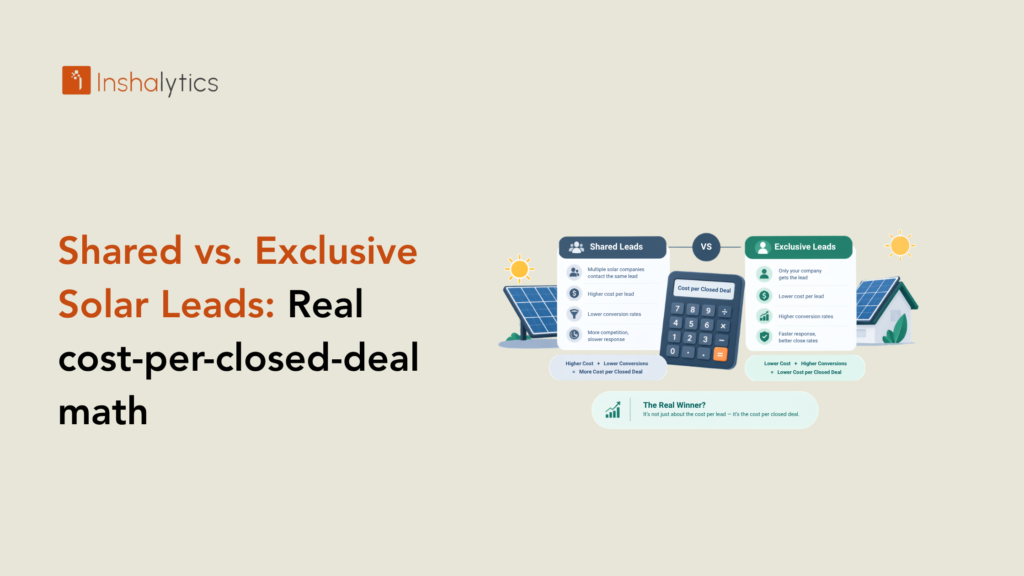
Shared marketplace leads typically run in the $25 to $100 range per lead, a low enough number that they look attractive in isolation. But that same lead is often sold to four or five competing installers simultaneously, all racing to reach the same homeowner first, which turns your speed-to-lead process into the actual deciding factor rather than the lead itself.
Why Competing Against 4 Other Installers Crushes Close Rate
With multiple installers chasing the identical lead, close rates on shared leads frequently land in the low single digits, sometimes lower depending on how many companies are working the same list simultaneously. Run the simple math: 100 shared leads at $30 each is $3,000 spent; at a 2% close rate, that’s two deals, a real cost per acquisition of $1,500, even though the sticker price per lead looked cheap on the invoice.
Exclusive Leads: The Real Math
Exclusive leads cost more upfront, which makes them look like the more expensive option, until you run the same acquisition math and see where the numbers actually land.
Higher Sticker Price, Fewer Leads Needed to Close a Deal
Exclusive leads typically run $100 to $250 or more, sold to a single installer only. Because there’s no competing installer racing to the same homeowner, close rates run meaningfully higher, often in the 10 to 15% range instead of low single digits, which changes the entire economics of the purchase even before you factor in the reduced pressure on your sales team.
When Exclusivity Claims Aren’t Actually Honored by Vendors
Not every lead marketed as “exclusive” actually is. Some vendors resell leads after a delay, or route the same homeowner through multiple branded forms that funnel back to the same shared pool. Before paying an exclusive premium, ask a vendor directly how many companies receive each lead, and how exclusivity is verified and documented, and be wary of any vendor who hesitates to answer clearly. A confident, specific answer with real numbers is a good sign; a vague reassurance that “our leads are always exclusive” without supporting detail usually isn’t.
Running the Comparison on a $25,000+ Deal Size
At solar’s typical deal size, the gap between these two channels isn’t a rounding error. It’s often tens of thousands of dollars in wasted spend over a year, money that could otherwise fund a meaningfully larger lead volume or a shift toward owned channels.
Worked Example: 100 Shared Leads vs. 50 Exclusive Leads
100 shared leads at $30 each costs $3,000 and, at a 2% close rate, produces two deals, a $1,500 cost per acquisition. 50 exclusive leads at $80 each costs $4,000 and, at a 12% close rate, produces six deals, a $667 cost per acquisition. The exclusive spend is higher on paper and dramatically cheaper per closed deal in practice, which is exactly the kind of gap that stays invisible until someone actually does the math.
Where the Break-Even Point Actually Sits
The break-even point depends heavily on your specific close rates by source, which is exactly why tracking cost-per-acquisition by lead type, not just cost-per-lead, is the single most important reporting change most solar companies could make this quarter, and it’s a change that costs nothing but attention to implement.
Is There a Better Option Than Buying Either?
Bought leads, shared or exclusive, solve a short-term volume problem. They’re not the cheapest option available long-term, and the businesses that recognize this earliest tend to build a real competitive advantage over time.
Owned Channels: What SEO and GBP Cost Per Closed Deal Over Time
A complete, review-rich Google Business Profile combined with local SEO content is free at the point of the click. The investment is in building and maintaining it. Over time, owned-channel cost per closed deal typically falls well below even well-performing exclusive leads, because the cost doesn’t scale with volume the way per-lead pricing does. Local SEO for solar installers covers how to build that channel specifically, and how long it realistically takes before it starts producing meaningful volume.
Blending Bought and Owned Leads Without Overspending
Most successful solar companies don’t choose one channel exclusively. They use bought leads to fill volume gaps while owned channels mature, then shift budget away from bought leads as organic and referral volume grows, treating the transition as a gradual, deliberate process rather than an abrupt switch.
How Inshalytics Helps Solar Installers Get This Math Right
Getting cost-per-acquisition tracking right requires connecting your lead sources, your CRM, and your closed-deal data, work most solar companies don’t have the internal bandwidth to set up themselves while also running installations.
Building the Tracking to See True Cost-Per-Closed-Deal by Source
We build the attribution setup that connects every lead source to its actual close rate and deal value, so budget decisions are based on what’s really working instead of the sticker price on a lead vendor’s pricing page.
Shifting Budget From Bought Leads to Owned Channels Over Time
Once that tracking exists, the path forward becomes clear, and it usually means gradually shifting spend away from the highest-CPA bought sources and toward owned channels as they mature, exactly the kind of transition we plan and manage for solar clients on an ongoing basis.
A Framework for Deciding What to Buy Next Quarter
You don’t need perfect data to start making better decisions. You need to ask the right questions before your next purchase, and hold every vendor to the same standard regardless of how confident their sales pitch sounds.
Questions to Ask Any Lead Vendor Before You Buy
How many companies receive each lead? What’s the average age of the data at delivery? Can they provide sample close-rate benchmarks from similar installers? A vendor unwilling to answer clearly is telling you something important on its own, even if they never say it directly.
Setting Your Own Acceptable CPA Threshold
Before your next lead purchase, decide what cost-per-closed-deal you’re actually willing to accept, based on your average system size and margin, and hold every source, shared or exclusive, to that same standard regardless of the sticker price attached to it.
If you’re not currently tracking cost-per-acquisition by lead source, that’s the highest-leverage fix available to your marketing budget right now, and one you can start implementing this week. Let’s build the tracking that shows you where your money is actually working.