It’s 2 AM on a July night. A homeowner’s AC just died, their bedroom is 87 degrees, and they can’t sleep. They grab their phone and type “emergency AC repair near me.” Whoever appears first with a clickable phone number and an open business gets the call. The jobs worth $300 to $800 aren’t won by the best contractor. They’re won by the most visible one. See also common reasons HVAC Google Ads aren’t converting.
Google Ads is the fastest way to put your HVAC business in front of those emergency searches. Unlike SEO, which takes months to produce rankings, a properly built Google Ads campaign can generate service calls within 24 hours of launch. But most HVAC companies running Google Ads waste 30–50% of their budget on clicks that never convert because they don’t understand emergency intent or the campaign structure that captures it.
This playbook walks through exactly how to build Google Ads campaigns that turn panic searches into booked jobs.
Why Google Ads Is Built for Emergency HVAC Demand
Emergency HVAC demand and Google Ads are a near-perfect match. Homeowners with broken systems don’t comparison shop. They call the first credible option they see, which means the top-ranked ads capture outsized shares of conversion.
The “AC-Down-at-2 AM” Moment and What It’s Worth
When a homeowner’s system fails at 2 AM on the hottest day of the year, they’re not looking for the lowest price. They’re looking for the fastest response. Emergency service calls often convert above 30% from click to phone call, compared to 3–5% for non-emergency HVAC searches. The lifetime value of an emergency customer extends well beyond the single repair they call you for, maintenance next year, recommending you to neighbors, and eventually replacing their system with your company.
Why Urgent Searchers Don’t Comparison Shop
Normal purchase decisions involve comparison, reviews, and deliberation. Emergency purchases skip all of that. A homeowner sweating through a broken AC at midnight isn’t reading your “About” page. They’re looking at three things: Are you available now? Do you look credible? Can I click to call immediately?
Your ad copy, landing page, and phone prominence all need to serve this 15-second decision window.
Search Intent Hierarchy: Emergency vs. Planned vs. Research
HVAC searches fall into three intent tiers, each with different conversion economics:
- Emergency: “AC stopped working,” “no heat emergency,” “furnace won’t turn on,” highest conversion rates, highest cost-per-click, highest immediate revenue
- Planned: “AC installation ,” “furnace replacement cost,” “HVAC contractor near me”, moderate conversion rates, steady lead flow, larger ticket values
- Research: “AC not cooling enough,” “heat pump vs furnace,” “how often to service HVAC,” low conversion rates, higher long-term value through remarketing
Your campaign structure should treat these as separate campaigns with separate budgets and messaging.
Google Ads vs. Local Services Ads: Which One Should HVAC Companies Run?
Most HVAC companies should run both Google Search Ads and Local Services Ads simultaneously. Local Services Ads capture the highest-intent emergency searches on a pay-per-lead basis, while Google Search Ads provide scalable lead volume through keyword-based targeting. Running both maximizes visibility and lets each channel do what it does best.
Pay-per-Click vs. Pay-per-Lead Economics
Google Search Ads charge per click, typically $8–$50 in HVAC, depending on market and keyword. You pay whether or not the click becomes a lead. Local Services Ads charge per lead, typically $45–$85, with qualified lead disputes available through Google’s review process. For high-intent emergency searches, LSAs often produce a lower cost-per-booked-job than Search Ads. For crowded markets, see how much HVAC competition is too much to advertise in.
The “Google Guaranteed” Badge and Why It Matters for Panic Buyers
Local Services Ads display a green “Google Guaranteed” badge above your business name. This badge signals that Google has verified your license, insurance, and background check. For a homeowner making a panic decision, that badge reduces hesitation dramatically. The trust signal alone can lift conversion rates significantly over standard search ads.
When to Run Both (and How to Split the Budget)
Most HVAC companies should start with Local Services Ads (low barrier, pay-per-lead economics), then layer in Google Search Ads once LSA volume plateaus. A typical budget split for an established HVAC company might allocate 30% to LSAs and 70% to Google Search Ads, adjusted based on which produces a lower cost-per-booked-job in your market.
How Do You Set Up Google Ads for HVAC Emergency Calls?
To set up Google Ads for HVAC emergency calls, create separate campaigns for each service category (AC repair, furnace repair, emergency service), use call-only ad formats to drive direct phone calls, target high-intent emergency keywords, and apply tight geographic targeting around your actual service area. Conversion tracking for phone calls is essential before launch.
Campaign Structure: One Service, One Campaign
Don’t lump all HVAC services into one campaign. Create separate campaigns for:
- Emergency AC repair
- AC installation
- Emergency furnace repair
- Furnace installation
- HVAC maintenance
- Ductwork services
Separate campaigns let you control budgets, keywords, and ad copy independently. Google rewards relevance with lower costs-per-click, and tight service-specific campaigns maximize relevance.
Call-Only Ads That Skip the Website Entirely
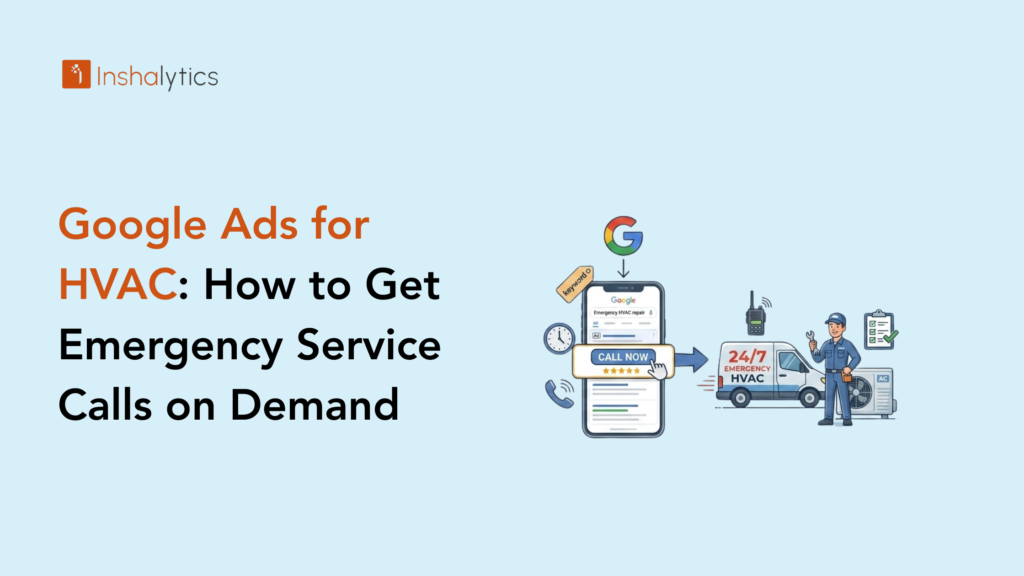
Call-only ads appear only on mobile devices and drive a direct phone call when clicked, with no website visit in between. For emergency campaigns, this format removes friction. Someone searching “AC repair now” at midnight doesn’t want to navigate a website. They want to press a button and talk to a technician.
Pair call-only ads with 24/7 availability messaging and verified click-to-call tracking.
Ad Extensions Homeowners Actually Tap
Ad extensions expand your ad’s real estate at no extra cost. The extensions that move the needle for HVAC include:
- Call extensions (phone number displayed and tappable)
- Location extensions (your business address and map pin)
- Sitelink extensions (direct links to service pages)
- Callout extensions (“24/7 Emergency,” “Licensed & Insured,” “Same-Day Service”)
- Structured snippets (service types, brands serviced)
Fully extended ads take up more of the search results page, pushing competitors below the fold.
Keyword Strategy for HVAC Emergency Campaigns
Keyword selection determines whether your Google Ads budget produces jobs or burns money. Emergency campaigns need a tight, high-intent keyword list with aggressive negative keyword filtering.
The Emergency-Intent Keywords That Convert Fastest
High-converting emergency keywords include:
- “Emergency AC repair”
- “AC repair near me”
- “24-hour AC repair”
- “AC not cooling.”
- “AC stopped working.”
- “No heat emergency”
- “Emergency furnace repair”
- “Furnace not working.”
- “Same day HVAC service”
Geographic modifiers (“[service] + “) add local relevance and typically convert higher than pure service keywords.
Negative Keywords That Stop You From Bleeding Budget
Negative keywords prevent your ads from showing on irrelevant searches. The must-add negatives for HVAC include:
- “Jobs,” “career,” “hiring,” “salary”
- “DIY,” “how to,” “tutorial.”
- “Parts,” “manual,” “schematic”
- “Training,” “certification,” “school”
- “Free,” “cheap,” “discount” (unless intentional)
- Competitor brand names you don’t want to bid on
Review your Search Terms report weekly and add new negatives as you spot wasted clicks.
Geographic Targeting Down to the ZIP Code
Target by ZIP code or radius around your service base. Targeting entire metro areas wastes budget on clicks from areas you don’t serve or don’t want to drive to. Tight geographic targeting typically lowers cost-per-lead by 20–40% compared to broad city targeting.
Writing HVAC Ad Copy That Converts Panic Into Phone Calls
HVAC ad copy isn’t about clever wordplay. It’s about matching the searcher’s urgency and giving them three things: availability, credibility, and a clear next step.
Headlines That Match Emergency Search Intent
Your first headline should match the keyword as closely as possible. If someone searches “emergency AC repair Phoenix,” your headline reads “Emergency AC Repair in Phoenix.” Headlines that mirror search intent win clicks over generic “Quality HVAC Service” copy every time.
Urgency Triggers: “Same-Day,” “24/7,” “Tech On Route”
Time-based copy converts emergency searchers faster than feature-based copy. Winning phrases include:
- “Same-day service available”
- “24/7 emergency response”
- “Tech dispatched in under an hour.”
- “No after-hours surcharge”
- “Licensed techs standing by”
These create a mental picture of speed and availability.
Trust Signals That Reduce Hesitation Before the Click
Even in a panic, homeowners hesitate to invite strangers into their homes. Trust signals in ad copy “Licensed & Insured,” “Google Guaranteed,” “4.9 stars across 847 reviews,” “BBB Accredited,” “Family-owned for 25 years,” reduce that hesitation enough to drive the click.
The Landing Page Mistakes Killing Your HVAC Google Ads ROI
The best Google Ads campaign in the world fails if clicks land on a bad page. Landing page design and conversion is where most HVAC Google Ads budgets leak silently.
Why Sending Emergency Clicks to Your Homepage Tanks Conversion
Your homepage tries to serve too many audiences: new customers, existing customers, job seekers, and commercial prospects. Emergency clicks need a dedicated landing page focused on one action: calling for emergency service. Sending emergency ad clicks to a homepage typically cuts conversion rates in half.
The Above-the-Fold Elements Every HVAC Landing Page Needs
Above the fold, the section visible before scrolling must include:
- Your phone number is the primary element
- A clear headline matching the ad’s promise (“Emergency AC Repair in [City]”)
- Availability messaging (“Open Now,” “Tech On Route in 60 Minutes”)
- One trust badge (Google Guaranteed, BBB, review stars)
- A simple form as a secondary CTA
Anything else pushes the phone number below the fold on mobile and loses conversions.
Mobile Speed and Click-to-Call Optimization
60–75% of HVAC emergency clicks come from mobile devices. If your page takes longer than three seconds to load, you lose more than half of those visitors before they see your phone number. Test your landing page speed at Google PageSpeed Insights and optimize images, hosting, and code until load times drop below two seconds.
How to Track HVAC Google Ads Performance Beyond Clicks
Clicks don’t pay the bills. Booked jobs do. Proper tracking connects every dollar of ad spend to a service call, a quoted estimate, or a completed job.
Conversion Tracking for Phone Calls (Not Form Fills)
Most HVAC leads come through phone calls, not form submissions. Call tracking assigns unique phone numbers to specific campaigns, ads, or keywords so you know exactly which ad produced which call. Without call tracking, you’re optimizing campaigns based on incomplete data.
Cost-per-Booked-Job vs. Cost-per-Lead
Cost-per-lead is a starting metric. Cost-per-booked-job is the real number. If emergency AC repair leads cost $80 and close at 40%, your cost-per-booked-job is $200. If maintenance leads cost $40 but close at 10%, your cost-per-booked-job is $400. Budget allocation should follow cost-per-booked-job, not cost-per-lead.
Weather-Triggered Budget Adjustments
Automated bidding rules can increase budgets during heat waves, cold snaps, or storms when emergency searches spike. Companies running static year-round budgets miss the most profitable windows. Tools like Google Ads’ automated rules and PPC management services include weather-based budget triggers.
How Inshalytics Builds HVAC Google Ads Campaigns That Fill Dispatch Boards
Most HVAC Google Ads accounts look like this: one campaign, 20 mixed keywords, homepage landing page, no call tracking. We rebuild them into systems that measure every dollar against booked revenue.
Our Emergency-Intent Campaign Framework
Every Inshalytics HVAC Google Ads engagement starts with campaign restructuring, separating emergency, planned, and research campaigns, building dedicated landing pages for each, and installing call tracking before a single ad goes live. Foundation first, then optimization.
Why We Run Google Ads and SEO Together (Not Separately)
Paid ads produce calls while SEO ramps up. SEO builds owned lead flow that eventually reduces dependence on paid ads. Running them together is the most efficient path to sustainable lead generation; you’re never stuck waiting months for SEO while also never being held hostage to rising ad costs.
Transparent Reporting: Every Click Traced to Revenue
Our reporting shows every lead, every call, every booked job, and every dollar of revenue tied to specific campaigns and keywords. No vanity metrics, no percentage-of-ad-spend fee structures, no black boxes.
Google Ads for Heating and Cooling Repair Companies
Repair searches are some of the highest-intent clicks in local advertising, because the person searching has a system that is not working. For heating and cooling repair companies, the basics are the same each season: campaigns built around repair and emergency terms, ads that mention same-day or 24/7 availability only if you can deliver it, call extensions and a landing page that loads fast on a phone. Keep heating and cooling repair in separate ad groups so the ad and landing page match the problem the person searched for.
Launch Your First HVAC Emergency Campaign: A 7-Day Action Plan
If you’re starting from zero, you can have an emergency campaign live and generating calls within a week.
Days 1–3: Setup and Keyword Research
Open a Google Ads account. Set up conversion tracking (calls and form fills). Build your keyword list from the categories above. Draft negative keyword lists. Configure geographic targeting by ZIP code.
Days 4–5: Ad Copy, Extensions, and Landing Pages
Write at least three ad variants per campaign. Configure all relevant ad extensions. Build a dedicated emergency landing page with phone prominence, trust signals, and sub-two-second load speed.
Days 6–7: Launch, Monitor, and Optimize
Launch with conservative budgets. Monitor search terms daily for the first week and add negative keywords aggressively. Adjust bids based on which keywords produce calls. By day seven, you should have enough data to begin scaling what works. Emergency HVAC searches are the most valuable real estate in home services advertising, and they reward contractors who build campaigns around the actual psychology of emergency intent. Get the structure right, and Google Ads becomes a predictable dispatch-board-filler. Get it wrong, and you’re just funding Google’s quarterly earnings. If you want help building a campaign that actually converts panic searches into booked jobs, Inshalytics runs HVAC Google Ads campaigns that measure success in revenue, not clicks. Book a free Google Ads audit and find out exactly where your current campaigns are leaking budget.