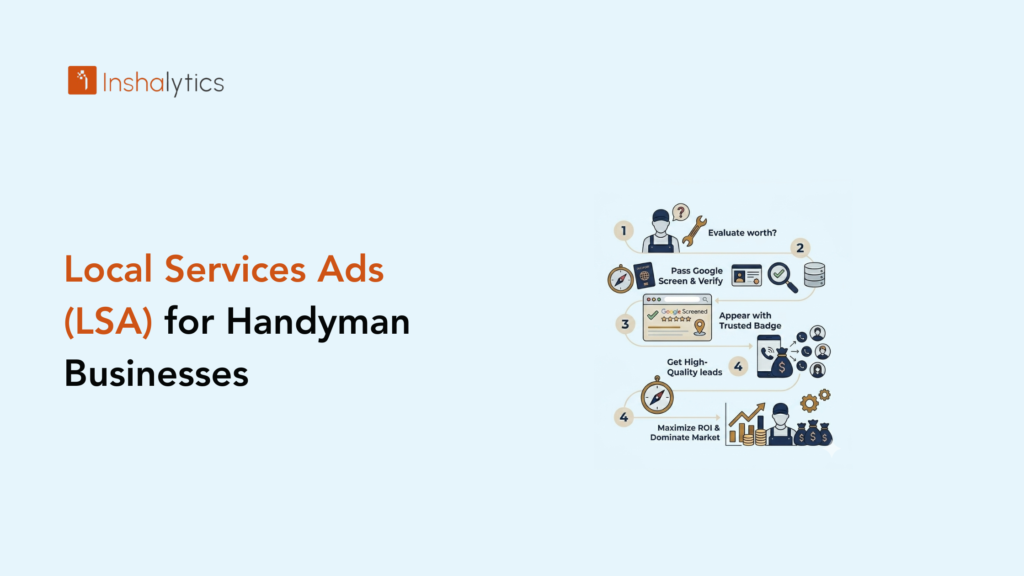
Google places Local Services Ads above everything else on the search results page: above standard Google Ads, above the map pack, above every organic listing. For a homeowner searching “handyman near me,” LSA results are the first names they see. That position matters. But position alone doesn’t tell you whether LSA is worth the money for your handyman business. The real answer depends on your market, your margins, your operation’s ability to answer calls, and whether you understand the 2025 rule changes that have shifted what LSA actually costs. This guide gives you an honest, numbers-forward look at LSA for handyman businesses: what it is, what it costs, when it works, and when it doesn’t.
What Are Local Services Ads and How Do They Work for Handymen?
Local Services Ads are a pay-per-lead advertising product built specifically for local service businesses. Understanding the mechanics is essential before deciding whether to run them.
Where LSA Ads Appear (Above Google Ads and the Map Pack)
LSA listings appear at the very top of Google search results for relevant local queries above traditional pay-per-click Google Ads and above the Local 3-Pack map results. On mobile, which is where the majority of handyman searches happen, LSA listings often dominate the entire visible screen before the user scrolls. Each listing displays your business name, star rating, number of reviews, phone number, and years in business. It is the highest-visibility real estate Google offers to local service businesses. Understanding how homeowners search for handymen online helps contextualize where LSA sits in the full search journey.
Pay-Per-Lead vs. Pay-Per-Click: The Key Difference
Standard Google Ads charge you every time someone clicks your ad, whether they call, leave immediately, or book a job. LSA is different: you only pay when a potential customer contacts you directly through the ad via phone call or message. If someone sees your LSA listing and doesn’t call, you pay nothing. This model removes a significant layer of wasted spend. However, it introduces a different challenge: you pay for contacts, not conversions. A call that lasts 30 seconds with someone who wanted a service you don’t offer still costs you a lead fee. Managing invalid leads through Google’s dispute process is now a required skill for any business running LSA at scale.
The Google Screened Badge: What It Means in 2026
The “Google Screened” badge that appears on LSA listings signals to homeowners that Google has verified your business including a background check on the business owner, license verification (where applicable by state), and insurance confirmation. This badge removes a meaningful trust barrier for homeowners who are cautious about letting someone into their home. As of 2025, Google discontinued the money-back guarantee that previously accompanied the badge, which means the badge now conveys legitimacy and verification but no longer carries a financial safety net for homeowners. The practical effect: reviews and responsiveness have become even more important differentiators, since the badge alone carries less weight than it once did.
The Real Cost of LSA for a Handyman Business
The pay-per-lead model sounds straightforward, but the actual cost of LSA is more nuanced than the lead price Google shows you.
How to Calculate Your Break-Even Cost Per Lead
Start with this calculation before you spend a dollar on LSA: (Average job value) × (Close rate) = Revenue per lead. If your average handyman job is worth $400 and you close 40% of the leads you get, each lead is worth $160 in revenue to you. If LSA leads cost $50 each, your return is strong. If LSA leads cost $120 each in a competitive market, your margin compresses significantly. This math changes by trade type, market size, and job mix. A handyman business with a high average ticket (bathroom renovations, deck repairs) can sustain higher lead costs. A business doing small repairs at $150 average ticket cannot. Run the math before you commit a budget.
What Handyman Calls Actually Cost and What Close Rate to Expect
LSA lead costs for handyman businesses vary widely by market. In lower-competition markets, handyman leads can run $20–$45 per lead. In competitive metro areas Chicago, Los Angeles, Dallas, New York costs can reach $60–$100 per lead or more. Close rates for handyman LSA leads average 30–50% for businesses with strong review profiles and fast response times. Response speed is a major close rate driver: leads contacted within 5 minutes of calling close at dramatically higher rates than leads called back 2 hours later. If your operation can’t answer calls during business hours or return missed calls within minutes, LSA will underperform for you regardless of lead price.
The 2025 Credit Policy Change Every Handyman Needs to Know About
In 2025, Google made a significant change to the LSA credit policy: it discontinued automatic credits for “job type not serviced” and “geo not serviced” leads. Previously, if you received a lead for a service you don’t offer or a location outside your service area, you could claim an automatic credit. That safety net is gone. Now, if your service category or service area settings are not configured precisely, you pay for leads you can’t convert. This change makes initial LSA setup significantly more consequential than it used to be. Precise category selection and tight service area definition are no longer optional; they are the primary defense against paying for leads that will never result in jobs. Pair your LSA setup with a fully optimized Google Business Profile, which feeds directly into your LSA profile configuration.
Is LSA Worth It for Handyman Businesses?
This is the question most handyman owners are actually asking. The honest answer is conditional, and understanding the conditions is more valuable than a blanket yes or no.
When LSA Makes Strong Business Sense
LSA works well for handyman businesses in specific situations:
• You’re in a market with real search demand. LSA cannot generate demand that doesn’t exist. If homeowners in your market search for handyman services frequently, LSA captures that demand directly.
• Your average job value is high enough; businesses doing bathroom renovations, deck repairs, and multi-trade jobs absorb lead costs more easily than those doing small repairs at a $100–$200 average ticket.
• You answer calls consistently: LSA rewards responsiveness in its ranking algorithm. Businesses with high response rates get more lead volume. If you or someone on your team answers the phone during business hours, LSA will perform better.
• You have a strong review base: LSA ranks heavily in favor of businesses with more reviews and higher ratings. If your GBP has 50+ reviews above 4.5 stars, you’ll outrank competitors with fewer reviews even at similar budgets.
• You’re in a growth phase: LSA delivers leads immediately, unlike SEO, which takes months to mature. Using LSA to fill your calendar while your organic lead system develops is a legitimate bridge strategy.
When LSA Will Drain Your Budget Without ROI
LSA is a poor fit when: Your market is saturated with well-established competitors who have hundreds of reviews. Your operation can’t answer calls reliably. Your average job value is too low to absorb competitive lead costs. Your service area overlaps heavily with other handyman businesses using LSA, driving up lead prices. If your GBP has fewer than 20 reviews or a rating below 4.3, you’ll lose almost every impression to higher-rated competitors. In these situations, the budget spent on LSA would generate stronger long-term returns if invested in local SEO for handyman services instead.
Markets Where LSA Performs vs. Markets Where It Doesn’t
LSA performs best in mid-sized cities and suburban markets where handyman search volume is meaningful, but LSA competition hasn’t yet driven costs to levels that compress margins. Markets like secondary cities Columbus, Nashville, Charlotte, Salt Lake City often have strong demand with manageable lead costs. Major metro markets Los Angeles, New York, and Chicago can be profitable for businesses with 100+ reviews and strong operations, but the lead costs require careful tracking against job revenue. Rural markets often have insufficient search volume to make LSA viable at all.
How Does LSA Compare to Other Lead Sources for Handymen?
LSA doesn’t exist in isolation. Every dollar spent on LSA is a dollar not spent on another channel. Knowing how it compares helps you allocate your marketing budget intelligently.
LSA vs. Angi and Thumbtack Platform Leads Side by Side
Angi and Thumbtack also charge per lead, but with important differences. Platform leads are shared; the same lead is often sold to multiple businesses simultaneously, creating a race to respond and driving price competition. LSA leads are exclusive: when a homeowner calls through your LSA ad, that contact comes to you alone. LSA leads also carry higher intent because the homeowner initiated the search themselves rather than being matched by an algorithm. For a full breakdown of why platform dependency hurts your margins, see why lead marketplaces hurt handyman profit margins.
LSA vs. Organic SEO Speed vs. Long-Term Cost
LSA delivers leads from day one of going live. Local SEO for handyman businesses takes 3–12 months to generate meaningful organic call volume. But the economics flip over time: a business ranking organically in the Local 3-Pack pays nothing per lead. A business running LSA indefinitely pays for every contact forever. The smart approach for most handyman businesses is to run LSA while SEO matures, then reduce LSA spend as organic volume builds. This preserves cash flow in the early months without creating permanent platform dependency.
LSA vs. Google Ads Targeting, Cost, and Control
Traditional Google Ads give you more control over targeting (specific keywords, devices, time of day, audience segments) but charge per click regardless of outcome. LSA gives you less granular control but charges only for contacts. For handyman businesses, LSA typically delivers a lower cost per booked job than Google Ads when set up correctly because paying for a phone call from an interested homeowner converts better than paying for a click that may or may not result in a call. Google Ads works better for handyman businesses targeting specific high-value services with clear purchase intent keywords. For a broader comparison of paid channels, see our analysis of Google Ads for handyman services.
Setting Up LSA for a Handyman Business the Right Way
How you set up your LSA profile determines how much of your budget is wasted. These are the decisions that matter most.
Background Check and Licensing Requirements Before You Go Live
LSA requires identity verification for the business owner, a background check through Google’s partner verification service, and proof of insurance (general liability at minimum). State licensing requirements for handymen vary significantly some states require licenses only for specific trade work above certain dollar thresholds. Google’s verification process checks against your state’s licensing database. Make sure your license status and insurance are current before applying incomplete verification delays your approval by weeks. Estimated approval timeline after submitting all documentation: 2–4 weeks.
How to Configure Service Categories to Avoid Paying for Bad Leads
Select only the specific services you actually perform. If you don’t do plumbing, don’t include plumbing Google’s matching algorithm may send you plumbing leads and you’ll pay for them even though the 2025 policy change eliminated automatic credits. Be specific within categories: “Drywall Repair” is better than a broad “General Handyman” catch-all if drywall is a primary service. Tight category selection improves lead quality more than any other LSA setting. Review your category list every 90 days and remove categories where you’re receiving leads you can’t serve.
Review Count and Response Rate What Google’s Algorithm Weighs
LSA ranking is not purely budget-driven. Google’s LSA algorithm considers: review count and rating (more reviews and higher ratings outcompete lower budgets), response rate (businesses that respond to most contacts rank higher than those who miss calls), proximity to the searcher, and budget availability at the time of the search. A handyman business with 80 reviews and a 4.8 rating running a $30/day budget will often outperform a competitor with 10 reviews running $100/day. Investing in your review base before launching LSA directly improves your LSA performance.
Should Your Handyman Business Use LSA as a Long-Term Strategy?
The decision to run LSA is not just about whether it works today it’s about what role it plays in your broader lead generation strategy.
The Owned Lead Argument: Why LSA Alone Is a Rented Pipeline
LSA is Google’s product. Google controls the pricing, the matching algorithm, the verification requirements, and the dispute process. That control has been exercised in ways that cost handyman businesses money the 2025 credit policy change being the most recent example. A business whose entire lead pipeline runs through LSA is entirely dependent on Google’s decisions. When Google changes pricing, your cost per job changes. When Google changes the matching algorithm, your lead volume changes. The businesses that run LSA alongside an owned lead system GBP, organic SEO, a converting website use LSA to supplement a foundation they control, rather than substituting for one. See how this plays out across channel types in our overview of how homeowners search for handymen online.
How to Use LSA as a Bridge While Your Organic Lead System Matures
The most effective LSA strategy for a growing handyman business is time-bounded: use LSA at a moderate budget ($15–$25/day in lower-competition markets, $30–$60/day in mid-tier markets) to maintain call volume while investing in Google Business Profile optimization and local SEO in parallel. As your organic rankings improve and your GBP starts generating map pack calls, reduce LSA spend proportionally. The goal is to reach a point where your owned channels deliver a consistent baseline of calls without any per-lead cost, and LSA becomes a seasonal boost tool rather than a permanent line item.
Need help building the lead system behind the LSA? Inshalytics builds the organic lead infrastructure that lets handyman businesses reduce paid dependency over time. Talk to us about what that looks like for your market.