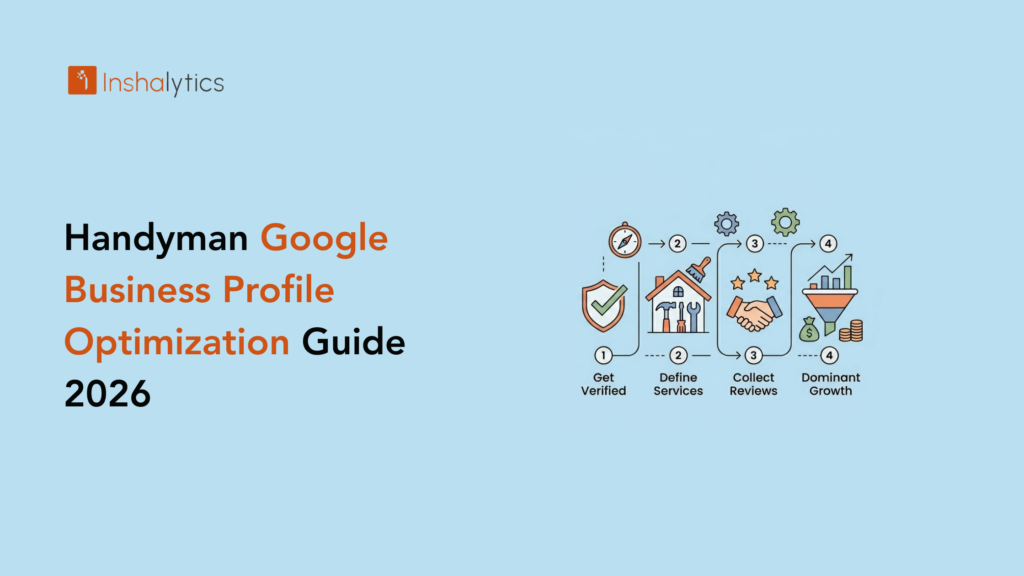
Two handyman businesses in the same city. Same services. Similar pricing. One gets 30 calls a month from Google. The other gets three. The difference, almost always, is the Google Business Profile. Your GBP is not a directory listing you set up once and forget it is a dynamic lead asset that Google actively ranks, rewards, and penalizes based on how well it’s maintained. This guide walks through every element of GBP optimization that matters for handyman businesses in 2026, from the foundational setup that most businesses skip to the ongoing signals that separate the top of the Local 3-Pack from the bottom.
Why Your Google Business Profile Is Your Most Valuable Lead Asset
Before optimizing anything, it helps to understand what your GBP actually does and why Google cares about it.
How the Local 3-Pack Decides Who Gets the Call
The Local 3-Pack the map with three business listings that appears at the top of Google search results for local queries captures the majority of clicks for searches like “handyman near me.” The businesses in those three slots are determined by Google’s local algorithm, which weighs three core signals: relevance (how well your profile matches what the homeowner searched), distance (how close your business is to the searcher), and prominence (how well-established and trusted your business appears online). You can’t move your address to be closer to searchers, but you can dramatically improve relevance and prominence and that’s what this guide covers.
What an Optimized GBP Actually Looks Like vs. a Neglected One
A neglected GBP typically has a basic business name, a phone number, and whatever Google auto-populated when the listing was first created. No services listed. Two photos. No posts. No review responses. A handful of reviews with no replies. An optimized GBP has a complete service list with individual service descriptions, 30+ current photos, weekly posts, keyword-rich review responses, and updated hours including holidays. Google surfaces the optimized profile because it has more signals to match against more searches.
The Three Ranking Signals Google Uses Relevance, Distance, Prominence
Understanding these three signals tells you exactly where to spend your optimization effort. Relevance is improved by completing every field in your GBP especially service descriptions and your business description with the keywords homeowners actually search. Distance is partially fixed by your address, but you can expand your reach by correctly configuring your service area. Prominence grows through reviews, citations (your business listed consistently across the web), and the overall authority of your website. All three compound over time which is why businesses that start early maintain an advantage that’s difficult for competitors to close.
Setting Up Your GBP Correctly as a Handyman (Service-Area Business Rules)
Handyman businesses have a specific setup challenge that most generic GBP guides miss: you don’t have a storefront. You go to the customer. That changes several critical configuration decisions.
How to Configure Your Service Area Without a Storefront Address
As a service-area business (SAB), you should hide your physical address and define your service area by cities, zip codes, or radius. This is a critical step many handymen skip either leaving their home address visible (a privacy risk) or failing to define their service area at all (which limits their geographic reach). Go to your GBP dashboard, navigate to Business Information → Location, and toggle off the storefront display. Then add every city, neighborhood, or zip code you actively serve. Don’t pad this list only include areas you genuinely cover. Google can detect over-claiming and will suppress your listing in markets where your engagement data doesn’t support the listed area.
Choosing the Right Primary and Secondary Categories
Your primary category is the single most important category signal Google uses to match your profile to searches. For most handyman businesses, “Handyman” is the correct primary category. Don’t be tempted to use a more specific category like “Carpenter” or “Painter” as your primary it will narrow your match footprint dramatically. Use secondary categories to capture related searches: “Home Repair Service,” “General Contractor,” “Drywall Contractor,” “Painter,” and others that reflect your actual service mix. Limit secondary categories to services you genuinely offer category spam is a suspension risk.
NAP Consistency Why Your Name, Address, and Phone Must Match Everywhere
NAP consistency Name, Address, Phone number is a foundational local SEO signal. Google cross-references your GBP information against other mentions of your business across the web: Yelp, Angi, BBB, local directories, your own website. When the information matches exactly, it reinforces your location authority. When it doesn’t match because you changed your phone number but didn’t update every listing, or because your business name is formatted differently in different places it creates conflicting signals that suppress your ranking. Audit every citation source you know about and bring them into alignment with exactly how your GBP reads. See the broader context of NAP consistency and local SEO for a full citation audit framework.
What Should a Handyman Put on Their Google Business Profile?
Every field in your GBP is an opportunity to tell Google and homeowners more about your business. Leaving fields empty is leaving visibility on the table.
Writing a Business Description That Ranks and Converts
Your business description (up to 750 characters) is one of the few places where you can use natural language to signal your services and location to Google. It is not indexed as heavily as your website, but it does influence relevance matching. Write it for the homeowner first, with your primary service keywords woven in naturally: what you do, where you serve, how long you’ve been doing it, and what makes you reliable. Avoid keyword stuffing Google’s quality filters catch it. A good description sounds like something a confident professional would actually say about their business, not a list of search terms stapled together.
Services Section How to List Every Job Type Google Can Match to Searches
The Services section is one of the most underused parts of GBP for handyman businesses. Google allows you to list individual services with names, descriptions, and prices (optional). Each service you add is a potential match point for a specific search. Instead of just listing “Handyman Services,” break it down: “Drywall Repair,” “Door Installation,” “TV Mounting,” “Furniture Assembly,” “Ceiling Fan Installation,” “Gutter Cleaning.” Add a brief description to each service (1–2 sentences explaining what’s included). This level of specificity is what gets your profile matching niche searches that a generic profile will never capture.
Photos That Work: What Google’s AI Reads and What Homeowners Trust
In 2026, Google’s Vision AI actively reads your photos to understand what your business does. A profile with photos of completed jobs before-and-after pairs, tools in use, finished work in real homes signals to Google’s algorithm what services you provide. Generic stock photos of a handyman silhouette do nothing for your ranking and actively undermine homeowner trust. Aim for a minimum of 20–30 high-quality photos, updated regularly. Add your logo and a cover image that clearly represents your work. Geotagging your photos with location metadata provides an additional proximity signal that strengthens your “Distance” ranking factor.
Reviews, Posts, and Signals That Keep You Ranking
GBP optimization is not a one-time project. The businesses that stay at the top of the Local 3-Pack maintain a consistent cadence of activity that tells Google their business is active and trusted.
Review Velocity Why Consistent Reviews Beat a One-Time Surge
Getting 50 reviews in one month and then nothing for six months is worse than getting 5 reviews every month consistently. Google’s algorithm weighs review velocity the rate at which new reviews arrive as a freshness signal. A steady stream of new reviews tells Google that your business is actively serving customers. Build a simple system: after every completed job, send the customer a direct link to your GBP review page via text message. A personal, low-friction ask converts far better than a generic “please leave us a review” at the bottom of an invoice. For a full breakdown of the relationship between reviews and leads, see how reviews impact handyman lead generation.
Responding to Reviews With Keywords (Without Sounding Robotic)
Every review response is an opportunity to naturally include service and location keywords in your GBP content. When responding to a review that mentions drywall work in Austin, your response might include: “Thank you, [Name] we’re glad the drywall repair in your Austin home turned out exactly as planned.” This is not keyword stuffing; it’s natural context. Google reads review responses as part of your profile’s content. Respond to every review positive and negative within 48 hours. Unanswered negative reviews are a trust signal in the wrong direction.
Google Posts The Weekly Habit That Signals an Active Business
Google Posts short updates that appear on your GBP listing are one of the easiest and most underutilized optimization levers available. Post at least once per week. Effective post types for handyman businesses include: seasonal service reminders (“Deck inspection and repair before summer book now”), completed job showcases (with a photo and brief description), and offers or promotions for slower periods. Posts expire after six months but maintain a freshness signal on your profile while they’re active. Businesses that post weekly consistently outperform those that post quarterly.
GBP + LSA: How to Stack Both for Maximum Google Real Estate
Running GBP and Local Services Ads together is one of the most effective ways to dominate the first page of Google for handyman searches in your area.
What Happens When You Run LSA Alongside an Optimized GBP
When both channels are active and optimized, your handyman business can appear three times on the first page of a Google search: once in the LSA results at the very top, once in the Local 3-Pack map results in the middle, and once in organic search results if your website ranks. This level of visibility is not just about more clicks it creates a familiarity effect. Homeowners who see your business name appear multiple times in a single search are more likely to trust and call you. LSA also feeds engagement data back into your GBP, reinforcing your prominence score.
Verification Requirements for LSA and How GBP Feeds Into It
To run LSA, Google requires background check verification, license documentation (varies by state and trade type), and insurance confirmation. Your GBP must be verified before LSA is approved. The information in your GBP business name, phone, service area must align exactly with your LSA profile. Mismatches cause delays or rejections. For a full breakdown of LSA costs, setup, and whether it makes sense for your handyman business specifically, see our guide to Local Services Ads for handyman businesses.
When GBP Optimization Is No Longer Enough on Its Own
A fully optimized GBP is a powerful start. But in competitive markets, GBP alone won’t carry your entire lead pipeline. The businesses that dominate local search pair a strong GBP with a broader owned-lead system.
What a Fully Managed Local SEO System Looks Like
GBP optimization is one layer. The full system includes: a high-converting handyman website that supports GBP with consistent NAP and location-specific content; a citation-building strategy that reinforces your business information across the web; content that captures long-tail searches your GBP alone can’t rank for; and a review generation system that keeps velocity consistent. Each layer amplifies the others. Understanding how homeowners search for handymen online is the foundation that informs how all these layers should be built.
How Inshalytics Builds the Lead Infrastructure Behind the Profile
Most handyman businesses optimize their GBP once and wonder why the results plateau. Sustained local search dominance requires ongoing management: responding to reviews, publishing posts, updating service descriptions as offerings change, monitoring GBP insights for ranking movement, and coordinating GBP signals with website and citation updates. This is what Inshalytics manages for handyman clients not just a GBP checklist, but a coordinated local search system built to generate consistent, predictable call volume.
Ready to turn your GBP into a reliable lead source? Talk to the Inshalytics team about what a managed local search system looks like for your market and service area.