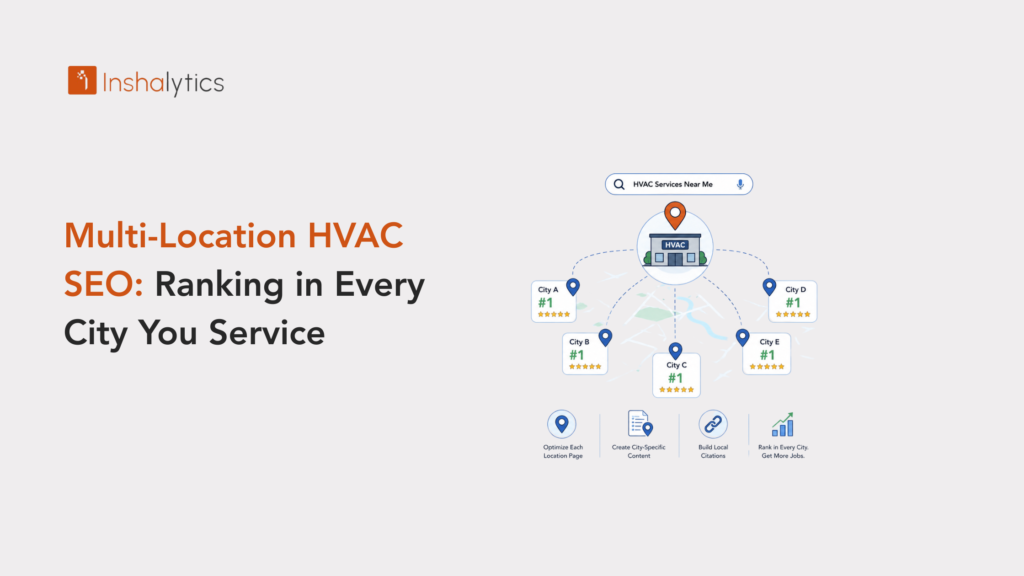
An HVAC company covering fifteen towns from one office often ranks well in exactly one of them: the town the office sits in. The other fourteen stay invisible, not because the demand isn’t there, but because a single homepage was never built to rank in more than one place at a time.
This guide covers how to build location pages that actually earn rankings across every city served, how to avoid quietly competing against your own pages, and how to manage a single Google Business Profile across a wide service area without risking a suspension. Done properly, each new market becomes its own source of booked jobs instead of an afterthought on a coverage map.
One Homepage Won’t Rank You Everywhere
Google needs a reason to show a specific page for a specific city, and a general homepage rarely gives it one, no matter how well that homepage is written.
Why Google Needs a Dedicated Page Per City
A page built specifically around a city, its neighborhoods, and the services offered there gives Google clear signals about geographic relevance that a single generic homepage simply cannot provide. Without that dedicated page, the business is competing for local visibility with one hand tied behind its back in every city except the one it’s headquartered in.
This is one of the most common gaps in HVAC websites overall, not just multi-location ones. A business assumes that mentioning a service area somewhere is enough, when Google is really looking for a page that behaves like a genuine local resource.
The Difference Between a Location Page and a Service-Area Mention
Listing a city in a bulleted service-area list is not the same as having a real page built for it. A genuine location page includes local context, relevant service details, and enough unique content to be treated as its own destination, not just a line item on a coverage map.
A visitor landing on a real location page should immediately feel like the business understands their specific area, not like they’ve landed on a template with the city name swapped in.
Building Location Pages That Actually Rank
Thin, templated location pages tend to underperform or get ignored entirely. The pages that rank share a few specific traits that are worth building into a checklist from the start.
The 60-70% Unique Content Rule
Boilerplate about core services can appear across every location page, but each one should carry a meaningful majority of genuinely unique content: local climate considerations, neighborhood characteristics, and details specific to that market. Pages that are near-identical copies with only the city name swapped tend to get treated as duplicate content rather than distinct, valuable pages.
This is often the single biggest reason a multi-location rollout underperforms. It’s tempting to template every page and change only the city name, but that shortcut is exactly what limits how many of those pages will ever rank.
A useful test is reading two location pages back to back. If swapping the city names would make them indistinguishable, the pages need more genuinely local substance before they’re ready to launch.
Local Proof: Reviews, Photos, and Case Studies by City
A location page that includes reviews from customers in that specific city, project photos from real jobs there, and any relevant local case studies reads as far more credible than a generic template, both to Google and to the homeowner deciding whether to call.
This kind of proof also does double duty. It strengthens the page for ranking purposes while giving a hesitant homeowner in that specific city a concrete reason to trust a business that might otherwise feel like an outsider to their community.
Avoiding Keyword Cannibalization Between Pages
When two location pages both chase the same broad keyword, they end up competing against each other instead of the actual competition, which weakens both. Assigning each page its own clear keyword focus, tied to its specific city and service combination, keeps pages reinforcing each other instead of splitting the same ranking opportunity.
This is worth checking early, before a dozen pages are live, since untangling cannibalization after the fact takes far more effort than planning the keyword map correctly from the start.
Managing Your Google Business Profile Across Multiple Service Areas
Location pages are only half the picture. The Google Business Profile setup behind them has its own rules for multi-location businesses, and getting this wrong can jeopardize the whole strategy.
One GBP Per Physical Location, Not Per City
A Google Business Profile should exist for each real physical office or dispatch location, not for every city listed as a service area. Cities covered without a physical presence belong on the service-area list within that one legitimate profile, not as separate listings of their own.
This distinction trips up a lot of growing HVAC businesses, since it feels intuitive to want a profile for every market served, but Google’s guidelines are explicit that a profile represents a real, staffed location, not a coverage zone.
Why Duplicate Listings Risk Suspension
Creating a separate Google Business Profile for each city served, without a real office in each one, violates Google’s guidelines and puts every listing at risk of suspension, including the legitimate one. The safer, more durable path is one strong profile per real location, paired with well-built service area pages on the website.
A suspension doesn’t just cost the fake listings. It can drag down the one real profile too while the issue gets sorted out, which makes this a risk worth avoiding entirely rather than testing the boundaries.
Recovering from a suspension can take weeks and requires proving the legitimate location’s authenticity to Google, a disruption that’s entirely avoidable by structuring listings correctly from the start.
Structuring Multi-Location Content So It Compounds
A handful of well-built pages rarely happens by accident. It takes a deliberate rollout plan rather than launching everything at once.
Building a Location Page Rollout Plan
Rather than launching a dozen thin pages at once, prioritizing the highest-opportunity cities first and building each page out properly tends to produce stronger, faster results than spreading effort too thin across every market simultaneously. Once the top few pages are performing, the same proven local SEO framework and keyword approach can be repeated for the next tier of cities.
This staged approach also makes it easier to spot what’s working before committing the same effort across every remaining market, rather than discovering a structural problem only after a dozen pages are already live.
Tracking Cost-Per-Booked-Job by City to Prioritize Expansion
Measuring cost-per-booked-job city by city, rather than looking at the business as one blended average, shows exactly where the next location page investment will pay off fastest, and where a market simply isn’t worth the build-out yet.
This kind of city-level tracking often surfaces surprises. A market that seemed like an obvious priority on paper can turn out to convert poorly, while a smaller, overlooked town quietly outperforms expectations.
How Do You Know Your Multi-Location SEO Is Actually Working?
Multi-location SEO is working when new cities start earning their own map pack visibility and organic leads independently, not just riding on the strength of the home market. That independent performance, city by city, is the real sign of progress.
What Healthy Growth Looks Like Across Markets
Healthy growth looks like map pack visibility and organic leads appearing gradually in newer markets, following the same trajectory the original location took, rather than staying flat no matter how much content gets added.
It’s reasonable for newer markets to lag behind the original location in raw numbers. What matters is whether they’re following a similar growth curve, just offset in time, rather than showing no movement at all.
When to Bring in Dedicated Local SEO Support
Once a business is managing location pages, citations, and Google Business Profile strategy across five or more markets, the coordination required usually justifies dedicated support rather than continuing to manage it as an occasional side task squeezed between other priorities.
At that scale, the risk isn’t just slower growth. It’s inconsistent quality across pages, which can quietly undermine markets that were previously performing well.
Ranking an HVAC business in every city it serves takes more than listing those cities somewhere on the website. It takes dedicated, genuinely unique pages, a Google Business Profile structured correctly around real physical locations, and a deliberate rollout that avoids competing against your own content. Done well, each new market becomes its own independent source of booked jobs instead of quietly riding on the visibility of just one.
Serving multiple cities but only really visible in one? Get a free multi-location SEO audit to see which markets are ready for their own dedicated page.