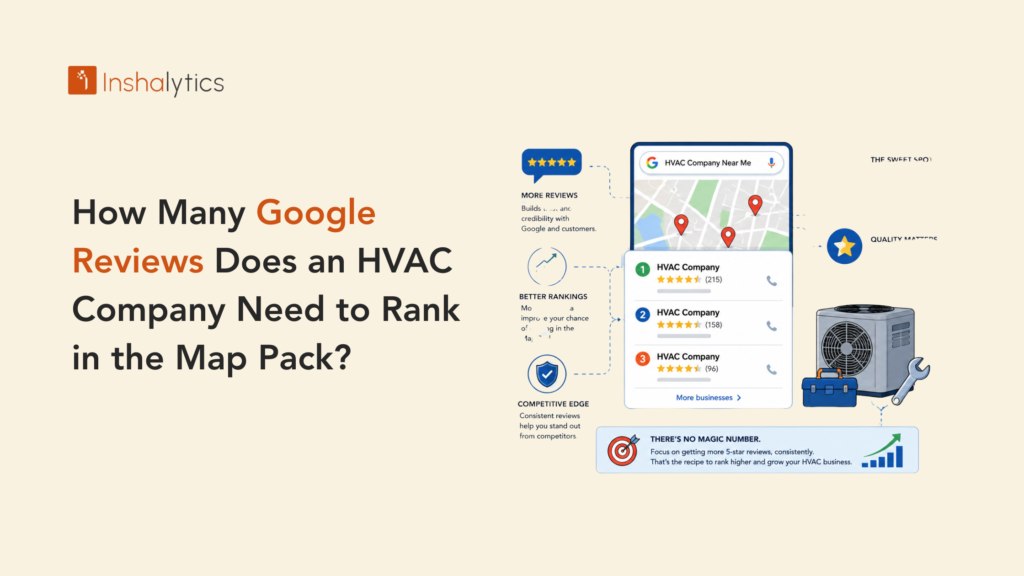
Type “HVAC repair near me” into Google and three businesses show up above everything else. Every HVAC owner who isn’t one of them eventually asks the same question: how many reviews do I actually need to get in there? It feels like there should be a clean answer. Hit a hundred reviews and you’re in. There isn’t one, and chasing a number pulled from a generic blog post is a good way to waste months chasing the wrong target.
The honest answer is that there is no single number. The businesses holding those top three spots in a small town and the businesses holding them in a major metro can be separated by a gap of more than ten times as many reviews. This guide breaks down what the review benchmark actually looks like by market size, why recency matters as much as volume, and what to do once your review count catches up and you’re still not ranking.
There’s No Universal Number, Only a Local One
There is no fixed review count that guarantees a map pack spot, because Google ranks your business against the specific competitors in your market, not against a global average. The number you actually need is whatever your top three local competitors currently have, which means the real research starts with a search, not a spreadsheet of national averages.
Why Google Ranks You Against Neighbors, Not a Global Average
Map pack rankings are inherently local and competitive. A business with a strong review count can still miss the top three if its direct competitors have even stronger ones, and a business with what sounds like a modest review count can hold a top spot if the local competition simply hasn’t caught up.
This is why chasing an arbitrary round number, like 100 reviews, misses the point. The only benchmark that matters is what the businesses currently ranking above you actually have, which is something you can check directly by searching your own core keywords and looking at who shows up.
Small-Town vs. Metro Review Benchmarks
In smaller and suburban markets, competition for the map pack tends to be thinner, review totals across all competitors run lower, and the businesses holding the top spots can sometimes do it with well under a hundred reviews. In large, competitive metro markets, the opposite is true: fierce competition among established HVAC companies pushes the realistic floor for a top-three spot much higher, sometimes into the hundreds.
[STAT NEEDED: verify current market-tier benchmark ranges before publishing, ideally pulled from your own client data or a recent third-party local-search study] The gap between these two tiers is large enough that a benchmark pulled from the wrong market size can send an HVAC business chasing a target that’s either far too easy or wildly out of reach.
Review Benchmarks by Market Size
Breaking the benchmark down by market tier gives a far more useful target than one flat number ever could, and it changes how a business should think about its own review strategy.
Small and Suburban Markets
In smaller cities and suburban service areas, HVAC map pack leaders often compete with far fewer total reviews than their metro counterparts, sometimes in the range of a few dozen. The bar is lower here, but it still moves. A business that assumes reviews don’t matter in a small market because the numbers look modest usually loses the top spot to a competitor who kept collecting them anyway.
The mistake most small-market owners make is treating a low bar as no bar at all. Even a market where the top three sit in the twenties or thirties can shift quickly if one competitor commits to a consistent request system while the others coast.
Mid-Size Metro Markets
Mid-size metros sit in the middle, where a business typically needs a steadily growing review count well into the double or triple digits to hold a consistent top-three position, depending on how many established competitors are already active in the area.
This tier is often where the competitive research pays off most, since the gap between an average competitor and a top-three competitor tends to be meaningful but still closeable within a reasonable timeframe with consistent effort.
Competitive Major Metros
In the most competitive metro markets, the businesses holding the top three map pack spots frequently carry review counts in the hundreds, sometimes several hundred, reflecting years of consistent collection rather than a short-term push. Entering this tier without a real review system in place is close to impossible, no matter how good the work is.
Businesses in this tier need to think in terms of sustained monthly velocity rather than a one-time campaign to hit a target number, since the competitors already holding those spots aren’t standing still either.
Why Recency Beats Raw Review Count
A large review count sitting untouched for a year does less for a ranking than a smaller count that keeps growing every week, and this is the part of the benchmark most owners overlook.
How Google Reads Review Velocity
Google’s local ranking systems weigh recency alongside volume. A company with hundreds of reviews collected years ago and nothing recent can lose ground to a competitor with a smaller total but a steady, current stream, because recency signals an actively operating, currently trusted business.
This is why two businesses with similar total review counts can perform very differently in the map pack. The one still actively earning new reviews every week is sending a much stronger signal than the one coasting on an old total.
The Risk of a Stale Review Profile
A stale profile does not just stop helping. It can actively start working against a business, since a searcher browsing reviews can tell the difference between a company that is still earning trust today and one that peaked a few years ago. The fix is not a one-time push to hit a number. It’s a system that keeps new reviews coming in every week.
A business that notices its most recent review is several months old should treat that as an urgent fix, not a minor housekeeping item, since it’s actively undermining every other ranking effort in the meantime.
Closing the Review Gap Without Buying or Faking Reviews
Whatever the local benchmark turns out to be, the way to close the gap is the same: a consistent, automated request system, not shortcuts that risk the business’s standing entirely.
Building an Automated Review Request System
A request sent automatically after every completed job, timed for when the customer’s satisfaction is freshest, consistently outperforms occasional manual asks. This is one of the simplest, highest-leverage systems an HVAC business can put in place, and it’s also one of the most commonly skipped.
The timing matters as much as the automation itself. A request sent the same day as a completed repair, while the relief of a working system is still fresh, converts at a meaningfully higher rate than one sent a week later as an afterthought.
Why Review Velocity Lowers Cost-Per-Booked-Job Over Time
Every review earned through a system that’s already running costs nothing incremental in ad spend, yet it directly improves map pack visibility, which drives more organic calls at zero marginal cost. Tracked against cost-per-booked-job across the business as a whole, a strong review system is one of the highest-return investments available, because its benefit compounds instead of resetting every month like paid ad spend does.
A business that stops paid ads for a month sees calls drop off almost immediately. A business that stops asking for reviews doesn’t feel the impact for months, by which point rankings have already started slipping quietly in the background.
What to Do If You’re Still Not Ranking After Fixing Reviews
Reviews are one input, not the whole system. If the count and recency both look healthy and the map pack still isn’t showing your business, something else is holding it back.
Other Map Pack Factors Worth Auditing
Google Business Profile completeness, category selection, service area accuracy, and directory citation consistency all factor into map pack ranking alongside reviews. A full breakdown of why HVAC businesses don’t show up on Google Maps covers these other factors in detail, and is worth working through once reviews are no longer the obvious weak point.
It’s easy to fixate on reviews specifically because the number is so visible and easy to track. That visibility can distract from other factors that are just as important but harder to see at a glance.
When to Get a Local SEO Audit
If reviews, profile completeness, and citations all check out and rankings still haven’t moved, it’s usually a sign the issue sits deeper in the broader local SEO setup, including keyword and category strategy, and worth a professional look rather than more guessing without a clear diagnosis.
A fresh set of eyes at this point often catches something that’s been overlooked simply from being too close to the business day to day.
The number of reviews an HVAC company needs to rank in the map pack depends entirely on the market it’s competing in, and chasing a generic target misses that. What matters is knowing where the local top three actually sit, building a system that keeps new reviews coming in every week rather than in occasional bursts, and treating recency as seriously as total count.
Want to know exactly where your review count stands against the competitors actually ranking above you? Get a free competitive review audit and see the real gap, not a generic benchmark.