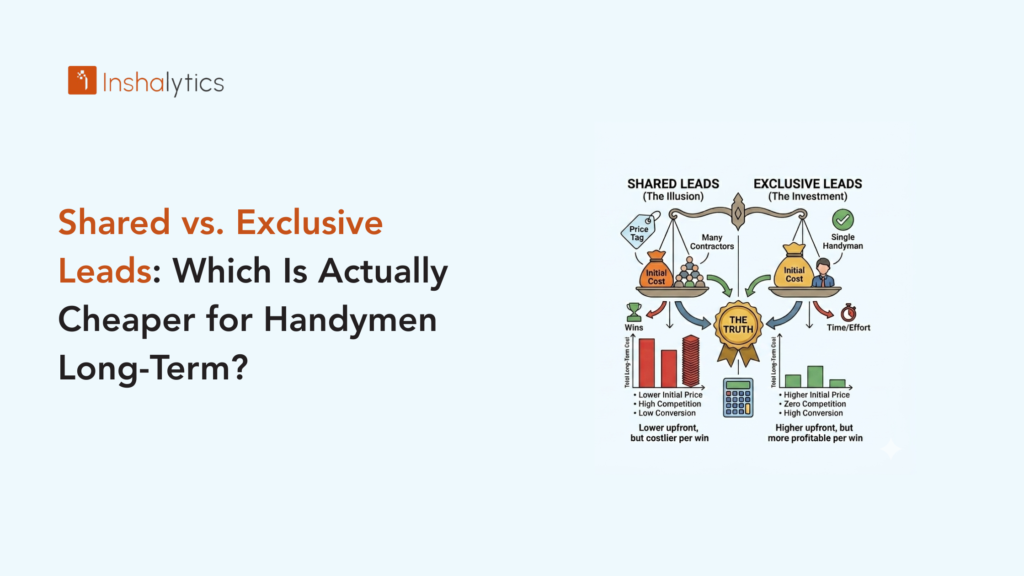
The platform charges $18 for a shared handyman lead. Your own Google Ads or local SEO might cost $55 per lead once setup is established. The platform looks cheaper. That comparison is wrong because it stops too early. What matters is not the cost per lead. It is the cost per booked job, and that number is determined almost entirely by close rate. A shared lead with a 10% close rate costs $180 per booked job at $18 per lead. An exclusive lead with a 40% close rate costs $137.50 per booked job at $55 per lead. The supposedly cheaper shared lead is actually more expensive where it matters. This guide runs the full long-term cost comparison so you can see exactly how the two models diverge over 6, 12, and 24 months.
Why Sticker Price Is the Wrong Comparison
The shared versus exclusive lead debate almost always gets framed around price per lead. That framing produces the wrong conclusion. Price per lead is an input. Cost per booked job is the output. The only metric that connects to your revenue and margin is cost per booked job, and that is determined by close rate, not lead price.
The Close Rate Gap Between Shared and Exclusive Leads
Shared leads from platforms like Angi, Thumbtack, and HomeAdvisor are sold simultaneously to three to five contractors. When your lead notification arrives, so does the same notification for four of your competitors. Your close rate on these leads is structurally limited: you are competing on response speed and price under time pressure, the homeowner is fielding multiple calls at once, and whoever is cheapest or fastest typically wins. Industry data for shared handyman leads puts typical close rates at 8% to 15%. Exclusive leads, whether from your GBP, Google Ads, LSA, or your own website, go to you only. The homeowner searched for a handyman, found your business, and made a deliberate choice to contact you. Close rates on exclusive inbound leads run 30% to 50% for businesses with strong review profiles and fast follow-up.
The Cost Per Booked Job Math at Different Close Rates
Cost per booked job = Cost per lead divided by Close rate. At a $30 shared lead with a 10% close rate: $300 per booked job. At a $30 shared lead with a 15% close rate: $200 per booked job. At a $55 exclusive lead with a 35% close rate: $157.14 per booked job. At a $55 exclusive lead with a 45% close rate: $122.22 per booked job. These numbers demonstrate that a shared lead can be cheaper per booked job only when close rates are unusually high on the shared source or unusually low on the exclusive source. Under typical conditions, exclusive leads deliver lower cost per booked job at most price points. The true cost per lead calculation guide covers how to calculate this for your specific numbers.
What the Cost Comparison Looks Like Over 12 Months
Here is a practical 12-month comparison for a handyman business spending $1,500 per month on lead acquisition. On shared platforms at $30 per lead: 50 leads per month, 6 booked jobs at 12% close rate, cost per booked job $250, annual booked jobs 72, annual lead spend $18,000. On owned channels (Google Ads plus GBP optimisation) at an effective $55 per lead: 27 leads per month, 11 booked jobs at 40% close rate, cost per booked job $136, annual booked jobs 132, annual lead spend $18,000. Same spend. 83% more booked jobs from exclusive sources. The math favours exclusive leads at identical spend levels when close rate differences are applied.
Why Shared Lead Platforms Are Structurally Designed to Lower Your Close Rate
The low close rates on shared leads are not accidental. They are a product of how the platform model is designed. Understanding the structure explains why the cost disadvantage compounds over time rather than improving.
The Multi-Contractor Race and What It Does to Your Positioning
When a homeowner submits a request on Angi or Thumbtack, the platform notifies three to five contractors simultaneously. Each contractor calls as fast as possible because response speed is the primary variable that determines whether you even speak to the homeowner. This race creates a dynamic where the first person to call wins the conversation regardless of their skills, reviews, or fit for the job. It also creates price pressure: the homeowner, now speaking with multiple contractors, asks each one about price. The contractor who wants the job undercuts. This race-to-the-bottom pricing is a structural feature of shared lead platforms, not a temporary market condition. It means your average job value from shared leads is typically lower than your average job value from exclusive leads, compounding the already-unfavourable cost-per-booked-job math.
How Shared Platforms Build Their Brand at Your Expense
When a homeowner books a handyman through Angi, they remember finding the handyman on Angi. They do not remember your business name. When they need work done again six months later, they return to the platform, pay for another lead, and potentially select a different contractor. Every job completed through a shared platform builds the platform brand and drives repeat business back to the platform, not to you. Owned channel leads (a homeowner who calls your GBP number, visits your website, or clicks your Google Ad) associate the experience with your business. They call you directly next time. They refer their neighbour to you by name, not to a platform. The long-term value of an exclusive lead extends far beyond the cost comparison for that single booked job.
Platform Dependency Versus Owned Pipeline
A business running exclusively on shared platform leads has a pipeline that costs money every month indefinitely and produces nothing if the spend stops. A business that has invested in building owned channel leads (GBP ranking, local SEO, website conversion optimisation) has built an asset that generates leads at declining cost over time and retains value even when spend is paused. The impact of lead marketplace dependency on handyman margins covers the long-term financial risk of platform dependency in detail. The alternatives to Angi and Thumbtack guide covers the owned channel alternatives and their cost trajectory.
When Shared Leads Are Justified (The Honest Case)
Shared leads are not always the wrong choice. There are specific situations where they represent a reasonable short-term use of marketing budget while a more sustainable lead system is being built.
During the First 90 Days of a New Business
A newly launched handyman business with no reviews, no GBP ranking, and no website authority cannot compete for exclusive organic leads. Shared platforms provide immediate lead volume that builds the job history, review base, and referral relationships that will eventually fuel an owned-channel system. Used as a temporary bridge during the first 90 days, shared leads serve a legitimate purpose. Used as the permanent acquisition strategy, they cap your growth at the margin the platform allows.
For Filling Specific Gaps in a Slow Period
Even a handyman business with a healthy owned-channel pipeline encounters slow periods (post-holiday January, for example). A short burst of platform spend during slow periods to fill scheduling gaps can be justified when the cost per booked job during that period is evaluated honestly against the alternative of idle technician time. The key discipline is returning to your cost-per-booked-job calculation at the end of each campaign and not allowing temporary gap-filling to become permanent platform dependency.
For Service Types With High Close Rates on Shared Platforms
Some service categories produce higher-than-average close rates on shared platforms because the job urgency is high and the homeowner is less likely to spend time comparison shopping. Emergency repairs, same-day service requests, and highly specialised tasks where few local contractors are qualified generate shared leads that convert at closer to 20% to 30% rather than the typical 8% to 15%. Run the cost-per-booked-job calculation for each service type separately. A shared platform may be unfavourable for general handyman leads but acceptable for emergency or specialty leads where urgency increases your close rate.
The 24-Month Cost Trajectory Comparison
The most important difference between shared and exclusive lead strategies is not the month-one cost. It is the direction each model moves over time.
Shared Lead Costs Over 24 Months
Shared lead platform costs do not improve with time. Your per-lead cost typically increases year over year as platforms raise prices and as competition for leads in your market grows. Your close rate does not improve because you are still competing against four other contractors on every lead regardless of how many five-star reviews you accumulate. The true cost of bad leads compounds as your business becomes more reliant on the platform and your time cost of processing low-quality leads grows with volume. There is no compounding benefit from platform spend. When you stop paying, the leads stop immediately.
Exclusive Lead Costs Over 24 Months
Owned-channel exclusive lead costs move in the opposite direction. A GBP that ranked in the Local 3-Pack at month 8 continues generating calls at no additional media cost in months 12, 18, and 24. A website that converts at 4% in month 6 converts at 4% in month 24 with no additional spend. Local SEO investment compounds: domain authority, review volume, and citation consistency built in months 1 to 12 make every subsequent improvement faster and cheaper. Industry data for contractor businesses shows that exclusive lead cost per booked job from owned channels typically decreases 40% to 60% between year one and year two as the compounding effects of SEO and GBP maturation take hold.
The Crossover Point
For most handyman businesses, the crossover point where owned-channel exclusive leads become less expensive per booked job than shared platform leads occurs at around months 9 to 14 of a properly executed local SEO and GBP program. The first 6 months require investment that may not yet exceed shared platform economics. By month 12, the cost per booked job from owned channels has typically dropped below shared platform levels. By month 24, the gap is usually substantial. Starting the owned-channel build earlier means reaching the crossover point sooner and spending fewer months at shared platform economics. The local SEO guide for handyman services covers the timeline and milestones in detail.
How Inshalytics Builds the Exclusive Lead Pipeline for Handyman Businesses
Inshalytics builds the local search infrastructure that generates exclusive, inbound handyman leads at declining cost per booked job over time. This includes GBP optimisation for map pack visibility, local SEO content that ranks for service-specific and location-specific searches, LSA setup and management for immediate top-of-page visibility, and website conversion optimisation that turns visitors into calls. Every element generates exclusive leads where the homeowner has already chosen to contact your business specifically.
Ready to build a lead pipeline that gets cheaper over time instead of more expensive? Talk to Inshalytics about how the shared-to-exclusive transition works for your market and service area.