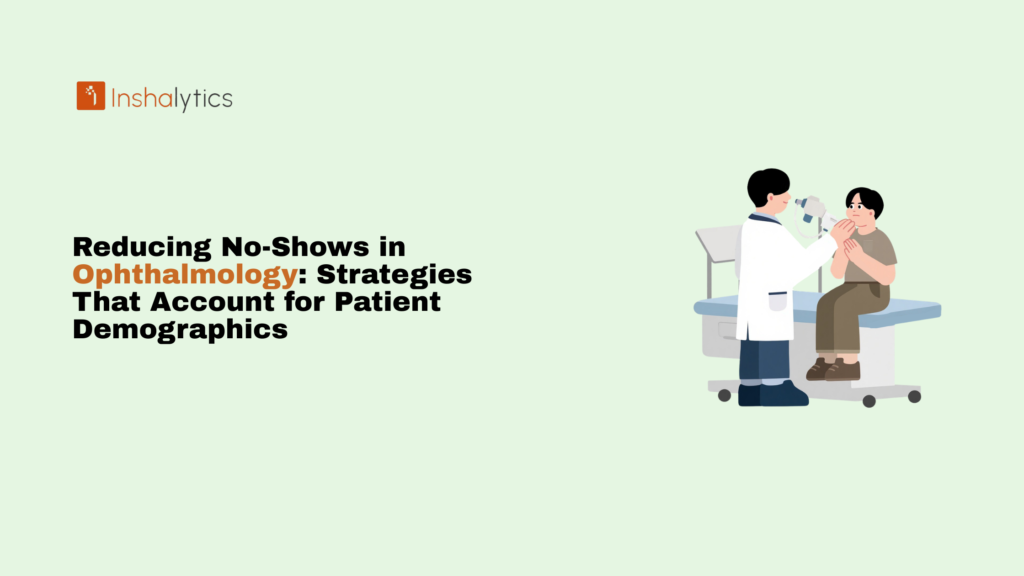
Every empty exam chair represents lost revenue, wasted staff time, and, most critically, a patient whose eye health just took a back seat. With ophthalmology appointment no-shows averaging around 22%, practices lose hundreds of thousands of dollars annually to patients who simply don’t show up. But the standard playbook of blanket reminder calls and cancellation fees only scratches the surface. The real lever for reducing no-shows in ophthalmology lies in understanding who is missing appointments and why, then building targeted engagement strategies around those demographic patterns. This guide walks you through the research-backed demographic factors driving missed appointments in eye care and gives you a practical framework for using segmented automation, personalized outreach, and analytics to keep your schedule full and your patients on track.
Navigate This Post
The True Cost of No-Shows in Ophthalmology Practices
Missed appointments create damage that extends far beyond an empty time slot. The financial, clinical, and operational consequences compound across your practice, affecting everything from revenue predictability to long-term patient outcomes.
Revenue Loss and Scheduling Disruptions From Missed Appointments
Consider a mid-sized ophthalmology practice seeing 35 patients per day. At a 22% no-show rate, that’s roughly seven or eight empty slots daily. With average visit reimbursements ranging from $150 to $300 depending on procedure complexity, the math is staggering, $1,050 to $2,400 in lost daily revenue, or up to $624,000 annually.
The financial hit doesn’t stop at the missed visit. Your staff already spent time confirming the appointment, verifying insurance, and preparing charts. Meanwhile, patients on your waitlist who could have filled those slots remain unscheduled, pushing new patients toward competitors with shorter booking windows.
How No-Shows Affect Patient Outcomes in Eye Care
Ophthalmology carries uniquely high clinical stakes for missed appointments. Many sight-threatening conditions, glaucoma, diabetic retinopathy, macular degeneration, progress silently, showing no symptoms until significant damage has occurred. A glaucoma patient who skips a follow-up may not notice vision changes until irreversible optic nerve damage has set in.
Research from Duke University found that one-third of glaucoma patients stop attending regular follow-up appointments over a 10-year period, with only 17% of those who drop out eventually returning to care. Of those who did return, two-thirds had experienced disease progression or complications. Each no-show isn’t just a scheduling inconvenience, it’s a potential clinical outcome that worsens with every missed touchpoint.
Why Ophthalmology Faces Higher No-Show Rates Than Other Specialties
Ophthalmology’s 22% average no-show rate places it above primary care (19%), endocrinology (14%), and dentistry (15%), though below dermatology and pediatrics (both 30%). Several structural factors drive this.
First, ophthalmology appointments frequently involve long lead times. Patients scheduled six months out for routine follow-ups show no-show rates approaching 38%, compared to just 9% for those booked within two weeks. Second, many ophthalmology patients are older adults managing appointments across multiple specialists, which creates scheduling conflicts. Third, unlike acute conditions where symptoms motivate attendance, routine eye exams feel less urgent to patients whose vision appears stable, even though silent conditions may be progressing underneath.
Which Patient Demographics Influence No-Show Rates the Most?
Patient demographics are among the strongest predictors of whether someone will keep their ophthalmology appointment. Age, gender, insurance status, language, and geographic distance all create measurable differences in attendance patterns, and understanding these variations is the foundation for building targeted interventions instead of one-size-fits-all reminders.
Age and Generational Differences in Appointment Attendance
Research consistently shows that younger patients are significantly more likely to miss appointments than older adults. A study of over 4,600 new patient appointments at an academic ophthalmology department found that patients aged 18–40 were 3.4 times more likely to no-show than patients over 60.
For ophthalmology practices, this creates a split challenge. Pediatric ophthalmology patients depend entirely on parents or guardians to prioritize and manage scheduling, meaning your reminders need to reach and motivate the caregiver, not the patient. Younger adults (18–40) tend to deprioritize eye care that doesn’t feel urgent, especially for routine monitoring visits. Older patients generally attend more reliably, but they face distinct barriers: transportation limitations, managing multiple specialist appointments, and lower comfort with digital communication channels like text-based reminders.
How Gender, Language, and Insurance Type Affect No-Show Behavior
Male patients are 1.1 times more likely to miss appointments than female patients, a finding that holds across healthcare settings and has been confirmed in ophthalmology-specific research. This gap suggests that outreach strategies may need to account for differing health engagement patterns between genders.
Language barriers create another significant obstacle. Patients who receive appointment communications in a language they don’t fully understand are far less likely to confirm or attend. One quality improvement project examining no-shows among English, Spanish, and Cantonese-speaking patients found that language-concordant communication was critical for reducing missed appointments.
Insurance type adds yet another layer. The Penn State study found that uninsured patients were 6.9 times more likely to no-show than Medicare patients, while Medicaid patients were 1.5 times more likely. This reflects broader socioeconomic barriers, transportation challenges, inflexible work schedules, and confusion about covered services, not disinterest in care.
The Role of Distance, Transportation, and Socioeconomic Factors
Geographic distance affects no-show behavior in unexpected ways. A study of over 263,000 appointments found that patients living both very close to the clinic (under 5 miles) and very far away (over 20 miles) had higher no-show rates than those in the 5–10 mile range. This suggests both urban access barriers and distance fatigue contribute to missed appointments.
Socioeconomic vulnerability amplifies every other risk factor. Patients in neighborhoods with higher social vulnerability index scores show lower adherence to ophthalmology follow-up appointments, even when controlling for clinical severity. The compounding effect of childcare needs, hourly employment without paid leave, and competing healthcare priorities creates a set of barriers that generic reminder systems simply cannot address on their own.
Why Appointment Lead Time Is a Hidden Demographic Variable
Lead time, the gap between when an appointment is scheduled and when it occurs, functions as a demographic-adjacent variable because it disproportionately affects certain patient groups. A cross-sectional study of 51,529 ophthalmology appointments found that no-show rates climbed from 9.1% at a 0–2 week lead time to 38.3% at six months in resident clinics.
Patients with chronic conditions requiring long-term follow-up, those in high-demand subspecialties like retina, and patients navigating referral pathways all experience longer lead times by default. This means the patients who need consistent follow-up the most are structurally the most likely to miss their appointments, a problem that scheduling practices and automated engagement sequences can directly address.
How Can Ophthalmology Clinics Use Demographic Data to Predict No-Shows?
Predicting no-shows involves analyzing your existing scheduling and patient data to identify which individuals are statistically most likely to miss their next appointment, then intervening with the right outreach before the appointment date arrives. The most effective prediction models combine multiple demographic and behavioral variables rather than relying on any single factor.
Identifying High-Risk Patient Segments in Your Scheduling Data
Your practice management system already holds the data you need. Start by pulling reports that cross-reference no-show history with patient age, insurance type, zip code, preferred language, and appointment lead time. Most EHR and scheduling platforms can generate these reports, though extracting actionable insights often requires combining multiple datasets.
Look for clusters. Are your no-shows concentrated among patients under 40 with Medicaid coverage and appointments scheduled more than three months out? That level of specificity lets you design interventions targeting the actual problem rather than blanketing your entire patient base with the same generic reminder.
Building Risk Profiles Based on Historical Attendance Patterns
Prior no-show history is the single strongest predictor of future no-shows. A patient who has missed two or more appointments is exponentially more likely to miss again. Build a simple risk scoring system that assigns points for each factor: previous no-shows (highest weight), appointment lead time over four weeks, age under 40, distance over 15 miles, and public insurance.
Patients scoring above your threshold trigger enhanced outreach workflows, more reminder touchpoints, different communication channels, and proactive rescheduling offers. This isn’t about penalizing patients. It’s about matching your engagement intensity to each patient’s actual likelihood of falling through the cracks.
Turning Practice Management Data Into Actionable Patient Insights
Raw data only becomes useful when it drives specific actions. Map each identified risk factor to a corresponding intervention. Long lead times trigger automated reminder sequences that escalate as the appointment approaches. Language barriers trigger multilingual communications. Transportation-related zip codes trigger messages that include directions, parking information, and telehealth alternative offers.
The goal is a responsive communication system where patient characteristics automatically determine what messages they receive, when they receive them, and through which channels, eliminating the manual guesswork that overwhelms front desk staff and ensuring no high-risk patient slips through unnoticed.
Demographic-Driven Reminder Strategies That Actually Work
Generic reminders reduce no-shows by roughly 34% from baseline rates. Demographic-tailored reminders push that number significantly higher by reaching the right patients through the right channels at the right times.
Tailoring SMS, Email, and Voice Reminders to Patient Preferences
Not every patient responds to the same communication channel. Text messages deliver 98% open rates and work exceptionally well for patients under 55, SMS reminders alone can reduce missed appointments by up to 38%. Email reminders provide space for detailed pre-appointment instructions, directions, and educational content, making them ideal for complex visits like post-surgical follow-ups. Automated voice calls remain the most effective channel for older patients who may not regularly check text messages or email.
The key is asking patients their preferred contact method at intake and programming your reminder system to respect those preferences rather than defaulting to a single channel for everyone. A 2024 meta-analysis confirmed that multi-channel approaches outperform any single-channel strategy for improving appointment attendance.
Adjusting Reminder Frequency Based on Appointment Lead Time
A patient booked two weeks out needs one confirmation and one day-before reminder. A patient booked four months out for a retinal follow-up needs a completely different cadence. Design your reminder sequences to escalate as lead time increases.
For appointments scheduled more than eight weeks out, consider a four-touch sequence: an initial booking confirmation, a check-in at the midpoint, a detailed reminder one week before, and a final confirmation 24 to 48 hours prior. Each touchpoint should add value beyond repeating the date and time, include relevant eye health information, preparation instructions, or an easy one-tap option to reschedule if the original time no longer works.
Multilingual and Culturally Sensitive Communication Approaches
If your patient population includes non-English speakers, sending reminders only in English is effectively the same as not sending them at all. Identify the primary languages represented in your patient base and build parallel reminder templates for each one.
Beyond translation, consider cultural factors that affect scheduling behavior. Some patient populations rely heavily on family decision-makers for medical appointments, which means your reminders may need to address caregivers rather than the patient directly. Pediatric ophthalmology practices should direct all communications to parents or guardians with clear, actionable language about what the child’s appointment involves and why attendance matters for their vision development.
Automating Patient Engagement to Reduce Ophthalmology No-Shows
Manual reminder calls consume an average of 8 to 10 staff hours per week in a mid-sized ophthalmology practice. Automation eliminates that labor while delivering more consistent, personalized, and effective outreach than any front desk team can manage alone.
Setting Up Multi-Channel Reminder Workflows That Scale
An effective automated workflow doesn’t just send a single text message. It orchestrates a coordinated sequence across SMS, email, and voice based on patient preferences and risk profiles. High-risk patients receive more touchpoints. Patients with long lead times enter drip campaigns that keep your practice top of mind. Confirmation responses automatically update your scheduling system, flagging unconfirmed appointments for staff follow-up.
Building these workflows requires integrating your scheduling platform with a marketing automation system capable of audience segmentation and conditional logic, an investment that pays for itself within months through recovered revenue and reduced staff hours.
Using Email Marketing Automation for Pre-Appointment Education
Pre-appointment emails serve double duty: they remind patients about their visit while educating them on why it matters. A glaucoma follow-up reminder that explains how intraocular pressure monitoring protects long-term vision gives patients a clinical reason to prioritize showing up, not just a date to remember.
Automated email sequences triggered by appointment type can deliver condition-specific educational content without requiring staff to manually select and send materials. This approach is particularly effective for ophthalmology, where patients frequently underestimate the importance of routine monitoring for slow-progressing conditions that show no symptoms until significant damage has occurred.
How Personalized Landing Pages and Online Scheduling Lower Barriers
Every friction point between a reminder and a confirmed appointment increases your no-show risk. The ideal patient experience is seamless: receive a reminder, tap once to confirm, or tap once to access a personalized pre-visit page with directions, parking details, insurance requirements, and intake forms.
Conversion-optimized scheduling pages that load quickly on mobile devices, display available slots in real time, and allow self-service rescheduling remove the barriers that cause patients to procrastinate until they eventually forget. Research shows that no-show rates drop by 29% when practices implement self-scheduling tools. At Inshalytics, we build exactly these kinds of patient-facing digital experiences, from mobile-responsive scheduling pages to automated pre-visit workflows, designed specifically to keep healthcare practices running at full capacity.
Tracking Engagement Metrics to Continuously Optimize Outreach
Automation without measurement is just automated guessing. Track key metrics across your no-show reduction campaigns to understand what’s working and where to adjust:
- Reminder open rates by channel: which formats get seen and which get ignored
- Confirmation response rates by demographic segment: where your outreach is landing and where it’s falling flat
- No-show rates before and after intervention: segmented by patient risk score to measure actual impact
- Rescheduling rates from reminder-triggered actions: capturing patients who would have silently no-showed
These analytics reveal which channels work for which patient groups, where your sequences need additional touchpoints, and which demographic segments remain stubbornly hard to reach. Regular reporting turns your no-show reduction effort into a continuously improving system that gets smarter with every scheduling cycle.
Ready to build automated patient engagement workflows tailored to your practice’s demographics? Our team at Inshalytics specializes in marketing automation, email campaigns, and conversion-optimized web experiences for healthcare practices. Get a free consultation to see how we can help your ophthalmology clinic reduce missed appointments and protect your revenue.
Practical Steps to Build a No-Show Reduction Plan for Your Practice
Strategy without execution is just a good idea. Here’s how to move from understanding demographic-driven no-shows to implementing a system that actively prevents them.
Auditing Your Current No-Show Patterns by Demographic Segment
Start by pulling 6 to 12 months of appointment data from your practice management system. Calculate your overall no-show rate, then segment it by age group, insurance type, appointment lead time, zip code, language preference, and prior no-show history. You’re looking for the segments where your no-show rate significantly exceeds your baseline.
These are your high-impact intervention targets, the patient groups where improved outreach will produce the largest scheduling gains. Document your findings in a simple dashboard that your team can reference and update monthly. Even a basic spreadsheet tracking no-show rates by segment gives you the visibility needed to make informed decisions about where to focus your engagement resources.
Choosing the Right Communication Channels for Your Patient Mix
Match your communication strategy to your actual patient demographics, not assumptions. If 40% of your patients are over 65, automated voice calls should be a core channel, not an afterthought. If you serve a significant Spanish-speaking population, bilingual SMS templates aren’t optional, they’re essential infrastructure.
Survey a sample of patients across your demographic segments to validate your channel assumptions. Then configure your automation platform to route each patient into the appropriate communication workflow based on their profile data. The practices that see the greatest no-show reductions are those that treat channel selection as a data-driven decision rather than a default setting.
Measuring Results and Refining Your Approach Over Time
Set a clear baseline before launching any new intervention. Track your no-show rate by segment weekly for the first 90 days, then monthly once patterns stabilize. Compare high-risk segments before and after implementing targeted outreach to quantify the specific impact of your demographic-driven strategies.
Expect gradual improvement rather than overnight transformation. Most practices see meaningful no-show reductions within 60 to 90 days of launching automated, demographic-tailored communication workflows. Refine continuously, if a segment isn’t responding to SMS, test voice calls. If long-lead-time patients still drop off despite reminders, experiment with earlier rescheduling offers or waitlist options that give patients more flexibility.
The ophthalmology practices that succeed at reducing no-shows long-term are those that treat it as an ongoing optimization process, not a one-time fix. By combining demographic awareness with marketing automation and consistent measurement, you build a patient engagement system that protects both your revenue and your patients’ vision. Inshalytics helps ophthalmology practices design and implement exactly these systems, from automated multi-channel reminder workflows and pre-appointment email campaigns to conversion-optimized scheduling pages built around your specific patient demographics. Schedule a free consultation to see how data-driven patient engagement can keep your chairs full and your patients on track