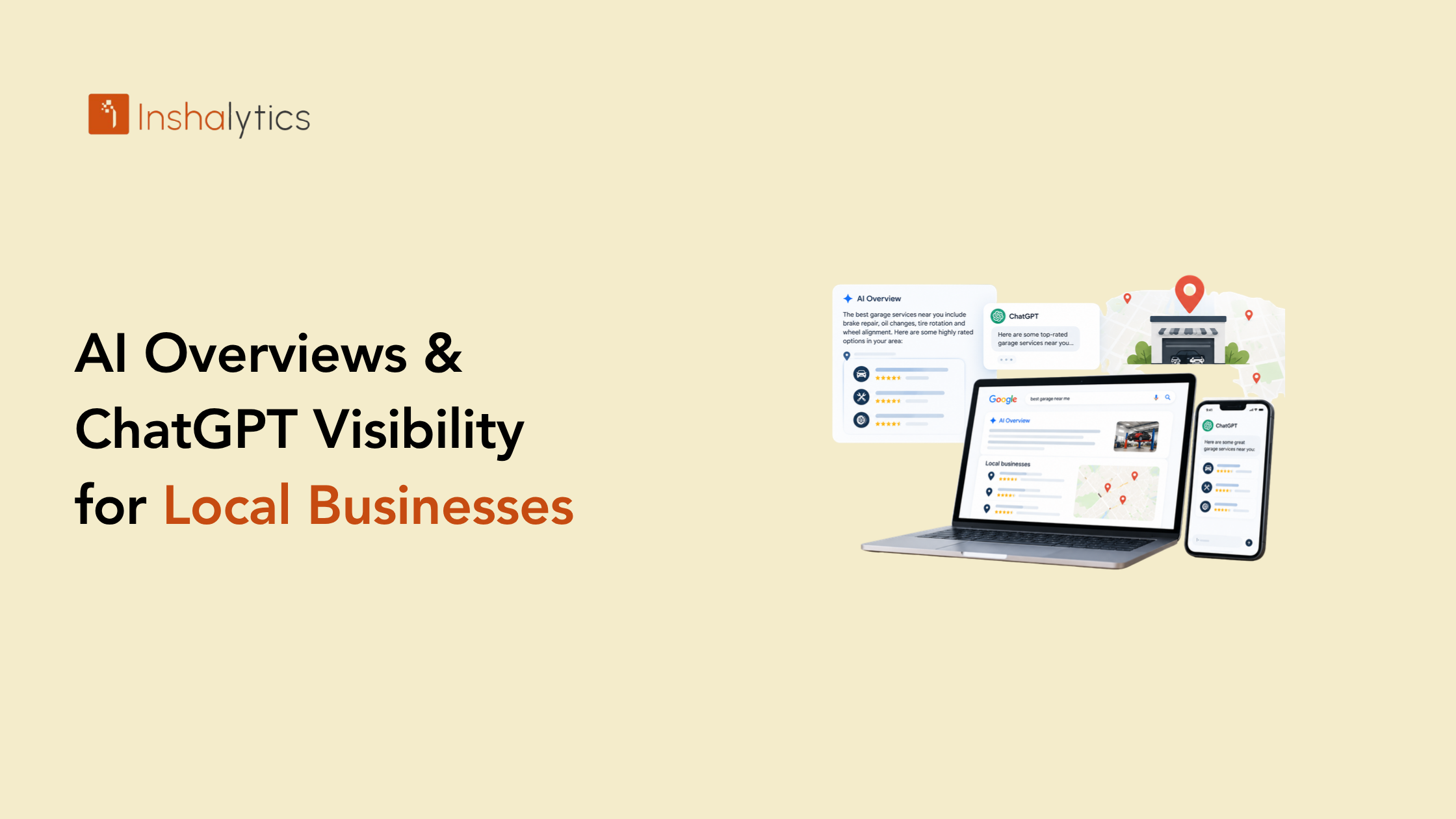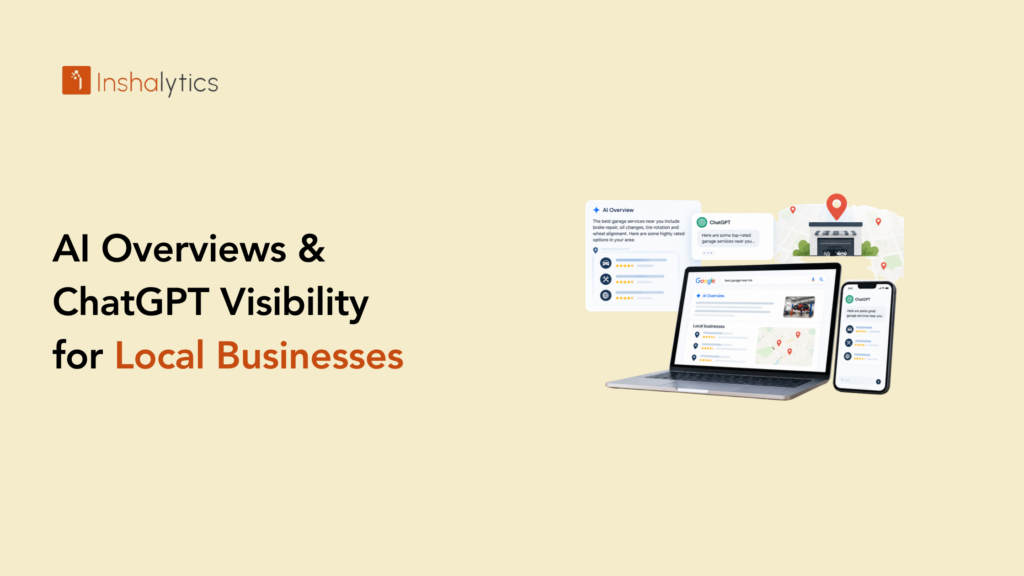
A homeowner asks an AI assistant for the best emergency plumber near them, and gets three names. Yours is either one of them or it is not. AI Overviews and ChatGPT visibility for local businesses depends less on tricks and more on the same signals that make a business easy to trust: consistent facts, real reviews, and clear pages.
This guide explains how AI tools choose local businesses, why local SEO still matters, which sources get you cited, how to optimize your site, how to measure visibility, and how to fix wrong information.
How Do AI Overviews and ChatGPT Choose Local Businesses to Recommend?
AI tools assemble answers from sources they can reach: search indexes, map and business data, review platforms, directories, and web pages. They tend to recommend businesses that appear consistently and credibly across those sources. Exact methods are not public and change often.
Where AI tools get local business data
Google’s AI features draw on Google’s own search index and business data. Other assistants use web search, partner data, and directories. A business with an accurate profile, a clear website, and mentions on trusted sites gives every system more to work with.
Citations vs rankings
An AI answer may cite a few sources and skip the rest, which makes it different from a ranked list of ten results. Being cited is the new goal beside ranking. Google says that to appear in its AI features, a page must be indexed and eligible to show with a snippet, and that no special markup is required. You can read that in Google’s guidance on AI features.
Does Local SEO Still Matter for AI Search?
Yes. Local SEO builds the same foundations that AI tools rely on: a verified business profile, consistent listings, reviews, and useful pages. Doing the basics well supports both traditional and AI results.
The map pack and Google Business Profile signals AI reuses
Your Google Business Profile holds categories, services, hours, photos, and reviews that appear across Google’s products. Keep it complete and current. Our Google Business Profile guide and our post on local pack SEO cover the details.
Reviews, entity consistency and NAP
Reviews tell AI tools, and customers, what you are like to work with. Consistent name, address, and phone details across the web help systems recognize you as a single business. Read our guide to NAP consistency for the audit steps.
Which Directories and Sources Get Local Businesses Cited?
AI tools often draw from sources that already carry authority: major directories, industry sites, review platforms, and local media. The more of these that describe you accurately, the better.
Core directories and industry-specific sources
Start with the main platforms in your market, such as Google, Apple Maps, Bing Places, Yelp, and Facebook, then add the directories that serve your trade, such as home services or dental and medical listings. Keep details identical everywhere.
Third-party mentions and local press
Mentions from local news, chambers of commerce, suppliers, and community organizations act as independent proof. Our guide to local SEO for plumbers shows how that work supports your visibility, and our local SEO for dentists guide shows how this plays out in one industry.
How Do You Optimize Your Website for AI Citations?
Write pages that answer real questions clearly, mark up your business facts accurately, and make sure crawlers can reach your content. Clear, helpful pages serve people first, and AI tools second.
Answer-first service pages and FAQs
Open each service page with a direct answer to the question a customer asks, such as what the service is, who it is for, and what it generally involves. Add a short FAQ for the questions your team hears every week. Avoid padding, because concise, accurate answers are easier to quote.
Schema and entity markup
Structured data helps search engines understand your business details. It is not a requirement for AI features, but accurate markup supports clarity. Our guide to technical SEO explains where schema fits.
AI crawler access and llms.txt
Check that your robots.txt does not block the crawlers you want, and that your pages are indexable. As for llms.txt, no major AI provider has confirmed that it uses the file, so treat it as optional. Our guide to llms.txt for service websites explains the current picture.
How Do You Measure AI Search Visibility?
Measure it with a repeatable set of test questions, plus referral traffic in your analytics. There is no single official report for AI recommendations, so consistency in how you test matters more than any one result.
A manual prompt-tracking checklist
Write a list of 10 to 20 questions customers might ask, such as who is the best emergency plumber in your city, or how much does a new water heater cost near you. Each month, ask them in the same AI tools, and record whether your business appears, how it is described, and which sources are cited. Responses vary, so look for patterns over time.
Tools and referral traffic in GA4
In Google Analytics 4, review referral traffic for visits from AI tools such as ChatGPT and Perplexity. Some tools do not pass referrer data, so treat the numbers as a floor. Pair them with call tracking and a simple question on your intake form: how did you hear about us?
What Can Go Wrong When AI Gets Your Business Wrong?
AI tools sometimes repeat outdated or incorrect facts, such as old hours, services you no longer offer, or the wrong service area. Finding and fixing the source of the error is the most reliable cure.
Spotting incorrect hours, services or service areas
Include a few fact-check questions in your monthly prompt test: What are the hours of your business? What services do you offer? Where do you serve? Compare the answers with reality.
Correcting the sources AI pulls from
Trace the wrong fact to its source, usually an old directory listing, a stale page on your site, or a third-party article. Update your Google Business Profile, fix your own pages, correct directory listings, and ask publishers to update outdated mentions. Some tools also offer a feedback option for reporting errors.
How Inshalytics Builds AI-Ready Local SEO
We treat AI visibility as an extension of strong local SEO. Our local SEO services cover the profile, listing, content, and technical work that AI tools draw on.
Local SEO and citation foundations
We clean up your listings, complete your profile, and build a steady review routine, so every system sees the same accurate business.
Content and schema for AI answers
We write answer-first service pages and FAQs and add accurate markup, so your pages are easy to understand and quote.
Monthly AI visibility reporting
We track a fixed set of prompts each month, record where you appear, and report the changes alongside your rankings and calls. Curious where you stand? Talk to Inshalytics about an AI visibility check.
Start With a 30-Day AI Visibility Audit
AI Overviews and ChatGPT visibility for local businesses grows from the same habits that win local search: accurate facts, real reviews, and helpful pages. A 30-day audit shows where you stand.
The audit checklist
- Write 10 to 20 customer questions and record how AI tools answer them today.
- Verify your Google Business Profile, Apple Maps, and Bing Places listings.
- Check that hours, services, and service areas match everywhere.
- Confirm your key pages are indexable and your robots.txt does not block the crawlers you want.
- Add answer-first openings and FAQs to your top service pages.
- Set up GA4 referral reporting for AI tools.
Next steps
Fix the factual errors first, because they cost you the most, then improve your pages and reviews. If you want a team to run the audit and the follow-up, let’s talk about how Inshalytics can help.