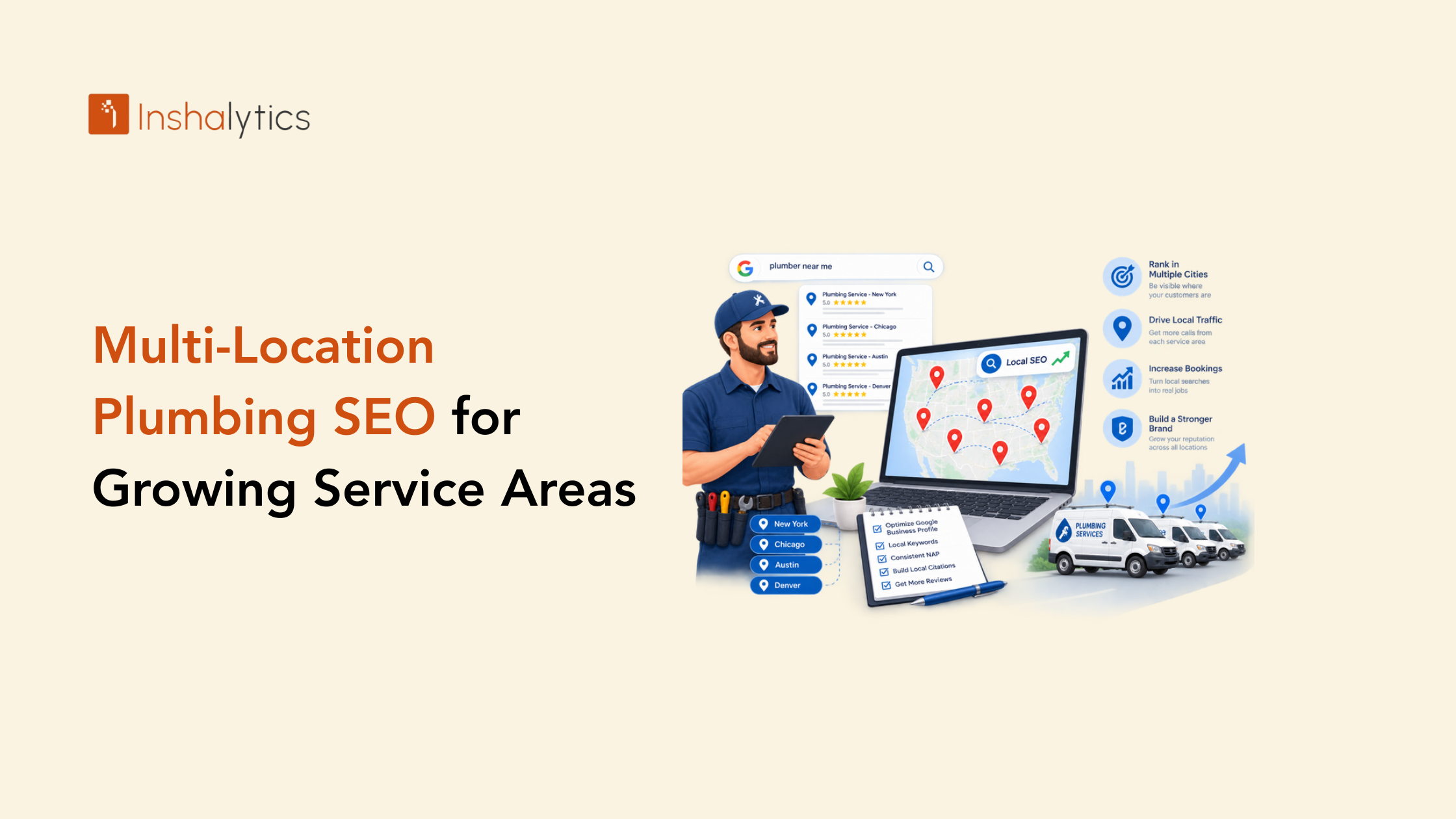

When a homeowner searches ‘plumber near me’ on their phone, the first thing they see isn’t a list of websites; it’s a map with three business listings. That map pack gets approximately 44% of all clicks for local service searches, and the businesses that occupy those three spots get the majority of the calls. Local SEO for plumbers is the discipline of earning and keeping one of those positions. This guide breaks down exactly what that requires, how long it takes, and what the compounding value looks like once you’ve built it.
Why the Map Pack Is Worth More Than Any Other Search Position
Understanding why the map pack matters more than organic rankings or paid ads helps you prioritise your marketing investment correctly. The map pack isn’t just another place to appear; it’s the primary decision surface for high-urgency local searches.
The 44% Click-Through Rate That Changes Everything
The Google Local Pack, the three-business map listing at the top of local search results, captures a disproportionate share of clicks compared to every other element on the search results page. Studies consistently show the top three map pack listings earn around 44% of total clicks for local service queries. For comparison, the first organic result below the map pack earns around 9–12% of clicks, and paid ads above the pack earn 3–5% per listing. That distribution means map pack position is the single highest-leverage real estate in local search, and it’s free once you’ve earned it. Our guide to the local pack and SEO explains the ranking mechanics behind how those three positions are awarded.
How Map Pack Rankings Drive Emergency Calls, Not Just Traffic
The urgency of plumbing searches amplifies the value of map pack positioning. When someone searches ’emergency plumber near me’ at 10 PM on a Friday, they’re not planning to read three articles and compare five options. They’re going to call whoever appears at the top of their screen and answer the phone. Map pack listings display your phone number, star rating, review count, and a direct call button, everything needed to convert a stressed homeowner in under five seconds.
The Google Business Profile: Your Most Important Plumbing Marketing Asset
Local SEO for plumbers starts and ends with your Google Business Profile (GBP). It’s the data source Google uses to display your map pack listing, and optimising it is the single most impactful thing most plumbing businesses can do for their local visibility.
Every Field That Impacts Ranking and How to Fill Them
Your GBP ranking depends on completeness, relevance, and activity. Every field should be filled accurately and specifically. Your business name must match your registered legal name; adding keywords to it violates Google’s guidelines and risks suspension. Your primary category should be ‘Plumber,’ with secondary categories for each relevant service type. Your services section should list every distinct offering with individual descriptions. Google uses these to match your profile to relevant searches beyond just ‘plumber near me.’ Our guide to NAP consistency in local SEO covers how to ensure your GBP information aligns correctly with every other directory listing.
Review Velocity: Why 20 New Reviews This Month Beats 100 Old Ones
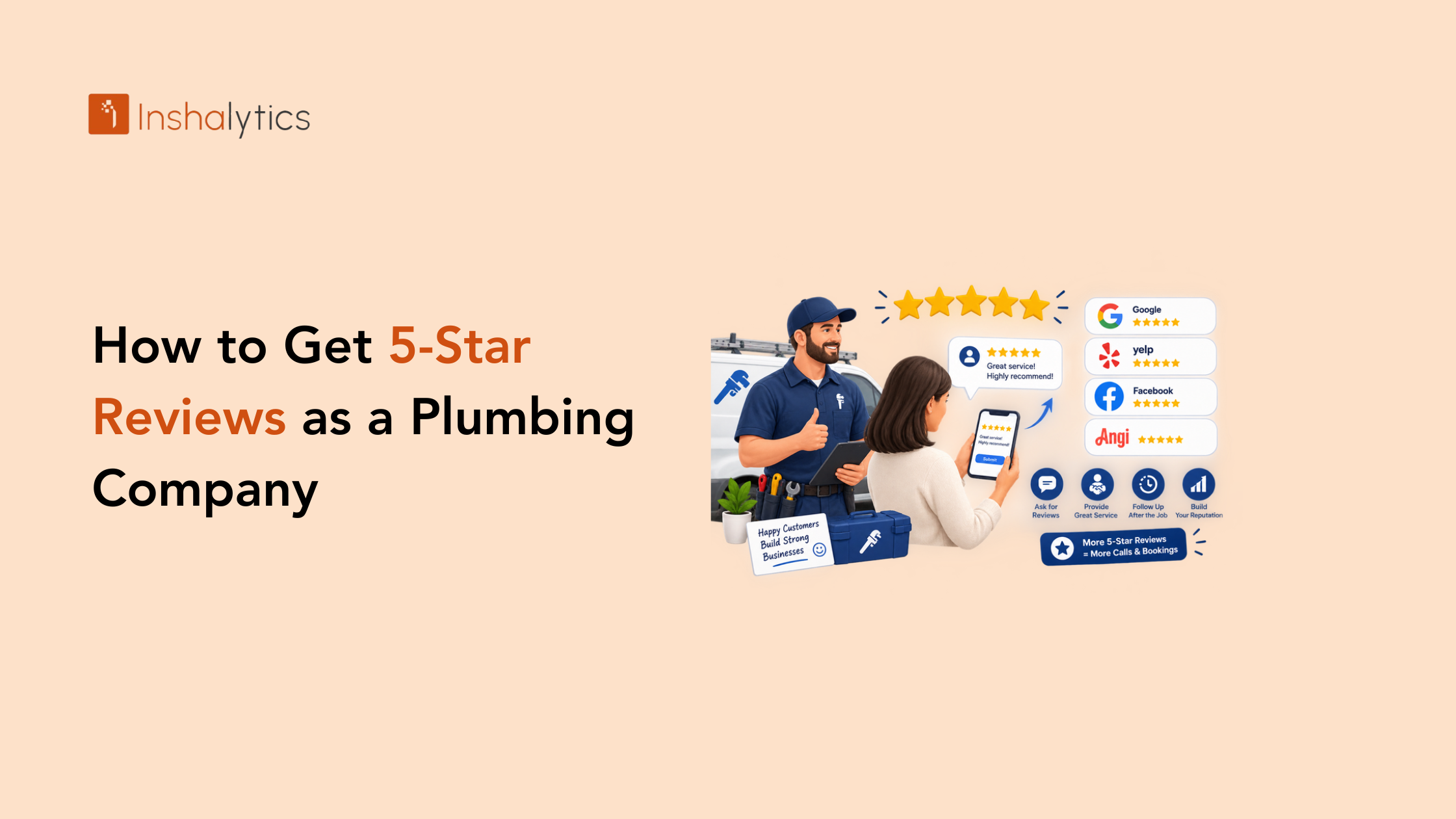
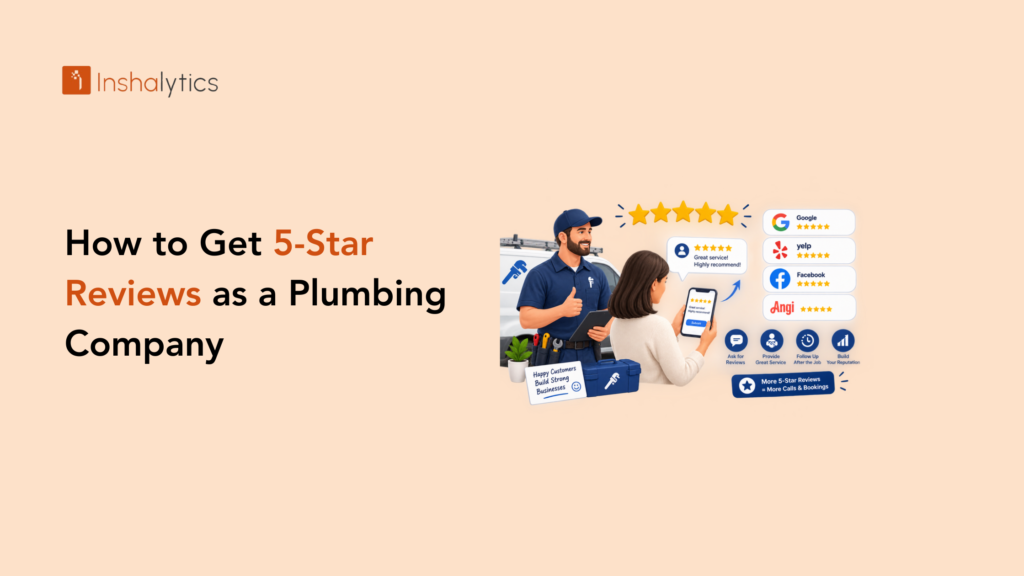
Google’s local ranking algorithm weights recent review activity significantly more than historical total count. A plumbing company that received 20 reviews in the last 90 days will often outrank a competitor with 200 reviews earned over five years, all else being equal. This means review management is not a one-time optimisation, it’s an ongoing operational process. Train every technician to request a review at the end of every completed job. Automate a follow-up text with a direct Google review link sent within two hours of job completion. See how the same review strategy produces results for handyman businesses in our guide on how reviews impact lead generation.
GBP Posts, Photos, and the Activity Signals Google Rewards
Google Business Profile allows you to publish weekly posts: service offers, seasonal promotions, job completion photos, and tips for homeowners. These posts don’t carry massive ranking weight individually, but consistent posting activity signals to Google that your business is active and engaged, a quality the algorithm explicitly rewards. Upload photos of completed jobs, your team, your vehicles, and your service equipment. Real photos outperform stock imagery because they signal authenticity and provide the visual proof homeowners need before calling.
Your Website’s Role in Map Pack Rankings
Many plumbing businesses believe their GBP is a standalone asset, optimise it, and you’re done. In reality, your website reinforces your GBP signals and provides the depth of content Google needs to understand your relevance for specific service terms.
Service Pages That Signal Relevance to Google
Every distinct service you offer deserves its own dedicated page on your website. A page for drain cleaning, a separate page for water heater services, another for emergency plumbing, and another for sewer line repair. Each page should include the specific service name, your coverage area, what the service involves, how much it typically costs, common symptoms that indicate the need for this service, and a clear call-to-action. Generic ‘plumbing services’ pages that list everything in one place without depth fail to send the specific relevance signals Google uses. Our guide to on-page SEO optimisation shows exactly how to structure these service pages for maximum ranking impact.
City Pages: How to Cover Multiple Service Areas Without Duplicate Content
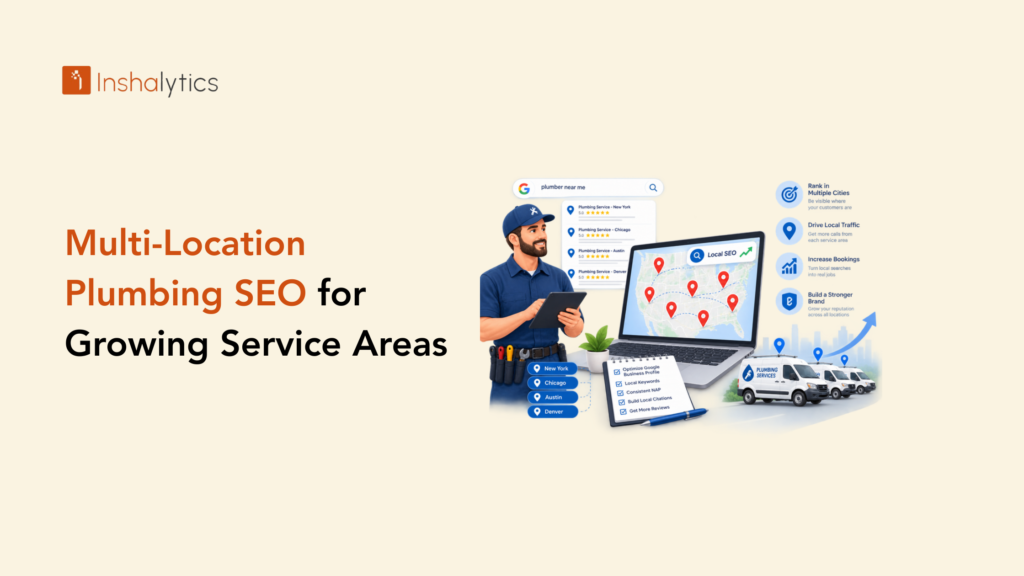
If you serve more than one city or town, create a separate landing page for each service area. A city page for ‘Plumber in [City Name]’ should include locally specific content: neighbourhood references, local landmarks, service area maps, and testimonials from customers in that specific city. Each page must be substantively different, duplicating the same content across 15 city names triggers duplicate content issues that can suppress your rankings. Our guide on how to build city-specific pages that generate leads (written for handymen but directly applicable to plumbers) covers the content framework for scalable city page creation.
Technical Factors That Hold Plumbing Sites Back
Page speed, mobile responsiveness, and Core Web Vitals are table stakes for 2026 plumbing SEO. Most plumbing emergency searches happen on mobile devices, and Google’s mobile-first indexing means it evaluates your site primarily through a mobile lens. If your website takes more than three seconds to load on a mobile connection, you’re likely losing calls before they happen. Our website conversion audit checklist identifies the technical issues most likely to be hurting your conversion rates right now.
Off-Page Local SEO: Building the Authority That Moves the Needle
On-page optimisation and GBP management build your relevance. Off-page signals, citations, backlinks, and review distribution build your authority. Authority is what separates plumbing companies competing for the same map pack position.
Citation Consistency: NAP Across Every Directory
A citation is any online mention of your business name, address, and phone number (NAP). Google cross-references your NAP across directories like Yelp, Yellow Pages, Angi, BBB, and dozens of others to verify your business’s legitimacy. Inconsistencies, such as a different phone number on Yelp than on your website, an old address on a local chamber of commerce listing, confuse Google and suppress your local authority. Conduct a citation audit using a tool like BrightLocal or Moz Local, identify every directory listing your business appears in, and standardise your NAP across all of them. Our guide to NAP consistency and local SEO covers exactly how to run this audit.
Local Backlinks: What Actually Helps Plumbing Companies Rank
Not all backlinks are equal in local SEO. A link from a national SEO blog carries far less local signal than a link from your city’s chamber of commerce website or a local real estate agency’s ‘recommended vendors’ page. Focus your link-building efforts on locally relevant sources: sponsor local community events, join local business associations, and partner with complementary home service businesses for referral link exchanges. Our guide to link building and backlinks covers the types of links that carry the most weight for local businesses.
Why Reviews on Multiple Platforms Compound Your Authority
Google reviews are your primary focus, but reviews on Yelp, Facebook, HomeAdvisor, and the Better Business Bureau also contribute to your overall online authority, and some searchers use those platforms directly. A plumbing business with 80 Google reviews, 30 Yelp reviews, and 20 Facebook reviews presents a stronger authority profile than one with 130 Google reviews and nothing else. Diversify your review collection efforts without diluting your Google review volume, since that remains the most direct ranking signal for the map pack. See our full local SEO optimisation strategies guide for a complete picture of how authority signals combine.
What Does It Actually Take to Dominate the Map Pack?
‘Dominate’ is a word used loosely in marketing. In practical terms, it means appearing in the top three map pack positions for the keywords that drive your most valuable business and staying there consistently.
How Long Before Local SEO Produces Consistent Leads?
For a plumbing business starting from scratch or from a weak baseline, realistic timelines look like this: GBP optimisation produces engagement improvements, more views, more calls within four to six weeks. Map pack movement for mid-competition terms typically starts appearing around months two to three. Ranking stability, where you’re consistently in the top three rather than occasionally appearing, usually takes four to six months of sustained effort. Organic website rankings for service pages take three to six months for lower-competition terms, longer for highly competitive urban markets.
What ‘Dominating’ Local Search Looks Like at 6 and 12 Months
At six months, domination looks like: consistent top-three map pack rankings for three to five of your core service terms, a review profile with 40–60 new reviews in the past 90 days, and organic website traffic generating 10–25% of your total inbound calls. At 12 months, it looks like: map pack rankings for your primary city and two to three surrounding service areas, organic search as your second-largest lead source behind paid ads, and a cost per lead that’s declining monthly. See how this compounds into the full lead system in our lead generation for plumbers guide.
How Inshalytics Builds Local SEO Systems for Plumbers
Our local SEO work for plumbing clients is designed around a simple principle: build the infrastructure that generates calls you don’t have to keep paying for. Explore our full search engine optimisation services to see the scope of what’s included in a plumbing SEO engagement.
From GBP Optimisation to Review Systems to Owned Organic Traffic
We start every plumbing SEO engagement with a full audit: GBP completeness, citation consistency, website technical health, existing ranking positions, and competitor analysis. From that baseline, we build a prioritised 90-day roadmap that addresses the highest-leverage gaps first. We configure automated review request systems, publish initial service and city pages, and begin the citation cleanup process in parallel. By month three, clients are typically seeing their first map pack appearances for target terms and their first organic-source calls. Read more about the full channel mix in our lead generation for plumbers guide.
The Long-Term Advantage of Leads You Don’t Have to Keep Paying For
The compounding nature of local SEO is its most powerful economic property. A plumbing business that ranks in the map pack for ’emergency plumber ‘ doesn’t pay per call from that position. Over 12 months, the return on the initial SEO investment grows as call volume increases and cost per acquisition drops. Our goal for every plumbing client is to have SEO generating the majority of their lead volume within 18 months with paid ads serving as a volume amplifier, not a survival mechanism. Explore our full lead generation services to see how SEO fits into the complete system. Ready to own your local map pack? Book a free local SEO audit with Inshalytics, and we’ll show you exactly where your plumbing business stands today and what it takes to reach the top three in your service area.