For local businesses competing for customers in specific geographic areas, few technical details matter as much as three simple pieces of information: your business name, address, and phone number. While this might seem trivially basic, the consistency of these NAP details across the entire web from your website to directories to social media profiles profoundly impacts local search visibility. Search engines use NAP consistency as a trust signal, verifying that your business is legitimate and accurately represented. Inconsistent NAP information confuses both search engines and potential customers, undermining local rankings and costing you valuable foot traffic and phone calls from nearby searchers.
Navigate This Post
What Is NAP?
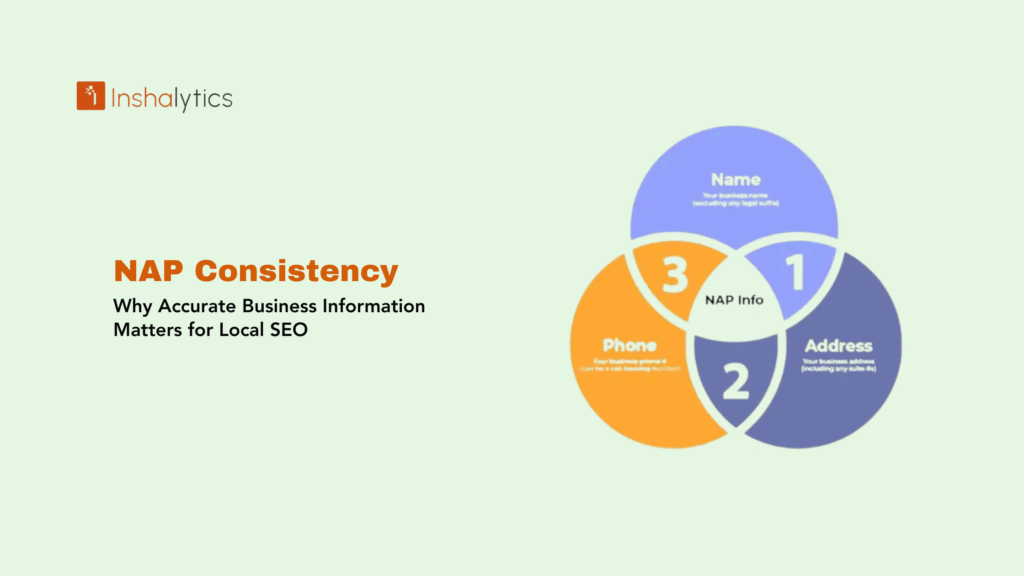
NAP stands for Name, Address, Phone Number, consistent business information crucial for local SEO across all online platforms. This acronym represents the foundational data elements that identify physical businesses in local search results, directories, maps, and other location-based services. NAP consistency means ensuring these three critical details appear identically everywhere your business is listed online, from your own website to Google Business Profile, Facebook, Yelp, industry directories, and any other platform mentioning your business.
While NAP seems straightforward, consistency challenges arise from subtle variations that humans recognize as equivalent but confuse search algorithms: abbreviations versus spelled-out words (St. vs Street), suite number formatting (Suite 100 vs Ste 100 vs #100), phone number formats ((555) 123-4567 vs 555-123-4567 vs 555.123.4567), and business name variations (including or excluding legal designations like LLC, Inc., or Co.).
NAP consistency serves multiple critical purposes: verifying business legitimacy to search engines, building citation authority through consistent mentions across the web, enabling accurate local search results when users search for businesses near them, preventing confusion that might send customers to wrong addresses or phone numbers, and establishing trust signals that influence local pack rankings and map visibility.
Why NAP Consistency Matters for Local SEO
Search engines, particularly Google, place enormous weight on NAP consistency when determining local search rankings and which businesses appear in the coveted local pack the map with three business listings prominently displayed for local searches.
Trust and verification form the foundation of NAP importance. When search engines find your business name, address, and phone number consistently represented across numerous authoritative websites, directories, and platforms, they gain confidence that you’re a legitimate, established business rather than spam or outdated information. Inconsistencies raise red flags suggesting unreliable data.
Citation building depends on NAP consistency. Citations mentions of your business NAP on other websites even without links contribute significantly to local search rankings. However, citations only build authority when NAP information matches across sources. Inconsistent NAP dilutes citation value as search engines struggle to confirm whether different variations reference the same business.
Local pack rankings directly correlate with NAP consistency. Businesses with perfectly consistent NAP across major directories, social platforms, and websites tend to rank higher in local search results than competitors with inconsistent information, even when other factors are comparable.
Google Business Profile verification becomes more straightforward when your NAP information matches what Google finds across the web. Inconsistencies can complicate verification or cause Google to question whether you control the business you’re claiming.
Customer trust and usability suffer when inconsistent information sends customers to wrong addresses, disconnected phone numbers, or creates confusion about whether they’ve found the correct business. This damages both customer acquisition and your business reputation.
Voice search accuracy increasingly matters as voice assistants source business information from structured data that depends on consistent NAP. Inconsistencies may prevent voice assistants from confidently recommending your business.
Components of NAP
Understanding proper formatting for each NAP element prevents common consistency problems.
Business Name
Your business name should be your actual, legal business name or the name customers know you by not keyword-stuffed variations.
Correct approach: “Johnson’s Plumbing” Incorrect approach: “Johnson’s Plumbing – Emergency Plumber Chicago – 24/7 Service”
Best practices for business name consistency:
- Use the exact same name everywhere
- Decide whether to include legal designations (LLC, Inc.) and apply consistently
- Don’t add keywords, service descriptions, or locations to your business name
- Match the name on your storefront signage and official documents
- Avoid promotional taglines or descriptive text
Address
Your physical address requires meticulous consistency in formatting, abbreviations, and details.
Key consistency elements:
- Street number and name (123 Main Street vs 123 Main St.)
- Suite, unit, or floor numbers (Suite 200 vs Ste 200 vs #200)
- City spelling and capitalization
- State abbreviations (California vs CA vs Calif.)
- ZIP or postal codes including ZIP+4 when used
Best practices:
- Choose one format and use it everywhere
- Match the United States Postal Service standardized format when possible
- Include suite numbers if your business has one
- Spell out “Street,” “Avenue,” “Boulevard” or abbreviate consistently
- Use two-letter state abbreviations (CA, NY, TX) for consistency
Service area businesses without physical locations customers visit should still maintain consistent address information where it’s appropriate to list, though they may hide addresses in Google Business Profile.
Phone Number
Phone number formatting presents numerous variation possibilities requiring standardization.
Common formats:
- (555) 123-4567
- 555-123-4567
- 555.123.4567
- +1-555-123-4567 (international format)
Best practices:
- Choose one format and use it universally
- Use local numbers rather than toll-free numbers when possible for local SEO
- Include country code for international businesses
- Ensure the number is trackable if using call tracking
- Make phone numbers clickable (click-to-call) on mobile
For businesses with multiple locations, each location needs its own unique phone number and NAP information. Shared phone numbers across locations create citation confusion.
Where NAP Consistency Matters
NAP information should be consistent across every platform where your business appears.
Your website serves as the authoritative source for NAP information. Display NAP prominently in:
- Header or footer on every page
- Dedicated contact page
- Location pages for multi-location businesses
- Schema.org structured data markup
Google Business Profile is the single most important place for accurate NAP, directly feeding local search results, Google Maps, and knowledge panels.
Major directories including:
- Yelp
- Apple Maps
- Bing Places
- Yellow Pages
- Better Business Bureau
Industry-specific directories relevant to your business type (TripAdvisor for restaurants, Avvo for lawyers, Healthgrades for doctors).
Social media profiles on platforms where your business maintains presence.
Review sites where customers rate and review your business.
Local chamber of commerce and business association directories.
Citation sites and business aggregators that distribute information to other directories.
Building NAP Citations
Strategic citation building amplifies local SEO benefits of consistent NAP.
Start with major platforms ensuring NAP accuracy on Google Business Profile, Bing Places, Apple Maps, Facebook, and Yelp before addressing smaller directories.
Use data aggregators like Yext, BrightLocal, or Moz Local that distribute consistent NAP to dozens of directories simultaneously, though these services cost money.
Manual submissions to industry-specific and location-specific directories provide quality citations aggregators might miss.
Structured data markup on your website using Schema.org LocalBusiness markup reinforces NAP information for search engines.
Monitor for unauthorized listings that may contain incorrect NAP, claiming and correcting them promptly.
Earn editorial citations through local news coverage, blog mentions, and community website references that include NAP information naturally.
Quality citations from authoritative, relevant sources matter more than citation quantity. Focus on directories users actually use and that search engines trust.
Finding and Fixing NAP Inconsistencies
NAP audits identify problems requiring correction.
Manual searches using site:domain.com “business name” “phone number” reveal where your NAP appears across the web.
Citation tracking tools like BrightLocal, Whitespark, or Moz Local automatically scan directories identifying NAP inconsistencies.
Google search for your business name plus city reveals major listings to audit.
Common inconsistency sources include:
- Old addresses after relocations
- Previous phone numbers after changes
- Acquired businesses with legacy listings
- Automatically generated listings with incorrect information
- Duplicate listings with variations
Correction process:
- Create spreadsheet documenting current NAP across all found sources
- Identify inconsistencies noting differences
- Prioritize corrections starting with major platforms
- Claim listings where possible and update directly
- Submit correction requests to unclaimed listings
- Document changes and verify updates
- Monitor periodically to catch new inconsistencies
Some corrections happen quickly while others take weeks or months as directories update their databases.
NAP Consistency for Multi-Location Businesses
Multiple locations create exponentially complex NAP management challenges.
Unique NAP for each location is essential. Every location needs:
- Distinct address (obviously)
- Unique local phone number (not shared corporate number)
- Location-specific Google Business Profile
- Individual directory listings
Naming conventions should clearly differentiate locations: “Johnson’s Plumbing – Downtown Chicago” “Johnson’s Plumbing – North Chicago”
Individual location pages on your website with unique NAP for each, proper structured data markup, and location-specific content.
Centralized tracking through spreadsheets or citation management platforms ensures consistency across all locations and all directories.
Bulk listing management tools help maintain consistency across dozens or hundreds of locations efficiently.
Common NAP Mistakes
Several frequent errors undermine NAP consistency benefits.
Keyword stuffing business names like “Best Chicago Pizza Restaurant Near Me – Mario’s” violates guidelines and creates inconsistency when some directories reject stuffed names.
Inconsistent formatting where you use “Street” on your website, “St.” on Google, and “St” (no period) on Yelp confuses search engines about whether these reference the same business.
Virtual office addresses for businesses not actually located at those addresses can violate guidelines and damage trust when customers visit expecting to find you.
PO boxes instead of physical addresses disqualify businesses from local pack rankings, as Google requires physical locations customers can visit.
Shared phone numbers across multiple business locations prevent search engines from distinguishing between locations.
Ignoring old listings after moving addresses or changing phone numbers leaves inconsistent information polluting your citation profile.
Neglecting aggregator updates means corrections to individual directories get overwritten when aggregators push old information.
NAP and Schema Markup
Structured data reinforces NAP information in search-engine-readable format.
LocalBusiness schema explicitly defines your NAP:
{
“@context”: “https://schema.org”,
“@type”: “LocalBusiness”,
“name”: “Johnson’s Plumbing”,
“address”: {
“@type”: “PostalAddress”,
“streetAddress”: “123 Main Street, Suite 200”,
“addressLocality”: “Chicago”,
“addressRegion”: “IL”,
“postalCode”: “60601”
},
“telephone”: “+1-555-123-4567”
}
Benefits of schema markup:
- Explicitly communicates NAP to search engines
- Enables rich results in search
- Supports voice search accuracy
- Provides structured data for knowledge panels
Ensure schema markup NAP matches your public-facing NAP exactly.
Monitoring NAP Consistency
Ongoing monitoring catches problems before they impact rankings.
Monthly audits of major directories ensure consistency remains intact.
Google alerts for your business name catch new mentions where NAP might appear.
Citation management platforms provide automated monitoring alerting to inconsistencies.
Search Console monitoring reveals how Google understands your business location.
Customer feedback sometimes reveals when directories display incorrect information.
Regular monitoring identifies issues from new directories adding your business, data aggregator errors, competitor sabotage (rare but possible), or user-submitted corrections containing mistakes.
Conclusion
NAP consistency ensuring your business Name, Address, and Phone number appear identically across all online platforms forms a cornerstone of local SEO success. This seemingly simple technical detail profoundly impacts local search visibility, Google Business Profile performance, and customer trust. Search engines use NAP consistency as a verification signal, confirming business legitimacy and building citation authority that influences local pack rankings.
Achieving NAP consistency requires choosing standard formats for each element, meticulously implementing these formats across your website, Google Business Profile, major directories, social media, and industry-specific platforms, then monitoring continuously to maintain consistency as the web evolves. The effort proves worthwhile through improved local rankings, increased visibility to nearby customers, and enhanced trust signals that separate established businesses from unreliable ones.
For local businesses competing in geographic markets, NAP consistency represents one of the most controllable, high-impact SEO factors available. Unlike earning backlinks or creating exceptional content that requires sustained effort, NAP consistency primarily requires attention to detail and systematic implementation. When you get these foundational details right everywhere your business appears online, you build the trust signals and citation authority that help you win the local search visibility driving foot traffic, phone calls, and revenue from customers in your area.