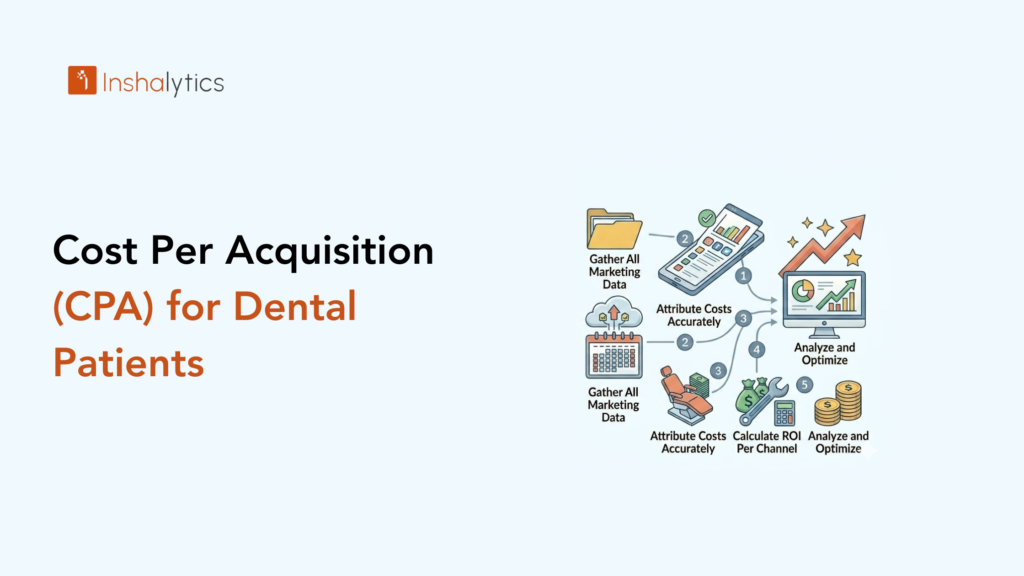
Your marketing is running, and patients are arriving. But at what cost? Cost per acquisition (CPA), called patient acquisition cost (PAC) in dental-specific contexts, is the single most important number for evaluating whether your marketing investment is profitable. Unlike cost per lead (which measures how efficiently inquiries are generated) or ROI (which measures overall return), CPA tells you specifically what you are paying to put a new patient in your chair. And whether that number is acceptable depends entirely on what that patient is worth once they are in your practice. This guide covers what CPA looks like across channels and practice types in 2026, how to calculate whether your specific CPA is acceptable, and how to reduce it when it is not.
What Is Cost Per Acquisition (CPA) for a Dental Practice?
Cost per acquisition measures the total marketing investment required to generate one new patient who attends an appointment. It is the revenue-facing metric that bridges the gap between marketing activity (leads generated) and marketing outcome (patients in chairs). Every dental marketing decision ultimately traces back to CPA: is what I am paying to acquire each patient justified by what that patient generates in production?
CPA vs. Cost Per Lead: Why the Distinction Matters
Cost per lead measures what you spend per inquiry. CPA measures what you spend per patient who books and attends. The difference is your conversion rate. If your Google Ads generates leads at $90 each and 35% of those leads become booked, attended patients, your CPA is $90 divided by 0.35, which equals $257.14. Cost per lead is an efficiency metric for the marketing channel. CPA is a profitability metric for the full acquisition system including front desk conversion. A low CPL with poor front desk conversion can produce a CPA that makes the channel unprofitable. A higher CPL with excellent conversion can produce a CPA that delivers strong ROI. Always evaluate both numbers together.
The CPA Formula Every Practice Owner Should Know
CPA = Total Marketing Spend divided by New Patients Acquired. Calculate this separately by channel: Google Ads CPA, local SEO CPA, email CPA, and social media CPA. Calculate it monthly and compare month over month. A declining CPA over time on a channel indicates improving efficiency. A rising CPA over time on a stable-spend channel indicates declining conversion, either from market saturation or from worsening lead quality. The dental marketing ROI framework shows how CPA connects to the broader ROI formula for each channel.
Why CPA Must Always Be Read Alongside Patient Lifetime Value
A CPA of $300 is excellent for a patient who accepts a $12,000 implant case and returns for hygiene for 10 years. The same CPA is poor for a patient who comes in on a $99 new patient special and cancels their second appointment. CPA without LTV context is an incomplete metric. Before deciding whether your CPA is acceptable, calculate your average patient lifetime value and establish the maximum CPA that keeps your LTV-to-CPA ratio at or above 5:1 (the minimum threshold for a profitable acquisition at most dental practices). That maximum CPA is your spending ceiling by channel.
What Is a Normal CPA for Dental Patients? (2026 Benchmarks)
The following benchmarks reflect 2026 US market data for dental practices running managed digital marketing programs. Actual CPA varies by market competition level, practice type, and channel maturity. These figures represent ranges for a well-managed program at benchmark performance.
General Dentistry CPA Benchmarks by Channel
For general dentistry practices targeting hygiene, restorative, and basic cosmetic patients in US markets in 2026:
• Google Ads: $150 to $300 per new patient. Competitive metro markets push toward $350 to $500.
• Local SEO (mature program, 12+ months): $50 to $150 per new patient. Cost declines as rankings compound without proportional spend increase.
• Email marketing (existing patient reactivation): $15 to $50 per reactivated appointment. Near-zero media cost makes this the most efficient channel on a per-patient basis.
• Social media paid: $150 to $350 per new patient for general dentistry targeting.
• Referrals: $15 to $35 per new patient. Lowest CPA of all channels but not scalable through direct spend.
Implant and Cosmetic Dentistry CPA: Why It Is Higher and Why That Is Fine
Implant and cosmetic dentistry CPA runs significantly higher than general dentistry because the keywords are more competitive and the patient decision cycle is longer, requiring more marketing touchpoints before conversion. Google Ads CPA for dental implant patients typically runs $300 to $600 per patient in standard markets and $600 to $1,500 in major metro areas with high implant keyword competition. A CPA of $500 for an implant patient who accepts a $6,000 single implant case represents a 12:1 first-case ROI. A CPA of $1,500 for a patient who accepts a $25,000 full-arch case represents a 16:1 ROI. The production value per patient makes the higher CPA entirely justifiable when correctly evaluated against case value. See Google Ads strategy for dental campaigns for the campaign types that produce the most efficient implant patient CPA.
How Practice Location and Competition Affect CPA
Market competition is the largest external variable affecting dental CPA. In less competitive suburban and rural markets, Google Ads CPCs for dental keywords may run $4 to $8 per click. In competitive metro markets (Los Angeles, New York, Chicago, Miami), CPCs for “dental implants near me” can reach $40 to $60 per click. At $50 CPC and a 5% landing page conversion rate, the cost per conversion is $1,000 before any front desk conversion is applied. This reality means that practices in high-competition markets either need larger budgets to achieve the same patient volume, or they must focus their marketing budget on the most efficient channels for their market (typically local SEO and Google Maps optimisation over broad paid search) to achieve a CPA that works against their average case values.
CPA Benchmarks by Marketing Channel for Dental Practices
The channel-level detail below helps practices evaluate whether their specific channel performance is at, above, or below benchmark before making budget allocation decisions.
Google Ads CPA: $150 to $300 for General Dentistry
A well-managed Google Ads campaign targeting general dentistry keywords in a moderately competitive US market should produce a CPA of $150 to $300 per new patient after 90 days of optimisation. Below $150 typically indicates either excellent landing page conversion (possible but rare) or low competition in a less-populated market. Above $300 for general dentistry in a standard market indicates either poor keyword targeting, weak landing page conversion, or above-average market competition that requires a strategy adjustment. For practices running Google Ads without a dedicated agency managing bid strategy, keyword negatives, and landing page optimisation, CPA is typically 30% to 60% higher than these benchmarks.
Local SEO CPA: Lower Over Time, Harder to Measure Short-Term
Local SEO CPA is the most difficult to calculate accurately and the most rewarding to track over time. At month 6 of an SEO program, if the program is generating 3 attributable new patients per month from organic search against a monthly SEO spend of $1,200, CPA is $400. At month 18, if the same program is generating 14 attributable new patients per month against the same $1,200 spend, CPA is $85.71. The investment is the same. The return has grown by compounding. This is why SEO CPA must be tracked on a rolling 3-month and 12-month basis rather than monthly snapshots. The local SEO guide for dental practices covers the ranking factors that determine how quickly CPA compresses in an SEO program.
Email Marketing CPA: The Lowest-Cost Channel for Existing Patients
Email marketing CPA for dental practices is calculated against the cost of the email platform and the staff time to send campaigns, typically $125 to $400 per month total. If a reactivation campaign generates 8 booked appointments at a platform cost of $150, CPA is $18.75 per appointment. This is the lowest achievable CPA in dental marketing because the audience already knows the practice, conversion rates are dramatically higher than cold acquisition channels, and the media cost is near-zero. The constraint is audience size: email reaches existing patients and requires a separate new patient acquisition strategy to grow the patient base that email then retains and reactivates.
Social Media CPA: When the Numbers Work and When They Do Not
Paid social CPA for general dentistry typically runs $150 to $350 per new patient. For high-ticket treatments (implants, Invisalign, cosmetic) where before-and-after creative generates strong consultation requests, CPA can be lower ($120 to $250) because the visual creative drives high intent from a specific treatment-considering audience. Social media CPA does not work at benchmark in two scenarios: when the ad creative is promotional rather than treatment-specific (promoting “new patient specials” to a cold audience generates low-intent leads that convert poorly), and when the follow-up process for social leads is slow (social leads have a shorter interest window than Google Ads leads and require same-day follow-up for acceptable conversion rates). The Facebook ads strategy for dental practices covers the creative and targeting setup that produces benchmark social CPA.
How to Calculate Whether Your CPA Is Acceptable for Your Practice
Benchmark CPA figures are reference points, not absolutes. Your specific CPA is acceptable when it produces an ROI that meets your practice profitability targets. Here is how to run that calculation.
The CPA-to-LTV Ratio: The Real Profitability Test
A CPA is acceptable when it produces an LTV-to-CPA ratio of at least 5:1. This means for every dollar you spend to acquire a patient, that patient generates at least five dollars in lifetime production. At an LTV of $8,000 per general dentistry patient (average annual value $1,000 times 8-year retention), the maximum CPA for a 5:1 ratio is $1,600. At an LTV of $3,500 for a patient who stays 4 years at $875 per year, the maximum CPA is $700. Most dental practices are acquiring patients well below their maximum justifiable CPA, which means they are underinvesting in patient acquisition. The dental patient LTV calculation shows how to run the full LTV estimate for your specific practice.
Working Backwards From Your Revenue Target to Your Maximum CPA
If your practice wants to add $20,000 in monthly production from new patients and your average new patient generates $900 in first-year production, you need 22 new patients per month. At a target CPA of $250, your monthly patient acquisition budget is $5,500. If your current Google Ads campaign is generating patients at $350 per patient, you either need to increase the budget to $7,700 to hit 22 patients, reduce your CPA through optimisation, or adjust the revenue target. This backwards calculation makes the budget conversation specific and grounded in production math rather than percentage-of-revenue rules.
When a High CPA Is Worth Paying (Implant Case Math)
A practice focused on full-arch implant cases ($20,000 to $30,000 per case) has a different maximum CPA calculation than a general dentistry practice. At a $25,000 average case value and a 40% net margin, each case generates $10,000 in net production. A CPA of $2,000 for that patient represents a 12.5:1 first-case ROI before accounting for any ongoing relationship value. At that margin, the practice can profitably outbid every general dentistry competitor for implant keywords on Google Ads, producing patient volume that general dentistry practices cannot match at those CPC levels. High CPA is not a problem when it is justified by high case value. The problem is when practices apply general dentistry CPA standards to specialty treatment marketing and cut campaigns that would have been highly profitable at the correct CPA ceiling.
How to Reduce Your Dental CPA Without Cutting Your Budget
CPA reduction does not require spending less. It requires converting more of the leads you are already generating and targeting the leads most likely to convert at the lowest cost.
Improve Lead-to-Patient Conversion Rate: The Fastest CPA Fix
If your CPL is $80 and your conversion rate is 25%, your CPA is $320. Improving conversion to 40% without changing marketing spend drops CPA to $200, a 37.5% reduction at zero additional media cost. The three highest-impact conversion rate improvements are: implementing missed-call text-back, training front desk on the top three objection scenarios (cost, insurance, scheduling), and adding a same-day callback process for voicemails. These three changes together typically move conversion rates from the 25% to 30% range into the 35% to 45% range in 60 to 90 days.
Improve Keyword Targeting and Negative Keywords in Google Ads
A significant portion of Google Ads spend at most dental practices goes to clicks that will never convert to patients: competitors researching your ads, people searching for dental school clinics, patients searching for their existing dentist by name, and people outside your service area. Implementing a comprehensive negative keyword list eliminates these clicks from your budget, reducing wasted spend and improving CPA automatically. Google Ads keyword match type management (moving from broad match to phrase and exact match for your highest-value keywords) further tightens targeting and reduces CPL, which directly reduces CPA without requiring additional spend.
Shift Budget Toward Lower-CPA Channels as Data Accumulates
After 90 days of tracking CPA by channel, your data will show which channels are generating patients below your maximum CPA threshold and which are above it. Shift budget from above-threshold channels toward below-threshold channels. If local SEO is generating patients at $120 CPA and Google Ads is generating them at $280 CPA, the correct move is to increase SEO investment (which will compound and lower CPA further) while optimising Google Ads targeting to improve its CPA toward benchmark. The dental marketing budget guide covers the full framework for channel budget allocation based on CPA performance data.
How Inshalytics Tracks and Optimises CPA for Dental Clients
CPA optimisation is not a one-time adjustment. It is a continuous process of tracking conversion rates, adjusting targeting, testing landing pages, and shifting budget toward the highest-performing acquisition channels based on monthly data. Inshalytics builds and manages this process for dental practices.
Channel-Level CPA Reporting That Guides Budget Decisions
Every monthly report from Inshalytics for dental clients includes CPA by channel, trended over 3 months to show whether CPA is improving or declining on each channel. Budget allocation recommendations in each monthly report are based on CPA trend data: channels with declining CPA (increasing efficiency) receive increased allocation, and channels with rising CPA receive targeted optimisation work before budget decisions are made. This data-driven allocation process replaces the budget-set-and-forget approach that most practices use and that leaves budget on underperforming channels for months before anyone notices.
Typical CPA Improvements in the First 90 Days
In the first 90 days of an Inshalytics engagement, CPA improvements for new dental clients typically come from three sources: attribution corrections (practices discover they were attributing fewer patients to specific channels than were actually arriving, so measured CPA drops simply from better tracking), front desk conversion process improvements (converting a higher percentage of existing leads from the same budget), and negative keyword cleanup in Google Ads (eliminating wasted clicks that inflated CPL). The combination of these three typically produces a 15% to 35% reduction in measured CPA within 90 days without any increase in media spend.
Want to know what your real CPA is and whether it is justified by your patient LTV? Talk to Inshalytics about a CPA audit and optimisation plan for your practice.