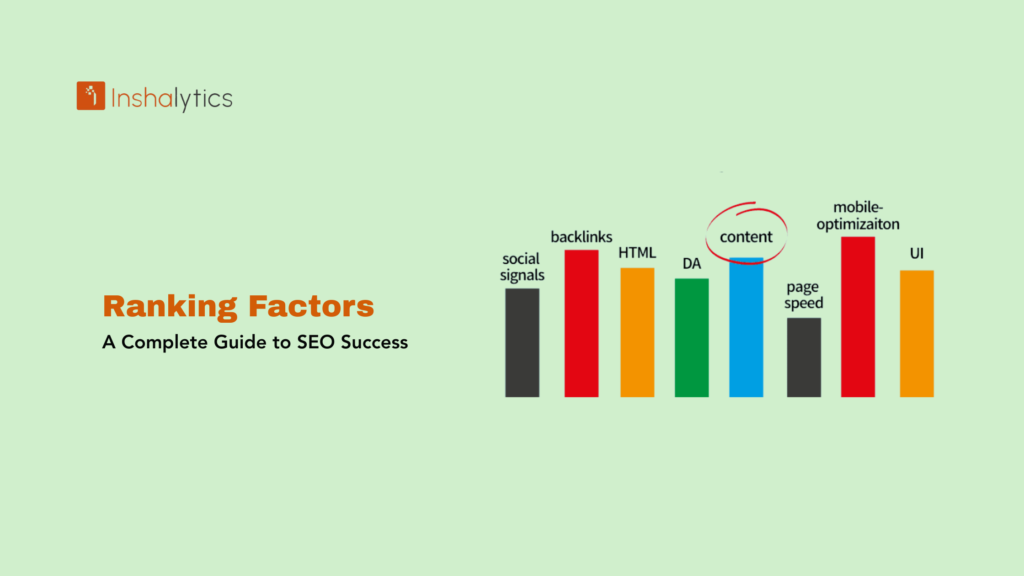
Ranking factors are the criteria and signals that search engines use to evaluate, score, and determine the position of web pages in search results. These elements ranging from content quality and backlinks to page speed and mobile-friendliness help search engines answer the fundamental question: “Which pages deserve to rank highest for this query?” While Google considers over 200 ranking factors in its algorithm, not all carry equal weight, and their importance varies depending on the query type, industry, and user context.
Understanding ranking factors is essential for SEO success because they represent the guidelines for what search engines value. By optimizing for the most important factors, you improve your chances of ranking higher, attracting more organic traffic, and achieving better visibility in search results.
Navigate This Post
Why Ranking Factors Matter
Search engines exist to provide users with the most relevant, helpful, and trustworthy results for their queries. Ranking factors are the measurable ways search engines evaluate whether a page meets these standards.
For digital marketers and website owners, ranking factors serve as a roadmap for optimization. Rather than guessing what might improve rankings, you can focus efforts on factors proven to influence search positions. However, it’s important to understand that ranking factors work together holistically excelling in one area while neglecting others won’t produce optimal results.
Categories of Ranking Factors
Ranking factors can be organized into several major categories, each addressing different aspects of what makes a webpage valuable to users.
1. Content Quality Factors
Content remains the foundation of SEO, and multiple factors evaluate its quality and relevance.
Content Relevance – How well the page’s content matches the search query and user intent. Pages that comprehensively address what users are searching for rank better than tangentially related content.
Content Depth and Comprehensiveness – Thorough coverage of topics demonstrates expertise and provides more value than superficial treatment. Search engines favor comprehensive content that fully answers user questions.
Content Freshness – For queries where recency matters (news, current events, trending topics), newer or recently updated content ranks higher. Freshness is less important for evergreen topics.
Content Originality – Unique, original content ranks better than duplicate or copied material. Search engines penalize sites with substantial duplicate content.
E-E-A-T (Experience, Expertise, Authoritativeness, Trustworthiness) – Particularly crucial for YMYL (Your Money or Your Life) topics affecting health, finances, or safety. Content demonstrating real experience and expertise from qualified authors ranks better.
Keyword Optimization – Strategic, natural inclusion of target keywords in content helps search engines understand topic relevance without keyword stuffing.
Content Format and Media – Use of images, videos, infographics, and other media that enhance user understanding and engagement positively impacts rankings.
2. Backlink Factors
Links from other websites remain one of the strongest ranking signals, acting as votes of confidence in your content.
Number of Backlinks – Generally, more backlinks indicate greater authority and trustworthiness, though quality matters more than quantity.
Backlink Quality – Links from authoritative, trusted websites carry significantly more weight than links from low-quality or spammy sites.
Link Relevance – Backlinks from topically related websites are more valuable than links from unrelated sites.
Anchor Text – The clickable text in links provides context about the linked page’s content. Natural, descriptive anchor text is ideal.
Link Diversity – Links from many different domains indicate broader recognition than multiple links from the same few sites.
Follow vs. Nofollow – While nofollow links don’t pass direct ranking value, they contribute to a natural link profile and can drive traffic.
Link Growth Rate – Natural, steady link acquisition is healthier than sudden spikes that might indicate manipulation.
3. On-Page SEO Factors
Elements directly on your webpage that search engines analyze for relevance and quality.
Title Tags – The HTML title appearing in search results significantly impacts rankings. It should include target keywords naturally and accurately describe page content.
Meta Descriptions – While not a direct ranking factor, compelling meta descriptions improve click-through rates, which can indirectly influence rankings.
Header Tags (H1, H2, H3) – Proper heading hierarchy helps search engines understand content structure and topic organization.
URL Structure – Clean, descriptive URLs containing relevant keywords are easier for search engines to understand than parameter-heavy URLs.
Internal Linking – Strategic links between pages on your site help search engines discover content, understand site structure, and distribute authority.
Image Optimization – Descriptive alt text, appropriate file names, and compressed file sizes improve accessibility and page speed.
Schema Markup – Structured data helps search engines understand content context and can enable rich snippets in search results.
4. Technical SEO Factors
Behind-the-scenes elements affecting how search engines crawl, index, and evaluate your site.
Page Speed – Fast-loading pages provide better user experiences and receive ranking advantages. Google’s Core Web Vitals specifically measure loading performance, interactivity, and visual stability.
Mobile-Friendliness – With mobile-first indexing, pages must perform well on mobile devices. Responsive design and mobile optimization are essential.
HTTPS/SSL – Secure sites with SSL certificates receive a ranking boost and display trust signals to users.
Site Architecture – Logical, well-organized site structure helps search engines crawl efficiently and users navigate easily.
XML Sitemap – Provides search engines with a roadmap of your site’s important pages, facilitating complete indexing.
Robots.txt – Properly configured robots.txt files guide crawlers on which pages to access and which to avoid.
Crawlability – Sites must be accessible to search engine bots without technical barriers preventing access.
Canonical Tags – Properly implemented canonical tags prevent duplicate content issues by indicating preferred page versions.
Core Web Vitals – Google’s specific metrics for page experience:
- Largest Contentful Paint (LCP) – Loading performance
- First Input Delay (FID) / Interaction to Next Paint (INP) – Interactivity
- Cumulative Layout Shift (CLS) – Visual stability
5. User Experience and Engagement Factors
Signals indicating how users interact with and respond to your content.
Click-Through Rate (CTR) – The percentage of users who click your listing in search results. Higher CTRs suggest compelling, relevant results.
Dwell Time – How long users stay on your page before returning to search results. Longer dwell time indicates satisfying content.
Bounce Rate – The percentage of visitors leaving after viewing only one page. High bounce rates may signal poor relevance or user experience.
Pogo-Sticking – When users quickly return to search results and click different listings, it suggests your content didn’t satisfy their needs.
Return Visitors – Users returning to your site indicates valuable content worth revisiting.
Social Signals – While not confirmed direct ranking factors, social shares and engagement correlate with quality content and can drive traffic and backlinks.
6. Domain-Level Factors
Site-wide characteristics affecting all pages on your domain.
Domain Age – Older domains with consistent publishing histories tend to have more established authority, though new domains can still rank well with quality content.
Domain Authority – Overall strength and trustworthiness of your entire domain based on backlink profile, content quality, and technical optimization.
Brand Signals – Branded searches, brand mentions, and recognition as an established entity positively influence rankings.
Site Speed (Overall) – Fast-loading sites throughout provide better experiences than sites with a few fast pages among many slow ones.
Content Volume and Quality – Sites with substantial high-quality content demonstrate expertise and attract more backlinks and traffic.
7. Local SEO Ranking Factors
For location-based queries, specific factors determine local search rankings.
Google Business Profile Optimization – Complete, accurate profiles with verified information rank better in local results.
NAP Consistency – Name, Address, and Phone number must be consistent across all online directories and citations.
Local Citations – Mentions of your business on local directories, review sites, and local websites.
Reviews and Ratings – Quantity, quality, and recency of customer reviews significantly impact local rankings.
Proximity – Physical distance from the searcher’s location affects local pack rankings.
Local Content – Content relevant to local events, news, and community topics strengthens local relevance.
How Ranking Factors Have Evolved
Search engine algorithms continuously evolve to better serve user needs and combat manipulation.
Early SEO (1990s-2000s)
Ranking factors were simplistic, focusing mainly on keyword density and basic backlinks. This led to widespread manipulation through keyword stuffing and link farms.
Modern SEO (2010s)
Google’s Panda (content quality), Penguin (link quality), and Hummingbird (semantic search) updates shifted focus toward quality over quantity and user intent over keyword matching.
Current SEO (2020s)
AI-powered algorithms like BERT, MUM, and RankBrain understand natural language, context, and user intent at sophisticated levels. E-E-A-T, user experience metrics, and Core Web Vitals have become increasingly important.
Future Trends
AI-generated content detection, entity-based search, multi-modal search (text, voice, visual), and personalization will likely shape future ranking factors.
Optimizing for Ranking Factors: Best Practices
Focus on High-Impact Factors
Prioritize the factors with the greatest influence: content quality, relevant backlinks, user experience, and technical optimization. Don’t waste time on minor factors with negligible impact.
Think Holistically
Strong performance across multiple factor categories produces better results than excelling in one area while neglecting others. Balance content quality with technical optimization and user experience.
Align with User Intent
The most important ranking factor is satisfying user intent. Create content that genuinely helps users accomplish their goals, and other factors will naturally improve.
Stay Updated
Search algorithms evolve constantly. Follow official search engine blogs, industry publications, and SEO experts to understand ranking factor changes.
Avoid Over-Optimization
Focusing too heavily on specific factors can result in unnatural, low-quality content. Optimize for search engines while prioritizing genuine user value.
Measure What Matters
Track rankings, organic traffic, engagement metrics, and conversions. These outcomes reveal whether your ranking factor optimization efforts are effective.
Common Misconceptions About Ranking Factors
Myth: All ranking factors carry equal weight – Reality: Different factors have vastly different impacts, and importance varies by query type and industry.
Myth: Social media shares are direct ranking factors – Reality: While social signals correlate with rankings, they’re not confirmed direct factors. Their value lies in driving traffic and potential backlinks.
Myth: More content always ranks better – Reality: Content length matters only when additional words add value. Comprehensive content outperforms both thin and unnecessarily long content.
Myth: Ranking factors are universal – Reality: Factor importance varies by query intent, industry, and competition level.
Myth: You can perfectly optimize for all factors – Reality: Some factors conflict (e.g., loading speed vs. rich media). Focus on balance and user value.
Conclusion
Ranking factors represent the measurable criteria search engines use to determine which pages deserve top positions in search results. While Google considers over 200 factors, success comes from focusing on the most impactful elements: creating high-quality, relevant content; earning authoritative backlinks; providing excellent user experiences; and maintaining strong technical foundations.
Rather than obsessing over every minor ranking factor, concentrate on the fundamental principle underlying all factors: providing genuine value to users. When you create content that comprehensively addresses user needs, build a fast and accessible website, and establish authority through quality backlinks and expertise, rankings improve as a natural consequence.
The most successful SEO strategies treat ranking factors as guidelines for creating better websites rather than checkboxes to manipulate search engines. By aligning optimization efforts with what genuinely helps users, you build sustainable visibility that withstands algorithm updates and delivers long-term results.
Key Takeaway: Ranking factors are the elements search engines evaluate when determining page positions in search results, including content quality, backlinks, user experience, technical optimization, and domain authority. Understanding and optimizing for the most important factors while maintaining holistic quality is essential for SEO success.