
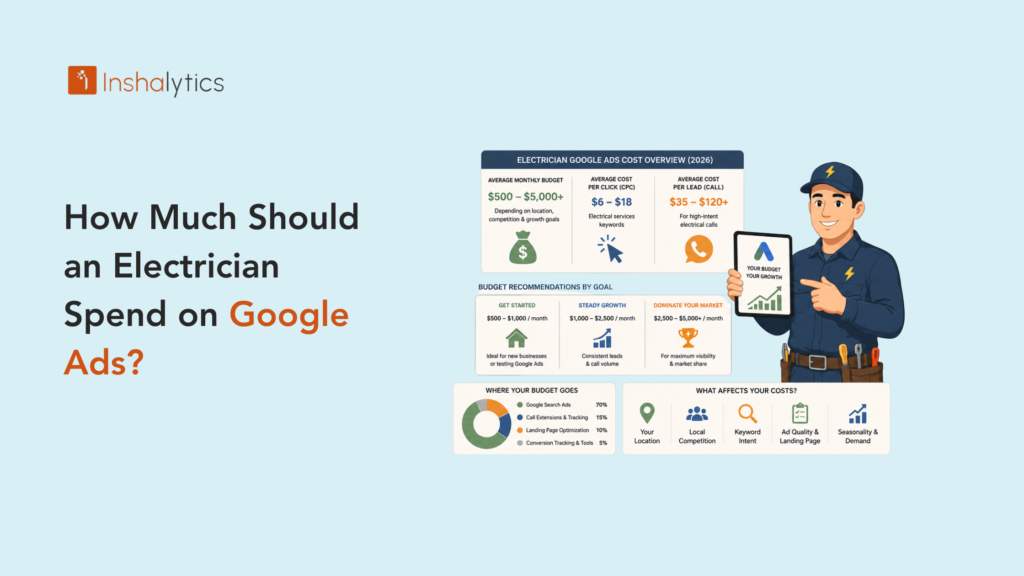
Ask five sources how much an electrician should spend on Google Ads and the answers range from a few hundred dollars a month to several thousand, which is technically all correct and practically useless without knowing why the range is so wide. This guide is specifically about Google Ads and Local Services Ads spend. For a broader look at marketing budget across SEO, social, and website investment too, the full electrician marketing budget guide covers that wider picture. In this guide, we cover electrician Google ads cost and what to do next.
Here, the focus is narrow and practical: what actually moves an electrician from the low end of that range to the high end, what a realistic 2026 cost breakdown looks like by service type, and a simple way to size a starting budget around your own numbers instead of an industry average.
Why Is the “Right” Budget Range So Wide?
The right Google Ads budget for an electrician depends primarily on market competitiveness and which services are being advertised, which is why national averages span such a wide range. A rural single-operator business and a multi-crew company in a competitive metro are simply not solving the same problem, even though both are technically “electricians running Google Ads.”
What Pushes You Toward the Low End
Smaller or less competitive markets, a narrower service focus, and starting with Local Services Ads rather than traditional search all tend to keep starting budgets lower without sacrificing meaningful visibility.
A single-crew electrician in a smaller town, focused mainly on residential repair work, can often maintain solid visibility on a modest monthly budget precisely because the competitive field isn’t bidding it up.
What Pushes You Toward the High End
Competitive metro markets, a mix of high-value commercial and emergency keywords, and running full traditional search alongside LSAs all push budget upward, often justified by correspondingly larger average job values.
A multi-crew company chasing both emergency residential calls and larger commercial panel work in a major metro is playing an entirely different budget game, and comparing its spend directly to a smaller operator’s isn’t a useful comparison either way.
2026 Cost Breakdown by Service Type
Different electrical services carry meaningfully different costs per click and per lead, and budgeting as if they’re all the same wastes money in both directions.
Emergency and Residential Repair Keywords
[STAT NEEDED: verify current cost-per-click and cost-per-lead ranges for emergency and residential electrical keywords before publishing] Emergency keywords tend to carry a premium cost per click, offset by fast, high-conversion behavior, since the searcher is ready to book immediately rather than comparing options.
This premium is usually worth paying, since the alternative, losing the call to a competitor who did bid on the term, costs more in lost revenue than the extra click expense ever would.
Residential repair keywords outside of true emergencies, like a flickering outlet or a tripped breaker, tend to fall somewhere between emergency and planned-purchase pricing, worth their own dedicated ad groups rather than folding into either extreme.
Panel Upgrades and Commercial Electrical Work
Panel upgrade and commercial electrical keywords typically carry a higher cost per lead than residential terms, which is generally justified by job values that can run into the thousands of dollars rather than a few hundred.
Budgeting for this category separately, rather than averaging it in with faster, lower-ticket residential work, gives a much clearer picture of whether the higher spend is actually paying off.
EV Charger Installation: A Lower-Cost Opportunity
EV charger installation keywords remain a comparatively under-bid opportunity as of 2026, with lower competition and cost per click than more established service categories, making this a strong candidate for a dedicated smaller campaign as the niche continues to grow.
Getting into this category early, before competition catches up and drives costs higher, is one of the more straightforward wins available in electrician PPC right now.
LSAs vs. Traditional Search: Where Should Your First Dollars Go?
For most electricians starting out, Local Services Ads should generally get the first dollars, since they’re pay-per-lead rather than pay-per-click and typically produce a lower cost-per-booked-job early on. Traditional search adds value on top of that once the LSA foundation is established.
Why Pay-Per-Lead Often Wins the Math Early On
Paying only for a verified lead, rather than every click regardless of outcome, removes a major source of budget waste for a business that’s still learning what converts in its market. This makes LSAs a lower-risk starting point than jumping straight into full search campaigns.
For a business without an existing track record of tracked conversions to optimize a full search campaign against, this lower-risk starting point matters more than it might seem on paper.
When to Add Traditional Search on Top
Once LSAs are producing consistent volume, layering in traditional search focused specifically on high-value keywords like panel upgrades, or on emergency terms where paying for guaranteed placement matters, extends reach without abandoning the lower-cost foundation already working.
This staged approach avoids the common mistake of launching every channel at once before there’s enough data to know which one deserves the larger share of budget.
Sizing Your Budget Around Cost-Per-Booked-Job, Not a Round Number
The most reliable way to set a starting budget isn’t picking a number that sounds reasonable. It’s working backward from what a booked job is actually worth.
Working Backward From Your Average Job Value
Starting with average job value and a target cost-per-booked-job that still leaves healthy margin, then working backward through an estimated close rate and cost per lead, produces a far more defensible budget than starting with an arbitrary monthly figure and hoping the math works out.
This approach also makes it obvious when a budget simply isn’t large enough to generate a meaningful number of leads in a given market, which is a far better thing to discover on paper than three months into a live campaign.
It also gives a clear number to check performance against once the campaign is live, rather than judging results against a vague sense of whether things feel like they’re working.
A Simple Formula for Your Starting Monthly Budget
Divide target monthly booked jobs by an estimated close rate to get a required lead volume, then multiply that by an expected cost per lead for the relevant service mix. The result is a budget grounded in your own numbers rather than a generic range pulled from somewhere else.
Revisiting this formula every quarter, as real close rate and cost per lead data accumulates, sharpens the budget over time instead of leaving it fixed on a first estimate.
When Should You Increase, Hold, or Cut Your Spend?
Increase spend when cost-per-booked-job is comfortably profitable and the business has capacity for more jobs. Hold spend when performance is stable but capacity is tight. Cut or restructure spend when cost-per-booked-job is trending in the wrong direction despite reasonable optimization.
Signals It’s Time to Scale Up
A consistently profitable cost-per-booked-job, technician capacity to take on more work, and a market that isn’t yet saturated with competing bids are the clearest signals that additional budget will convert into additional profit rather than diminishing returns.
Scaling before these signals are in place usually just amplifies whatever inefficiency already exists in the account, so it’s worth confirming the fundamentals are solid before increasing spend.
Signals You’re Overspending for What You’re Getting
Rising cost per lead without a corresponding rise in close rate, inconsistent lead generation despite steady spend, or a growing gap between cost-per-lead and cost-per-booked-job all suggest the budget needs restructuring before it needs increasing.
Continuing to increase spend on a campaign showing these signals rarely fixes the underlying problem. It just spends more money finding out the same issue on a larger scale.
There’s no single right number for how much an electrician should spend on Google Ads, but there is a right way to arrive at one: start with what a booked job is actually worth, size the budget backward from there, and lean on Local Services Ads early before layering in traditional search. That approach produces a number specific to your business, not a generic range that may not fit it at all.
Related reading: Google Ads for Electricians: Getting Calls for Panel Upgrades and
Want help building a starting budget based on your own average job value and the market? Get a free budget-sizing worksheet built around your numbers.