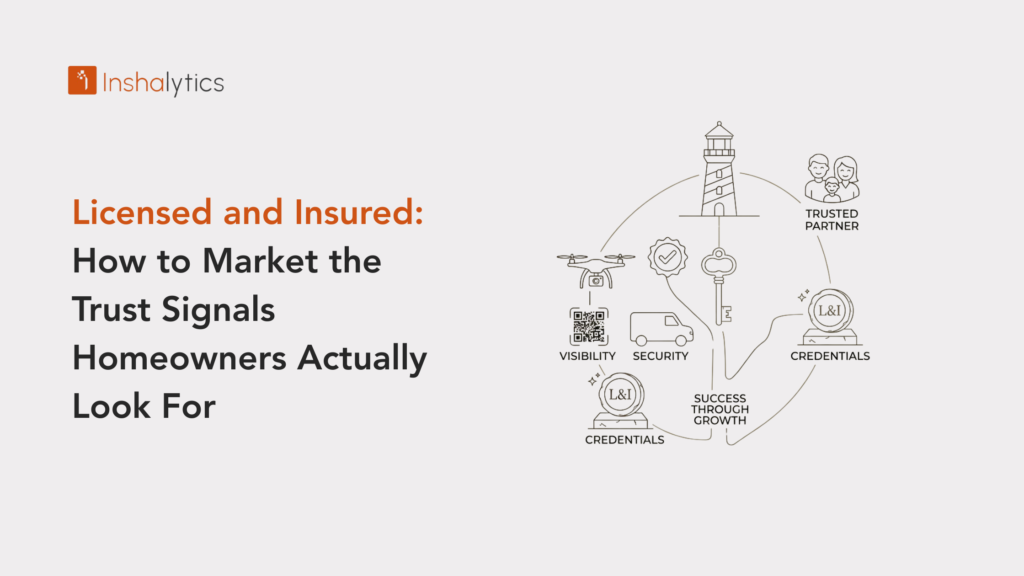
Almost every handyman website says the same three words: licensed, bonded, insured. Homeowners have seen the phrase so many times it barely registers anymore, sitting in a small font in the footer next to the copyright year. That is a problem, because these credentials are still one of the strongest reasons a homeowner picks one business over another. They just are not being marketed like it.
Most content on this topic explains why licensing and insurance matter to a homeowner. Very little explains how a business should actually market them so the message lands and converts into a booked job. This guide covers what these credentials really mean, which specific trust signals move the needle beyond the credentials themselves, and where to put them so they turn into booked jobs instead of getting lost in the footer.
What “Licensed, Bonded, and Insured” Actually Means
Licensed, bonded, and insured are three separate protections, and most homeowners and more than a few businesses treat them as one interchangeable phrase. Each one covers a different risk, and knowing the difference is what lets you explain it clearly instead of just repeating the phrase like a slogan.
Licensing: What It Verifies About Your Work
A license means your state or local jurisdiction has confirmed you meet a baseline standard of training and legal requirements for the work you perform. Requirements vary by trade and by state, and many places set a project dollar threshold above which a license becomes mandatory rather than optional.
For homeowners, a license is the closest thing to a guarantee that the person in their home has actually been vetted by someone other than themselves. It is also verifiable, which matters: a homeowner who wants to check can usually look up an active license number directly through their state’s licensing board.
Bonding vs. General Liability vs. Workers’ Comp
A bond protects the homeowner from dishonest acts, like a job left unfinished after being paid, backed by a third-party insurer rather than your own pocket. General liability insurance covers property damage or injury caused by your work, so if a technician damages flooring or a fixture, the homeowner is not left paying for it themselves out of pocket.
Workers’ compensation protects the homeowner too, just indirectly: if a technician is injured on their property and you carry no coverage, the homeowner can be pulled into that liability through their own homeowner’s insurance. Explaining this distinction, rather than lumping all three under one buzzword, is itself a trust signal, because it shows the homeowner you understand what you’re actually offering them.
Why Homeowners Confuse All Three
Most marketing, including a lot of handyman marketing, treats “licensed, bonded, and insured” as a single stamp of approval instead of three distinct protections. That is understandable, since spelling it out takes more words than a tagline allows, and most businesses default to the shorthand everyone else uses.
But a homeowner who understands what each piece actually protects them from trusts the business more than one who is just taking the phrase on faith. A short explanation, even a sentence or two on a service page or in an estimate, does more work than the phrase alone ever will.
The Trust Signals That Actually Move the Needle
Licensing and insurance matter, but they are not the only signals homeowners are reading. Some of the most persuasive ones have nothing to do with paperwork at all.
Response Time as a Credibility Signal
A business that replies within a few hours reads as organized and paying attention. A business that takes two days to answer a simple question raises doubt before any work has even started, regardless of how many credentials sit on the website.
Response time is a trust signal homeowners feel immediately, and it is one almost entirely within a business’s control. It costs nothing to fix beyond building the habit, and it often does more for conversion than any single piece of marketing copy.
Review Consistency Over Review Volume
A steady stream of recent reviews signals an active, currently operating business. A large pile of old reviews with nothing recent can actually raise more questions than it answers, since a homeowner scanning dates notices when the most recent one is over a year old.
Building a simple, consistent system for collecting reviews does more for trust over time than chasing a single big number. Recency and consistency read as proof the business is still delivering, not just that it once was good.
Showing Proof, Not Just Claiming It
Anyone can type the words “licensed and insured” into a website footer. Fewer businesses actually show the license number, offer to send a certificate of insurance before the job, or have a technician who can produce ID and documentation on request.
That extra, visible step is what separates a claim from proof, and homeowners can tell the difference, even if they never actually ask to see the paperwork. Just knowing it’s readily available changes how the claim is read.
Where to Display Your Credentials for Maximum Impact
Having the right credentials only helps if homeowners actually see them at the moments that matter, not buried somewhere they’ll never scroll to.
Google Business Profile and Website Placement
For most homeowners, your Google Business Profile is the first real impression they get, often before they ever visit your website. Licensing and insurance details belong in the business description, not buried in an About page nobody clicks.
On the website itself, credentials should appear in a few key spots:
• Near the top of the homepage, visible without scrolling
• On every individual service page, not just a single general trust page
• Inside quote or estimate confirmation emails
• On the booking or contact page, right where a homeowner is deciding to commit
On-Site Verification Documents Techs Can Show
A laminated card or a simple printout with license number, insurance carrier, and a phone number to verify it gives a technician something concrete to hand a hesitant homeowner. This matters most on first-time jobs, when trust has not been built yet through experience.
It also reinforces the message set by the website and ads, so the same story is told consistently from the first Google search all the way to the technician standing at the front door.
Ad Copy and Landing Page Messaging
In paid ads, “licensed and insured” competes for space with a dozen other claims. Pairing it with a specific, concrete detail, like the license type or years of coverage, makes the ad copy stand out from competitors making the same generic claim without any specifics behind it.
If the landing page a homeowner lands on doesn’t reinforce the same message, a website that doesn’t convert undoes the work the ad just did, and the click ends up wasted.
Turning Trust Signals Into Booked Jobs, Not Just Impressions
Trust signals only matter if they actually change whether someone books. Here is where they connect directly to lead quality and cost.
Building Trust Messaging Into Paid Ad Campaigns
Ads that lead with credentials and proof, not just price, tend to attract homeowners who are further along in deciding to hire rather than still shopping on cost alone. That shift shows up directly in close rate, since a homeowner who clicked because of a trust message is already partway sold before the phone even rings.
This works best when the specific credential detail appears in the ad itself, not just on the landing page it leads to. A headline mentioning a license type or years of coverage earns a click from a more decided searcher than a generic price-led ad ever will.
Why Cost-Per-Booked-Job Improves When Trust Signals Are Clear
Cost-per-booked-job, not cost-per-lead, is the number that actually reflects whether trust messaging is working. A campaign built around clear credentials and proof often produces fewer, more qualified leads, but a higher share of those leads convert into an actual booked job rather than a homeowner who calls three competitors and picks whoever answers first.
That trade-off, fewer leads at a lower overall cost-per-booked-job, is usually a win even when the raw lead count looks smaller on a dashboard.
Local SEO and Review Systems That Reinforce Credibility
Trust signals compound with local SEO. A well-optimized Google Business Profile with strong, recent reviews and visible credentials reinforces every other marketing channel pointing back to it, so the work put into ads or website copy is not undone the moment someone checks your listing before calling.
A homeowner who clicks an ad and then quickly checks the Google listing before dialing is a common path to a booked job. If that listing doesn’t reinforce the same credentials the ad promised, the trust built by the ad can unravel in seconds.
Building a Trust-First Brand That Outlasts Price Competition
Businesses that compete purely on price are always one cheaper competitor away from losing the job. Trust signals give homeowners a reason to choose you that has nothing to do with being the lowest bid.
Avoiding the Race-to-the-Bottom Pricing Trap
When price is the only differentiator homeowners can see, someone will always undercut it, often an uninsured operator with lower overhead and none of the protections a licensed business carries. Leading with proof and protection instead of price gives homeowners a reason to pay slightly more with confidence, rather than treating every quote as interchangeable.
This shift takes deliberate effort, since price is the easiest thing to compare and the easiest thing to lead with by default. Businesses that consistently win on trust instead have usually made a conscious choice to feature credentials ahead of price in every piece of marketing.
Making Licensing and Insurance Part of Your Core Marketing Message
Rather than treating credentials as a small compliance detail, the businesses that convert best build their entire trust story around them: what each credential protects, how to verify it, and what happens if something goes wrong. That message, repeated consistently across the website, ads, and in-person interactions, is what turns a generic tagline into a real competitive advantage instead of background noise.
Consistency matters more than any single clever line. A homeowner who sees the same clear trust message on the ad, the website, and the technician’s paperwork ends up more confident than one who sees three different, disconnected versions of the same claim.
“Licensed and insured” only works as a marketing message when homeowners understand what it actually protects them from, and when they can see proof rather than just a claim. The businesses that explain it clearly, display it prominently, and back it up with fast response times and consistent reviews are the ones that turn credentials into booked jobs instead of ignored footer text.
Not sure if your current listings and website are actually putting your credentials to work? Get a free review of your Google Business Profile and website to see where trust signals are being lost.