Most handyman businesses start with paid leads because they need work now, and organic search takes time. That is a reasonable short-term decision. Where it goes wrong is when “temporary paid leads while SEO builds” becomes permanent paid lead dependency because the SEO side never gets started. The result is a business that keeps paying for every lead it gets, indefinitely, with no improvement in lead cost over time. Local SEO and paid leads are not mutually exclusive, and they are not direct competitors in the same category. They operate on different timelines, different cost trajectories, and different risk profiles. This guide runs the cost comparison over a 24-month horizon so you can see exactly what each channel costs in months 1, 6, 12, and 24, and what the compound difference looks like at each stage. The existing SEO vs. Google Ads comparison covers which channel is better for your situation. This post focuses specifically on the cost trajectory over time.
How Paid Lead Costs Move Over Time
Paid lead costs are predictable and flat. This is both their strength and their weakness. You know what you are paying per lead. You know it will cost the same next month and the month after. You also know it will not get cheaper.
The Flat Cost Trajectory of Shared Platform Leads
Angi, Thumbtack, and HomeAdvisor lead cost what they cost. Your decade of experience, your 80 five-star reviews, and your 100% response rate on the platform do not reduce what you pay per lead. Platform pricing is set by the platform based on market demand for leads in your category and geography, not by your individual account quality. Industry data shows shared handyman lead costs have increased year over year since 2020 as more contractors enter the platforms and compete for the same pool of homeowners. What cost $15 per lead in 2020 typically costs $25 to $50 in 2026 in most US markets. Your cost trajectory on shared platforms trends upward without any corresponding improvement in lead quality or exclusivity.
The Cost Profile of Google Ads Over 24 Months
Google Ads costs are not flat because the algorithm improves with data. A Google Ads campaign that has been running for 12 months has significantly more conversion data than a campaign in its first 30 days, and that data enables better automated bidding that typically reduces cost per lead over the first 6 to 12 months of a well-managed campaign. After 12 months, Google Ads CPL for handyman services in a given market tends to stabilise, though it can increase as competition for popular keywords grows. The ceiling is higher than shared platforms because your ad quality score, landing page performance, and account history can reduce your effective cost per click relative to less-optimised competitors. But the fundamental characteristic remains: stop paying, stop receiving leads.
How Local SEO Costs Move Over Time
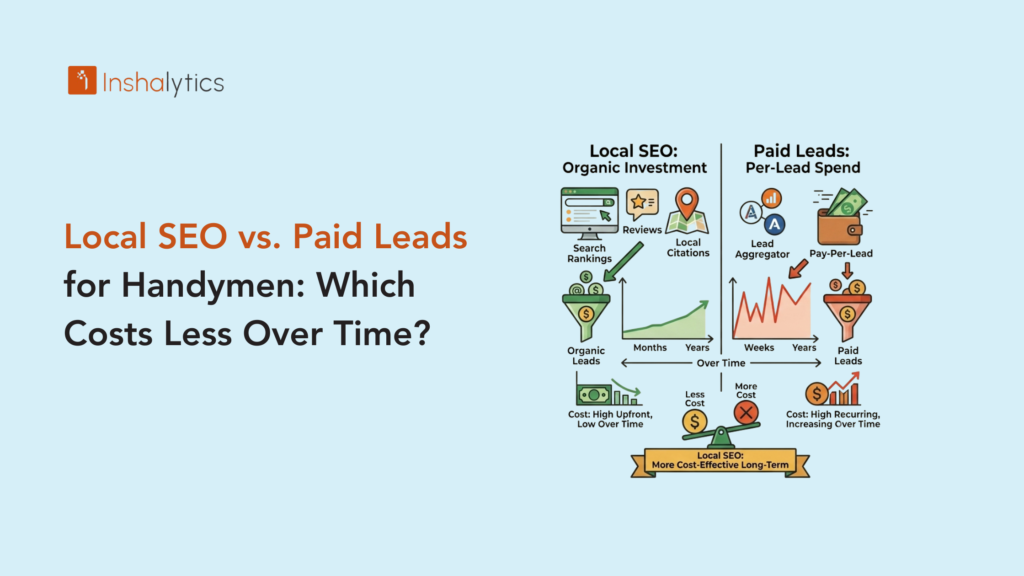
Local SEO costs move in the opposite direction from paid leads. The investment is front-loaded: the first 6 to 12 months require the most work and produce the least attributable lead volume. After month 12, the cost curve inverts as compounding rankings deliver increasing lead volume against stable or decreasing investment costs.
The Investment Phase: Months 1 to 9
In the first 9 months of a local SEO program for a handyman business, the primary work is foundational: GBP optimisation, technical website fixes, citation building, review generation, and content production targeting service-specific and location-specific keywords. During this phase, attributable organic leads from SEO are minimal. The cost per attributable SEO lead during the investment phase is high because the denominator (organic leads generated) is small relative to the monthly investment. This is the phase where most handyman businesses that started SEO stop it, declaring it ineffective. They stopped just before the compounding effect began.
The Compounding Phase: Months 10 to 24
At months 10 to 14 for a typical handyman business in a moderately competitive US market, local SEO rankings begin delivering consistent attributable leads from organic search. As the business continues its SEO investment and the rankings mature, organic lead volume grows while the monthly investment cost remains relatively stable. The cost per organic lead compresses as volume grows against a flat cost base. By month 18 to 24, a well-executed handyman SEO program typically delivers organic leads at an effective cost of $25 to $65 per lead (SEO investment divided by monthly organic lead volume) with close rates of 35% to 45%, producing a cost per booked job of $55 to $185. The full local SEO timeline and milestone framework for handyman businesses is covered in the local SEO guide for handyman services.
The 24-Month Cost Comparison: Side by Side
The following comparison uses realistic monthly investment levels for a handyman business choosing between the two strategies. Numbers are illustrative and based on industry benchmarks; actual results vary by market and execution quality.
Scenario A: Shared Platform Leads Only ($800/month)
Month 1: 32 leads at $25 average, 4 booked jobs at 12% close rate, cost per booked job $200. Month 6: Same numbers (platform costs have not changed). Month 12: 28 leads (competition has increased slightly, quality has declined), 3.4 booked jobs, cost per booked job $235. Month 24: 26 leads (platform costs now $31 per lead), 3.1 booked jobs, cost per booked job $258. Total 24-month lead spend: $19,200. Total jobs booked from the platform: approximately 81. Average cost per booked job over 24 months: $237. Asset built: None. Pipeline value if spend stops: Zero.
Scenario B: Local SEO Only ($800/month)
Month 1: 0 attributable organic leads (investment phase). Month 6: 4 to 6 organic leads (early ranking movement), 2 booked jobs, effective cost per booked job $400. Month 12: 15 to 20 organic leads, 7 booked jobs at 40% close rate, effective cost per booked job $114. Month 24: 25 to 35 organic leads, 12 booked jobs at 40% close rate, effective cost per booked job $67. Total 24-month SEO spend: $19,200. Total jobs booked from organic: approximately 105 (weighted toward months 10 to 24 when volume compounds). Average cost per booked job over 24 months: $183. Asset built: GBP ranking, domain authority, review base, and established local search presence. Pipeline value if spend stops: Significant. Rankings decay slowly over 12 to 18 months, not immediately.
Why the Comparison Favours a Combined Approach
Pure SEO in months 1 to 6 produces very few jobs, which is a cash flow problem for a business that needs revenue now. Pure shared platform leads for 24 months produce more jobs in months 1 to 6, but cost 40% more per booked job by month 24 and build nothing. The practical conclusion: use shared platform leads or Google Ads as a cash-flow bridge during the SEO investment phase (months 1 to 9), then reduce paid spend as organic volume grows in months 10 to 24. This is the compound strategy that produces the best 24-month economics: immediate revenue from paid channels plus compounding cost reduction from organic channels building simultaneously. The full lead generation guide for handyman businesses covers how to build and manage this dual-channel approach.
The Risk Profile Difference Between SEO and Paid Leads
Cost trajectory is not the only dimension of the comparison. Risk profile matters too, and the two channels have very different risk characteristics.
Paid Lead Risk: Platform Dependency and Price Volatility
Paid lead dependency creates business risk that compounds over time. The platform sets the price, controls the lead quality, and can change either without notice. Handyman businesses that have built their entire pipeline on a single platform have seen their cost per lead increase 40% in a single year, their lead quality decline as the platform accepts more contractor accounts competing for the same homeowner pool, and their business revenue becomes directly tied to a platform pricing decision they cannot influence. This is the risk profile of a business that rents its pipeline from a party with different incentives. The impact of lead marketplace dependency covers the long-term risk in detail.
SEO Risk: Timeline Uncertainty and Algorithm Sensitivity
Local SEO carries a different risk profile. The timeline to meaningful organic lead volume is uncertain and varies by market competition, execution quality, and starting domain authority. A poorly executed SEO program can produce low returns well past month 12. Google algorithm updates can affect organic rankings, though local SEO for handyman businesses is generally less volatile than organic search for competitive national keywords. The primary SEO risk is the investment phase: 6 to 12 months of spend before significant returns arrive. This risk is managed by tracking leading indicators (keyword position improvements, GBP impressions, website organic traffic) during the investment phase to confirm the program is on the right trajectory before month-12 returns arrive.
How Inshalytics Manages the Paid-to-Organic Transition for Handyman Clients
Inshalytics builds handyman lead systems that use paid channels for immediate revenue while SEO compounds in the background. We set a specific month-by-month milestone plan for each client: which paid channels to use at what spend levels during the SEO investment phase, when to expect the first significant organic lead volume, and how to reduce paid dependency as organic volume grows. The goal is a 24-month transition from a primarily paid pipeline to a primarily organic one, with paid channels retained for specific high-value service targeting where the economics justify them permanently.
Want to see what the paid-to-organic transition looks like for your handyman business and market? Talk to Inshalytics about a 24-month lead cost trajectory for your specific situation.