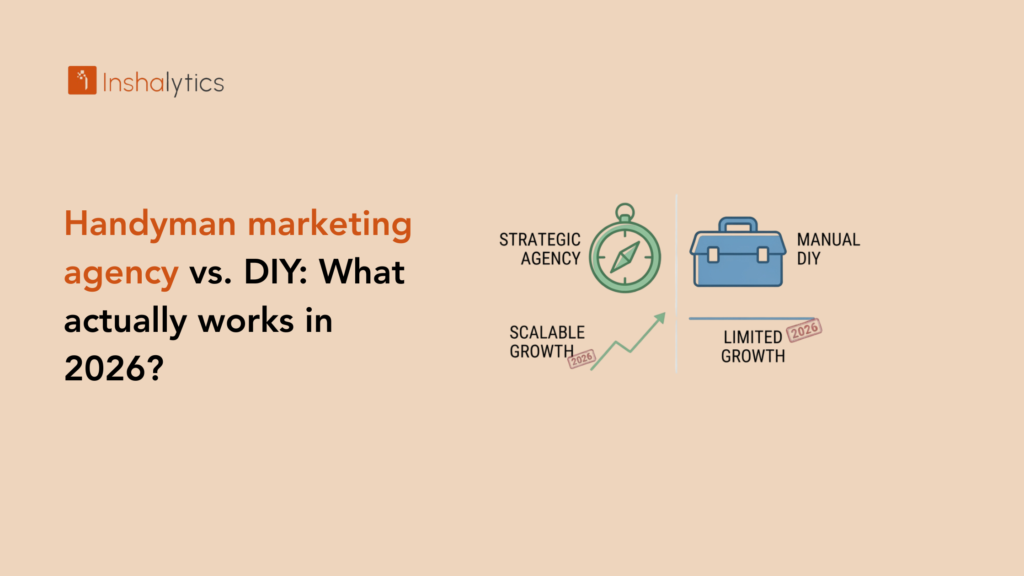
The default advice for small handyman businesses is always to try DIY marketing first. Handle your own Google Business Profile, post on Facebook, maybe run a small ad yourself. See what sticks before paying someone.
That advice made sense in 2015. In 2026, the gap between what a well-run marketing system delivers and what a time-strapped handyman can build between jobs has widened considerably. The question is not whether DIY or agency marketing exists; both clearly do. The question is what each actually costs in real terms, what each can realistically produce, and which one fits where your business is right now.
This guide gives you an honest comparison, not a sales pitch for agencies, and not a DIY cheerleading session. Just the actual tradeoffs.
Why the DIY vs. Agency Decision Looks Different for Handyman Businesses
The handyman business has a specific economic profile that changes how you should think about marketing investment. It’s not a legal firm or a software company. The inputs job ticket size, volume required, margin structure shape which marketing approaches actually pencil out.
Handyman Economics: Small Tickets, High Volume, Thin Margins
The average handyman job is worth $200–$600. To generate meaningful monthly revenue, most handyman businesses need a high volume of bookings, which means a high volume of leads. That volume requirement changes the math on marketing investment.
An agency charging $2,000/month needs to produce roughly 15–20 incremental booked jobs per month at a $350 average ticket to justify the investment at a 3:1 return. That’s achievable in most markets but it requires a well-run program, the right channels, and an operator who closes leads at a reasonable rate.
DIY marketing can work at lower volume. If you’re a solo handyman trying to fill 8–10 jobs per week in a single city, a well-maintained Google Business Profile and a focused local SEO effort might get you there without an agency. The moment you’re trying to scale beyond one crew or dominate a competitive metro, the time and expertise requirements of DIY start working against you.
The Time Cost DIY Marketers Never Account For
DIY marketing is not free; it costs your time, which has a real dollar value. If your billable rate is $85/hour and you’re spending 10 hours per month managing your own ads, writing content, updating your GBP, responding to reviews, and troubleshooting campaign performance, you’re investing $850 of your time in marketing.
That’s before accounting for the learning curve. Google Ads has enough complexity that operators making their first campaign routinely waste 30–40% of their budget on misconfigured settings, broad match keywords, or traffic sent to the wrong landing pages. The common mistakes handyman marketing approach produces are well-documented, and most of them come from operators trying to run channels they don’t fully understand.
What Changes When You’re Trying to Scale Past One Crew
Solo operators filling their own calendar have a different problem than two-crew operations trying to maintain consistent lead flow across multiple service types and a wider geographic area. The complexity scales faster than most people expect.
A GBP you manage yourself works fine when you have one location and one service area. It starts showing its limits when you need consistent lead flow in five cities, across eight service categories, while maintaining a 4.8-star review average. At that point, the system requirements exceed what most owner-operators can realistically manage between jobs.
What a Handyman Can Realistically DIY in 2026
Some channels are genuinely manageable as DIY. Others require expertise, time, or tooling that most handyman business owners can’t practically maintain. Here’s where the line falls.
Google Business Profile: The One Thing Worth Managing Yourself
Your Google Business Profile is the highest-return free marketing asset available to a handyman business. Fully optimized, actively managed, it can generate inbound calls in your primary service area at zero cost per click. GBP optimization for handyman businesses is genuinely learnable and genuinely worth your time.
The basics of GBP management accurate categories, a complete services list, consistent photo uploads, prompt review responses, and regular posts can be handled by the business owner. What gets harder is understanding why your rankings are flat despite a complete profile, or why a competitor with fewer reviews is ranking above you. That’s where technical SEO knowledge starts to matter.
As a starting point, own your GBP yourself. Update it consistently, generate reviews from every completed job, and treat it as an active channel rather than a static listing.
Review Generation: Systems You Can Run Without an Agency
Review velocity is one of the most significant ranking factors for local handyman businesses, and generating reviews is entirely within your control. A simple system works: send a text message with a direct link to your Google review page within 24 hours of completing a job.
This doesn’t require an agency. It requires consistency and a template you can send with two taps. The handymen who dominate their local Map Pack almost always have the most reviews and the most recent reviews, and they got there by asking after every single job, not by running a complex campaign. How reviews impact handyman lead generation is worth reading if you want the data behind this.
Nextdoor, Facebook Pages, and Free Visibility Channels
Nextdoor Business Pages, a Facebook business page with regular before-and-after photos, and community group engagement are all channels a handyman can manage without professional help. They’re also channels where showing up consistently matters more than showing up perfectly.
A solo handyman who posts two job photos per week on Facebook, responds to every community request for handyman recommendations on Nextdoor, and keeps their Google Business Profile updated will build meaningful local visibility over six to twelve months. It’s slow, but it compounds.
Where DIY Handyman Marketing Breaks Down
There are specific points in the marketing stack where DIY consistently underdelivers, not because handymen aren’t capable, but because the channels require expertise and time that most owner-operators can’t realistically provide.
Google Ads Without Expertise: The Budget Drain Nobody Talks About
Google Ads is one of the most effective lead generation channels for handyman businesses when it’s managed well. It is also one of the fastest ways to waste a marketing budget when it isn’t. Keyword selection, match type settings, negative keyword lists, bid strategy, and landing page alignment are all variables that significantly affect performance and all variables that take time to learn.
An operator who launches a Google Ads campaign without this knowledge will typically see a 30–50% budget waste rate in the first 60–90 days. On a $1,500/month ad spend, that’s $450–$750 in budget going to irrelevant traffic, competitor research queries, and job-seekers looking for handyman employment.
The comparison of SEO vs. Google Ads for handyman businesses is worth reviewing before you launch any paid campaign yourself.
Local SEO at Scale: Why Solo Operators Hit a Ceiling
Basic local SEO one location, one city, core services is manageable without professional help. SEO across multiple service types, multiple cities, and against well-funded competitors is a different challenge.
Building location pages for eight cities, creating service-specific content for each of your twelve service categories, building citations across 50+ directories, earning backlinks from locally relevant sites, and fixing the technical issues that suppress rankings this is a full-time scope, not a part-time management task. Most owner-operators who try to handle this themselves either do it inconsistently (which produces inconsistent results) or not at all (which produces no results).
The Attribution Problem: Not Knowing What’s Actually Working
The most costly consequence of DIY marketing is often not a wasted campaign it’s the inability to know which channels are producing which results. Without call tracking, UTM parameters, conversion goals in GA4, and a systematic lead source question at the point of booking, you have no reliable way to know whether your Facebook posts, your GBP, or your Google Ads are generating your jobs.
This means you can’t cut what isn’t working. You can’t scale what is. Tracking handyman lead sources is not glamorous marketing work, but it’s the foundation of every decision that follows.
What a Good Handyman Marketing Agency Actually Does Differently
A marketing agency worth hiring doesn’t just run campaigns better than you would. It builds systems, provides expertise, and creates accountability that a DIY approach structurally can’t replicate.
Lead System Design vs. Running Campaigns
The distinction between a good agency and a bad one is often this: a bad agency runs campaigns. A good agency designs a lead system where every channel feeds the same funnel and every dollar of spend is tracked back to booked jobs.
For a handyman business, this means your Google Ads landing page is built to convert handyman-specific searches, your GBP sends people to the same phone number as your ads, your review generation feeds your LSA ranking, and your content targets the exact searches your best customers are making. These components working together produce results that no individual channel can deliver alone.
Tracking That Connects Marketing Spend to Booked Jobs
The best handyman marketing agencies build attribution infrastructure before they launch a single campaign. Call tracking numbers for each channel, form tracking in GA4, UTM parameters on every link, and monthly reporting that shows cost per lead and cost per booked job, not just sessions and impressions.
This is the accountability layer that makes the investment defensible. When you can see that your Google Ads generated 24 leads last month, 9 of which became booked jobs at an average of $380, you know exactly what that channel is worth. You can’t see that from a DIY setup without significant technical investment.
Owned Assets: Who Keeps the Website, Ad Accounts, and Data
One of the most important questions to ask any marketing agency is asset ownership. Everything built for your business the website, the Google Ads account, the campaign history, the content should be yours to keep if you leave.
Agencies that build inside their own accounts and retain ownership on exit are not building you a marketing asset. They’re building themselves leverage. Before signing anything, clarify who owns every component, and make sure the answer is you. Read why handyman marketing agencies fail to understand the specific patterns that lead to bad outcomes.
The Honest Comparison: Costs, Outcomes, and What Each Option Requires From You
Here’s the actual comparison, without the spin.
When DIY Makes Sense (And When It’s Costing You More Than You Think)
DIY handyman marketing makes sense when:
- You’re a solo operator trying to fill 6–10 jobs per week in one city
- You have time to consistently manage your GBP, generate reviews, and post to social channels
- Your market is not highly competitive and basic visibility is achievable without significant investment
- You’re in the first 6–12 months of business and volume is not yet there to justify agency spend
DIY stops making sense when your inconsistency starts costing you leads, when your ad spend is producing poor results because of poor setup, or when the opportunity cost of the time you’re spending on marketing exceeds what an agency would charge to do it better.
When to Hire an Agency: The Business Signals That Matter
Consider professional help when:
- Your schedule is inconsistent: some weeks full, others empty, and you can’t identify why
- You’ve tried Google Ads yourself and couldn’t make the math work
- You’re operating across more than one city, and your rankings don’t reflect your actual service area
- You’re spending more than 10 hours per month on marketing tasks that aren’t producing measurable results
The point at which agency investment becomes mathematically obvious is different for every business. But the signal is usually the same: you know your marketing isn’t working at its potential, and you don’t know why.
How to Evaluate a Handyman Marketing Agency Before You Commit
The questions that reveal whether an agency is worth hiring:
- Can you show me attribution reporting from a current handyman client not impressions, but leads connected to booked jobs?
- Who owns my ad accounts, website, and content if I leave?
- What does success look like at 90 days in specific, measurable terms?
- How do you handle handyman seasonality, and what does your slow-season strategy look like?
- What’s your contract structure and exit clause?
Any agency that answers all five confidently, specifically, and without deflection is worth a second conversation.
How Inshalytics Approaches Handyman Marketing Differently
At Inshalytics, we don’t sell handyman businesses on agency dependency. We build systems designed to generate owned, exclusive leads the kind where a homeowner finds your business specifically, reads your reviews, and calls your number. Not a shared contact sold to three other contractors.
Building Owned Lead Systems, Not Rented Channel Dependency
The core of every Inshalytics handyman program is the distinction between owned leads and rented leads. Platforms like Angi and Thumbtack rent you access to homeowners, and the moment you stop paying, that access is gone. The SEO rankings, GBP authority, and campaign history we build for your business are assets that appreciate over time.
This is the same reason why building a marketing funnel that feeds from multiple owned channels produces better long-term economics than any single paid channel can deliver alone.
What Our Handyman Programs Include From Day One
Every Inshalytics handyman program begins with a full audit of current rankings, GBP completeness, competitor visibility, citation consistency, and existing lead sources. The audit drives the strategy. We don’t apply a template; we build for your market, your service mix, and your business size.
We handle the channels that require expertise: Google Ads setup and management, local SEO, and LSA optimization, while coaching you on the channels that work best when the business owner is involved, particularly review generation.
Ready to find out whether your market and business stage make sense for a professional program? Talk to the Inshalytics team; we’ll give you a straight answer, including if DIY is the better call right now.
The handyman marketing agency vs. DIY question doesn’t have one answer. It has an answer for where your business is right now.
Start with the channels you can genuinely manage consistently: your GBP, your reviews, and your free social presence. Add professional help when the complexity of the channels, the volume required, or the time cost of doing it yourself starts producing diminishing returns. And when you hire, evaluate agencies on accountability and asset ownership, not pitch decks and vague promises.
The goal is a lead system that keeps your calendar full without requiring you to be the marketing department. That’s true whether you build it yourself or hire someone to build it for you.