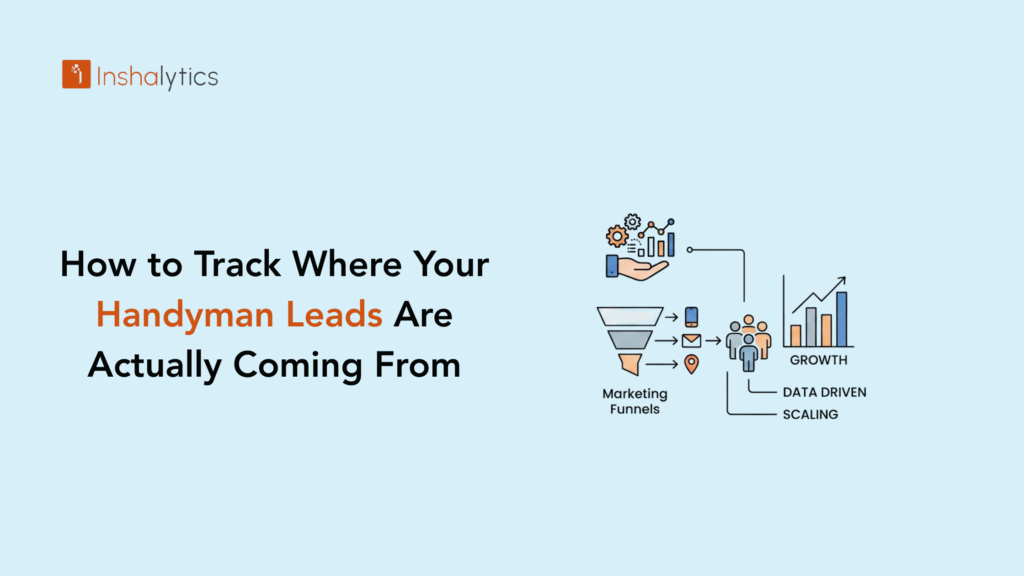
If you’re running Google Ads, doing some SEO work, and getting calls, that’s great. But do you actually know which of those activities is booking jobs? Most handymen don’t. They have a rough sense, ‘I think most calls come from Google,’ but no proof. Without proof, you can’t make smart decisions about where to invest next, and you’ll almost certainly kill a channel that’s working or fund one that isn’t. This guide shows you how to track where your handyman leads are coming from, with practical setups that work even without a dedicated marketing team.
Why Most Handymen Have No Idea Which Marketing Is Working
The gap between ‘I’m getting calls’ and ‘I know exactly what’s generating those calls’ is wider than most contractors realize. It’s not a reflection of intelligence; it’s a reflection of how lead tracking is rarely set up correctly from the start.
The ‘How Did You Hear About Us?’ Problem
Asking customers how they found you is better than nothing, but it’s unreliable. People forget. They say ‘Google’ when they mean they Googled your name after seeing your yard sign. They say ‘word of mouth’ when they actually clicked a Facebook ad that reminded them of a referral from six months ago. Human recall doesn’t map onto marketing attribution with any precision. It gives you a rough sense of your strongest channels, but it can’t tell you which specific keyword, ad, or page generated a profitable call.
What Misattributed Leads Actually Cost You
Here’s the real damage misattribution causes: you cut a channel that’s working because you can’t see its contribution, and you double down on a channel that looks busy but isn’t actually driving booked jobs. Many handyman businesses abandon their Google Ads or SEO mid-campaign because the attribution was broken, not the strategy. Our breakdown of the true cost of bad leads for handyman businesses quantifies exactly what this costs in real revenue terms.
The Three Things You Need to Track for Every Lead
Good lead attribution answers three questions for every single inquiry that comes in. Until you can answer all three, your marketing data is incomplete.
How Did They Find You? (Channel Attribution)
This is the top-level question: did this person find you through a Google search, a Facebook ad, a Yelp profile, a referral, a yard sign, or something else? Each of these needs a distinct path that you can trace back. For digital channels, this means having separate tracking mechanisms per source, different phone numbers for different campaigns, UTM parameters on links, and proper Google Analytics configuration. If everything points to the same phone number and the same website URL, you can’t distinguish between sources.
What Did They Search or Click? (Keyword and Source Data)
Within the ‘Google search’ bucket, there’s a second level of attribution: what did they search for before they called? Did they type ’emergency handyman near me’ or ‘deck repair estimate ‘? Those two searchers have different urgency levels, different job values, and different conversion behaviors. This data lives in your Google Ads search terms report and in Google Analytics 4’s organic landing page report. It tells you which specific intent signals are driving your most profitable jobs. Our guide to keyword research shows how to find those high-value terms systematically.
What Converted Them? (Landing Page or Form Tracking)
The third attribution layer is conversion tracking: what action did the lead take, and from what page? Did they call from your Google Business Profile listing? Did they fill out a form on your water damage page? Did they click the call button on a paid ad landing page? Each of these conversion paths should fire a tracking event in Google Analytics or your call tracking platform. Read our guide on landing pages to understand how each page should be set up to capture this data.
How to Set Up Basic Lead Tracking Without a Big Budget
You don’t need enterprise analytics software to track your handyman leads properly. A few well-configured free and low-cost tools cover the essentials for most small handyman businesses.
Call Tracking Numbers: One Per Channel, Minimum
The most impactful single change most handyman businesses can make is implementing unique phone numbers per marketing channel. Use your real business number for your physical signage and business cards. Get a separate tracking number for your Google Ads campaign, another for your GBP listing, and another for any Facebook ads you run. When a call comes in, the tracking system logs which number was dialed, giving you accurate channel-level attribution. CallRail and WhatConverts are the most common tools for this in the home services space, with plans starting around $45–$65 per month for basic call tracking.
UTM Parameters: How to Tag Your Links the Right Way
UTM parameters are small pieces of text added to the end of URLs that tell Google Analytics where a visitor came from. When you post a link to your website in a Facebook ad, email, or Yelp profile, adding UTM tags lets Analytics record exactly which source sent that visitor. You can build UTM URLs for free using Google’s Campaign URL Builder. A properly tagged Facebook ad URL might look like: yoursite.com/handyman-services?utm_source=facebook&utm_medium=paid-social&utm_campaign=spring-2026. See our guide on on-page SEO optimization for how proper URL structure supports your tracking setup.
Google Analytics 4 Goals: What to Track and What to Ignore
In GA4, set up conversion events for the actions that matter: phone number clicks, form submissions, and direction requests from your GBP. These are the signals that indicate a lead. Ignore bounce rate, average session duration, and pageviews as primary metrics; they tell you about traffic behavior but nothing about lead quality. Configure your GA4 property to fire conversion events when a phone number link is clicked on mobile, when a contact form is submitted, and when someone spends significant time on a high-intent page like your emergency services listing.
Understanding Attribution Models: Which One Is Right for Your Handyman Business?
Once you’re collecting attribution data, you need to decide how to credit it. Attribution models determine which touchpoint gets credit for a conversion, and different models tell different stories about your marketing.
First-Touch vs. Last-Touch: What Each Misses
First-touch attribution gives 100% of the credit to the first thing that introduced a lead to your business. Last-touch gives 100% to the final touchpoint before the conversion. Both are partial truths. A homeowner might see your Facebook ad in January, search Google and find your organic listing in March, and then click your Google Ad in April when the job finally becomes urgent. First-touch credits Facebook. Last-touch credits the ad. Neither tells the full story.
Why Home Service Businesses Should Lean on Assisted Attribution
For handyman businesses running multiple channels, the most useful attribution view is assisted conversion reporting, which shows the touchpoints that appeared in the path before a conversion happened, even if they weren’t the final click. This view shows you which channels are doing awareness and consideration work versus which ones are closing the final intent. It often reveals that a channel you were about to cut was actually assisting a large portion of your booked jobs. Our handyman marketing funnel guide explains how each channel contributes to the full customer journey.
The Simple CRM Approach for Solo Operators
If full attribution modeling feels like overkill, start simpler: build a basic lead log in a spreadsheet or your job management software. For every job you book, record the lead source, the job type, the job value, and whether it was a first-time or repeat customer. After 90 days, you have real revenue attribution by source, not click-level precision, but enough to know that your Google Ads generated $12,000 in revenue while your Angi listings generated $2,800 on the same budget. That’s actionable intelligence without enterprise software.
What Good Lead Source Data Lets You Do
Accurate attribution isn’t just a reporting exercise it directly changes how you make marketing decisions.
Cut Channels That Look Busy but Don’t Book Jobs
Some channels generate a lot of activity that looks like engagement but produces few booked jobs. Social media followers, website sessions from informational blog posts, and Angi impression counts can all look like marketing momentum without producing revenue. With proper lead tracking, you can identify exactly which sources are generating calls that convert versus calls that don’t. Read more about handyman lead quality vs. quantity to understand how to evaluate this for your own business.
Double Down on What’s Actually Filling Your Calendar
Knowing your cost per booked job by channel is the single most powerful number in your marketing dashboard. If your Google LSA campaign is generating booked jobs at $45 each and your Facebook campaign is at $180 each, that’s not a close decision. The same logic applies to keywords within Google Ads: if ’tile repair handyman ‘ books jobs at $35 and ‘handyman near me’ books at $95, your bidding strategy should reflect that difference.
Prove ROI to Yourself Before Scaling Any Channel
Before you increase the budget in any channel, you should be able to show yourself a positive return from that channel at the current spend level. Attribution data makes this possible. Without it, scaling is gambling. With it, scaling is a calculated decision: you know your cost per acquisition, the average job value, and the margin. If the math works, increase the budget. If it doesn’t, fix the conversion before adding volume.
How Inshalytics Builds Lead Attribution Into Every Campaign
Every campaign we run for home service clients is built with full-funnel tracking from the start. We don’t report on clicks and impressions; we report on booked jobs, cost per booked job, and channel-level revenue attribution. See how our handyman lead generation services are structured around this standard.
Full-Funnel Tracking: From First Click to Booked Job
We configure call tracking, GA4 conversion events, and UTM parameters across every traffic source before a single ad launches. Every lead that comes in is tagged with a source, medium, and campaign. We connect that data to your job management system wherever possible so that we can report not just on leads but on jobs completed and revenue generated by channel. Our broader digital marketing services are all built on this attribution foundation.
Why We Report on Booked Jobs, Not Just Form Fills
A form fill is a leading indicator. A booked job is a result. Many agencies stop tracking at the form fill and call that a conversion. We track the call, the call outcome, and, where possible, the job value. See exactly what this looks like in practice on our lead generation service page. Want to know which of your current marketing channels is actually filling your calendar? Book a free audit with Inshalytics, and we’ll show you where your leads are coming from and where you’re likely losing revenue you didn’t know you had.