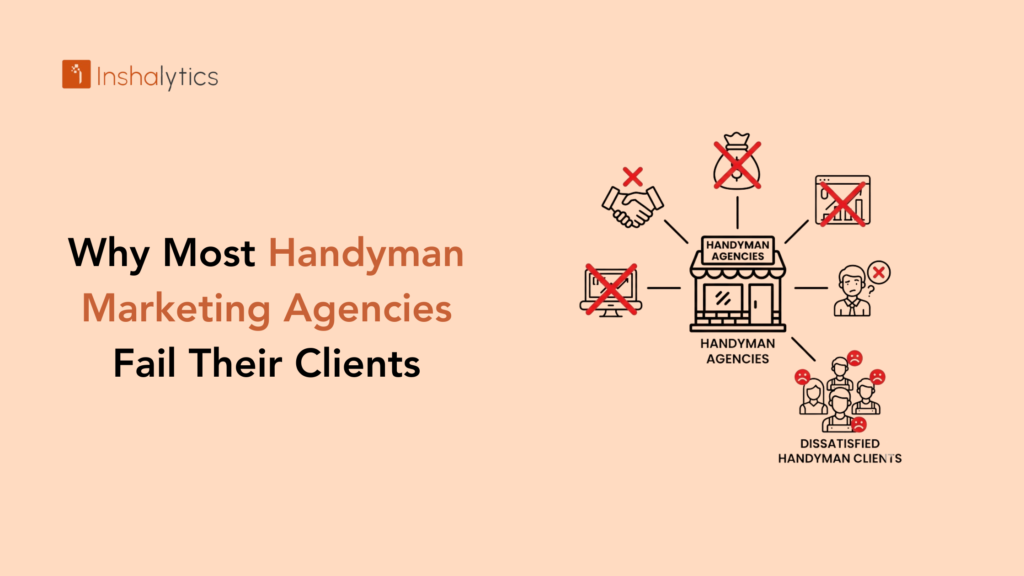
You signed the contract. You paid the retainer. You answered the onboarding questions and handed over access to your Google account. And then for the next several months, you received monthly reports full of graphs, a few emails from an account manager, and no meaningful increase in inbound calls.
This is not an uncommon story. In fact, it is one of the most consistent experiences handyman business owners share when they come to us after leaving another agency relationship. The frustration is real, the time lost cannot be recovered, and the root cause is almost always the same: the agency was not built for your industry.
This article breaks down why marketing agencies fail handyman clients, how to recognize the failure early, and what a marketing partnership that actually works looks like.
The Structural Problem With Most Marketing Agencies Serving Handymen
The agency industry’s failure rate with home service clients is not primarily a problem of effort or intent. It is a structural problem with how most agencies are built and what they understand.
They Don’t Understand Home Services, So They Apply Generic Frameworks
A generalist agency serves multiple industries using adapted versions of the same core frameworks. They understand marketing mechanics, how SEO functions, how to run PPC campaigns, and how to produce content. What they often do not understand is the specific buyer psychology, local search dynamics, and trust-based decision process that define home service marketing.
For a handyman business, the most important marketing channels are local search (Google Business Profile, Map Pack ranking, local keywords), review management, and trust-based content. A generalist agency that allocates budget toward brand awareness campaigns and social engagement is optimizing for the wrong variables in your market, and the results reflect that misalignment.
Handyman Marketing Requires Local, Trust-Based, Urgency-Driven Strategy, Not Generic Campaigns
A homeowner searching for a handyman is making a decision in minutes, not weeks. They are evaluating trust signals, reviews, photos, and proximity, not brand identity or social media presence. The marketing strategy that produces results in this environment is entirely different from the one that works for a product brand or a professional services firm.
An agency without this understanding applies the same levers they use for other clients: content volume, social engagement, and general brand awareness. These levers are not wrong in principle; they are wrong for your specific buyer at your specific moment of decision.
Why an Agency That Also Serves Tech Startups and E-commerce Cannot Serve You Well
Industry specialization is not about exclusivity; it is about depth of understanding. An agency that serves tech startups, e-commerce brands, professional service firms, and handyman businesses is not developing deep expertise in any of them. They are applying general principles across diverse categories.
Inshalytics focuses on home services. That focus means our frameworks are built around how local service businesses actually grow, not adapted from a different category and applied here.
The Five Most Common Ways Marketing Agencies Fail Handyman Businesses
Pattern recognition is the most useful tool for evaluating whether your current agency situation is working. These five failure modes appear consistently in failed home service marketing relationships.
Chasing Traffic and Impressions Instead of Calls and Booked Jobs
The most common agency failure mode is optimizing for inputs rather than outputs. Traffic is an input. A phone call is an output. Monthly website visitors are an input. Booked jobs are an output. An agency that celebrates traffic increases while your call volume stays flat has confused the metric for the goal. Traffic that does not convert to calls is not advancing your business; it is advancing the report.
Leading With Paid Ads Before Building the Local SEO Foundation
Paid advertising without an organic foundation is expensive and fragile. A homeowner who clicks your Google Ad and arrives at a website with no photos, sparse content, and a poor mobile experience will not call. A homeowner who discovers your business organically, reads your reviews, and then sees your ad as a confirmation of your credibility will.
Agencies that jump to paid advertising without first ensuring the conversion infrastructure on your website, your GBP, and your reviews is in order are spending your budget on traffic that leaks. The right sequence is foundation first, then amplification. Our SEO services always precede paid channel investment in our engagements.
Going Silent After Onboarding: No Strategy, No Reporting, No Accountability
This failure mode is the most common complaint from handyman business owners who have worked with agencies: an enthusiastic onboarding process, followed by weeks of silence, followed by a monthly report that raises more questions than it answers, followed by an account manager who is hard to reach.
A real marketing partner communicates proactively. They flag when something is not working before you ask. They explain what they are doing and why. They connect the work to the results. Silence after onboarding is not efficiency it is the first sign that the relationship is not going to produce what it promised.
Vanity Metrics That Look Good on Reports but Mean Nothing for Revenue
Impressions, reach, keyword rankings for terms that nobody actually searches, social media engagement rates, these numbers look like progress in a report without necessarily producing any revenue. An agency that fills monthly reports with these metrics while call volume stagnates is providing the appearance of accountability without the substance.
The metrics that matter for a handyman business are: inbound call volume, lead source attribution (where are calls coming from?), cost per acquired customer, and booked job conversion rate. Every other metric should be explained in terms of how it contributes to one of these outcomes.
Building Their Own Assets Instead of Ones You Own and Control
This is perhaps the most damaging failure mode, because it is often invisible until the relationship ends. Some agencies build your website on their own platform, manage your Google Ads under their own account, and create your content in tools that belong to them. When the relationship ends, you leave with nothing, or you pay a transition fee to recover assets that should have been yours from day one.
A trustworthy agency builds everything in your accounts, on your platforms, under your ownership. Full admin access from day one is non-negotiable.
How Do You Know if Your Current Agency Is Failing You?
The signs of a failing agency relationship are usually visible if you know what to look for, and easier to identify before the contract renewal than after.
The Monthly Reporting Audit: What the Numbers Should Actually Show
Request a breakdown of your monthly lead volume and its source. How many phone calls came in? Where did they come from: organic search, paid ads, or direct? What was the conversion rate on those contacts to booked jobs? If your agency cannot answer these questions with specific numbers, they are not tracking the outcomes that matter.
Compare this against what you experienced before hiring the agency. If lead volume has not meaningfully improved in four to six months, the strategy is not working, regardless of what the traffic graphs show.
Questions to Ask Your Agency That Every Good Partner Can Answer Immediately
Ask your agency:
- “How many inbound calls did our marketing generate last month?”
- “Which specific channels produced those calls?”
- “What are you currently testing or optimizing, and why?”
- “What has improved in our local search ranking, and which keywords?”
- “If we stopped working together today, what assets would I retain?”
A competent agency can answer every one of these questions specifically and promptly. Vague, delayed, or deflecting answers are diagnostic.
The Benchmarks That Tell You If Your Marketing Is Working or Burning Cash
For a handyman business with a functioning marketing system:
- Google Business Profile should be generating an increasing trend of calls and direction requests month over month
- Organic search traffic to the website should be growing, with a meaningful percentage converting to contact form submissions or calls
- The review profile should be showing new reviews arriving consistently
- Cost per acquired customer should be trending downward as the organic system matures
If these trends are flat or absent after six months, the system is not working.
What a Handyman Marketing Agency That Actually Works Looks Like
The alternative to the failure patterns above is not complicated to describe, but it requires an agency that has both the right expertise and the right values.
Industry-Specific Experience and a Proven Track Record in Home Services
Ask for case studies from handyman businesses, HVAC companies, plumbers, or similar home service businesses. Relevant experience is not just proof of success; it is proof that the agency understands the specific market dynamics that determine success in your category.
ROI-First Reporting: Leads, Calls, and Revenue Not Clicks and Impressions
The reporting should make the connection between marketing activity and business outcomes explicit. “We published four blog posts this month, which contributed to a 15 percent increase in organic traffic, which produced 12 additional inbound calls, of which your team booked 7 jobs.” is the level of clarity a good agency provides. Anything less is a gap.
Transparent Access to Your Own Accounts and Assets at All Times
Every account managed on your behalf, Google Ads, Google Analytics, Google Search Console, and your website hosting, should have you listed as the primary account owner from day one. No exceptions, no negotiations. If an agency resists this, the reason will not benefit you.
Why Inshalytics Is Built Differently for Handyman Businesses
We have built our agency around the specific requirements of home service businesses because that is where we have seen the most consistent pattern of generalist agency failure and the clearest opportunity to do better.
Home Services Is Our Domain. We Understand the Business, Not Just the Marketing
Our team understands that a handyman’s Google Business Profile often drives more leads than their website. We know that review velocity matters for local ranking. We know that homeowners make trust-based decisions in under five minutes and that the marketing system has to account for that compressed evaluation window. See our full service offerings to understand how each component addresses your specific market.
What Accountability and Transparency Actually Look Like Working With Our Team
You have full access to every account we manage from day one. Monthly reporting covers inbound lead volume, source attribution, ranking improvements, and the direct connection between those metrics and your business goals. If something is not working, we tell you before you ask, and we tell you what we are changing.
How We’ve Helped Handyman Businesses Recover From Failed Agency Relationships
Most of the handyman businesses we onboard have worked with at least one agency before us. The recovery process is predictable: audit the damage, rebuild the foundation correctly, and run the strategy that actually accounts for how local home service buyers behave. If your current marketing relationship is producing reports without results, contact our team for a free assessment. We will show you exactly where the gap is and what a home services-specific strategy would look like for your business.