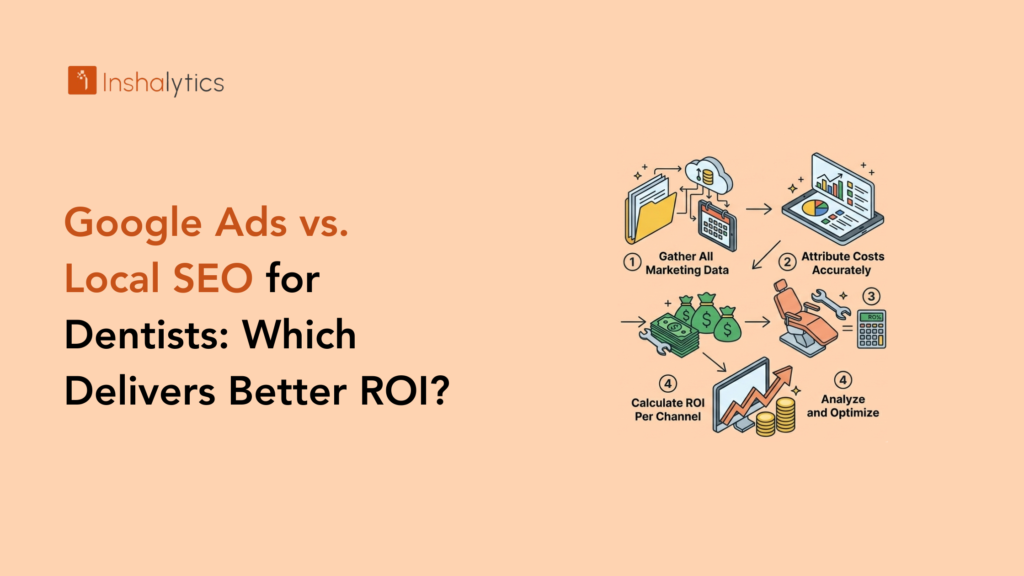
You have a marketing budget. You need new patients. The question your team keeps circling is whether to put that budget into Google Ads, which delivers leads immediately but costs money every month indefinitely, or into local SEO, which takes months to build but compounds over time without per-click costs. The answer is not the same for every practice, and the wrong choice costs real money in either missed patients (too slow with SEO alone) or wasted spend (too much on ads when organic could carry more of the load). This guide gives you the ROI profile of each channel, a direct performance comparison, and a clear decision framework based on where your practice is today.
Why This Comparison Is More Nuanced Than “Which Is Better?”
Google Ads and local SEO are not competing alternatives. They are different tools that work on different timelines, deliver patients through different mechanisms, and require different investments. The practices with the strongest patient acquisition systems typically run both, but with a budget split and sequencing strategy that reflects their current stage, their available monthly investment, and their treatment focus. Understanding the ROI profile of each channel is the starting point for that decision.
How These Two Channels Work Differently in the Patient Acquisition Funnel
Google Ads captures patients who are actively searching for a dentist right now and places your practice at the top of their search results instantly. Every click costs money. Every patient who calls from an ad is a direct result of that spend. The moment you stop paying, you disappear from search results. Local SEO builds your practice into the organic results and local map pack through a combination of website optimisation, Google Business Profile management, citation building, and content authority. It takes months to establish but delivers patients at decreasing cost per acquisition as rankings compound. A patient arriving through organic search costs you nothing in media spend once your rankings are established.
Why the Answer Depends on Your Practice Stage, Budget, and Treatment Mix
A newly opened practice with no patient base and no organic rankings needs patients immediately. Google Ads delivers them in days. SEO cannot. For that practice, Google Ads is not optional in year one regardless of its higher per-patient cost. An established practice with strong word-of-mouth and an existing patient base generating steady referrals has different priorities: SEO may deliver the lowest-cost incremental patients, while Google Ads can be targeted specifically at high-value treatments like implants and Invisalign where the case value justifies the CPC. Treatment mix matters because high-ticket treatment keywords on Google Ads are profitable at CPCs that would be unworkable for general dentistry volume practices.
The Case for Running Both (And When You Cannot Afford To)
The industry standard recommendation from dental marketing specialists is to run Google Ads for immediate patient flow while building local SEO for compounding long-term returns. This dual approach requires a minimum budget of approximately $3,000 to $5,000 per month to fund both adequately. Below $2,500 per month, spreading budget across both channels typically underfunds each below its effectiveness threshold. If your monthly budget is below $2,500, choose Google Ads for immediate results while investing in Google Business Profile optimisation (which has a significant SEO impact at near-zero cost) until the practice generates enough revenue from paid acquisition to fund a proper SEO program. The dental marketing budget guide covers the allocation framework by practice size.
Google Ads for Dentists: ROI Profile
Google Ads is the most immediately measurable dental marketing channel, with the clearest connection between spend and patient acquisition. Its ROI profile has distinct advantages and limitations that make it right for some situations and wrong for others.
Speed to First Lead: Days, Not Months
A properly structured Google Ads campaign for a dental practice can generate its first qualified patient call within 24 to 72 hours of going live. This speed is the channel definitive advantage for practices that need patients now: a newly opened practice, a practice adding a new associate who needs a full schedule, or a practice launching a new service line (implants, Invisalign, clear aligners) and wanting immediate visibility. No other patient acquisition channel except possibly paid social approaches this speed to first result. The dental Google Ads campaign types guide breaks down which specific campaigns generate the fastest qualified leads by treatment category.
Cost Per Patient via Google Ads: 2026 Benchmarks
Google Ads CPA for dental practices in 2026 ranges from $150 to $300 per new patient for general dentistry in moderately competitive markets, rising to $350 to $600 for implant and cosmetic dentistry targeting, and exceeding $800 per patient in major metro markets where dental keyword CPCs run $25 to $60 per click. Against a general dentistry LTV of $6,000 to $10,000 per retained patient, even the higher-end CPA represents a strong long-term return. The calculation that matters is CPA against LTV, not CPA against first-visit production. The dental marketing ROI formula covers the LTV-adjusted calculation in full.
Where Google Ads ROI Breaks Down and Why Most Dentists Overspend
Google Ads ROI underperforms in three specific scenarios. First, when the campaign targets broad match keywords without a comprehensive negative keyword list, wasting 20% to 40% of budget on irrelevant clicks. Second, when the landing page is the practice homepage rather than a service-specific page, conversion rates drop from 5% to 8% to 1% to 2%, and dramatically increase CPA. Third, when the campaign is managed by an agency that reports click and impression metrics without connecting spend to booked patients and production, making it impossible to identify waste. All three are fixable, but they require active management attention. A Google Ads account that has not been audited in 6 months is almost certainly wasting 25% or more of its budget.
Local SEO for Dentists: ROI Profile
Local SEO for dental practices operates on a fundamentally different economic model than paid search. The investment timeline is longer, the return is less predictable in the short term, and the long-term economics are dramatically more favorable for practices that commit to it.
Timeline to Meaningful Traffic: 3 to 6 Months; Full ROI: 12 Months
Local SEO for a dental practice follows a predictable progression. In months 1 to 3, technical foundations are set, and content is published, but ranking movement is minimal. In months 3 to 6, target keywords begin showing position improvements in Google Search Console, and some pages begin appearing on page one for lower-competition local terms. In months 6 to 10, traffic to key service pages grows, and attributable patient inquiries from organic search appear. In months 10 to 14, rankings for primary keywords like “dentist near me” and “dental implants ” are established, and the organic patient flow is consistent and measurable. At this point, the CPA from organic search begins compressing toward the $50 to $120 range as the monthly SEO investment is spread across a growing number of organic patients. The local SEO guide for dental practices covers the ranking factors that determine how quickly this progression unfolds for a specific practice.
Cost Per Patient via SEO: Why It Gets Cheaper Over Time
The economics of local SEO for dentists are fundamentally different from paid search because the cost per patient is not fixed. In month 6, if you are spending $1,200 per month on SEO and generating 3 attributable new patients per month, CPA is $400. In month 18, if the same $1,200 per month investment is now generating 14 new patients per month, CPA is $85.71. The investment has not changed. The return has grown because rankings compound. Each month of continued SEO work builds on the previous month rankings, content authority, and local citation strength. This compounding is the economic mechanism that makes SEO the highest-ROI channel at maturity for most dental practices, despite being the slowest channel to reach maturity.
The Compounding Advantage: What SEO Returns in Month 24 vs. Month 3
A dental practice that starts local SEO in January and tracks results through the following December has built a compounding asset. The domain authority accumulated through the year makes future content rank faster. The citation network built makes new service location pages appear in local results within weeks rather than months. The review volume accumulated through a managed review strategy converts a higher percentage of searchers without additional spend. By month 24, the same SEO investment that was producing minimal results at month 3 is the lowest-cost patient acquisition channel in the practice marketing mix, with a CPA that most paid channels cannot approach.
Google Ads vs. SEO: Head-to-Head Comparison
A direct comparison of the two channels across the dimensions that determine which to prioritise for your specific practice.
Cost Per Acquisition: Which Channel Wins at What Stage?
In months 0 to 6: Google Ads wins on CPA because SEO has not yet generated organic patients. In months 6 to 12: Google Ads and SEO begin to approach parity in CPA, with Google Ads still more consistent but SEO beginning to produce patients at a declining CPA. In months 12 to 24: Local SEO typically crosses below Google Ads CPA and continues declining. Beyond month 24: SEO CPA is typically 50% to 70% lower than Google Ads CPA at the same monthly investment level. The crossover point depends on market competition, SEO execution quality, and Google Ads campaign efficiency. The practice that starts SEO at the same time as Google Ads and sustains both reaches a point where it can reduce paid search reliance while maintaining patient volume through compounding organic acquisition.
ROI Durability: What Happens When You Pause Each Channel
Pause Google Ads today: leads stop arriving by tomorrow. The channel has zero residual value. Every patient it was generating requires active spend to continue. Pause local SEO today: rankings persist for months to years depending on how established they are and how active competitors become. The organic traffic and patient flow you built continues to deliver at its current level, declining slowly over 6 to 18 months as content ages and competitors invest. The SEO asset has significant residual value. This durability difference is the most important distinction for long-term practice marketing strategy: Google Ads generates revenue tied to spend, while local SEO builds an asset that generates revenue independent of ongoing spend for months after investment is paused.
Which Channel Wins for High-Value Treatments (Implants, Cosmetic)?
For implant and cosmetic dentistry, both channels have distinct roles. Google Ads captures existing buying intent from patients actively searching “dental implants near me” or “how much do dental implants cost” right now. These patients are in the decision phase and convert faster. Local SEO builds authority for implant-related search terms over time, producing a stream of implant-intent patients from organic search at a much lower CPA once rankings are established. Practices that have strong organic rankings for “dental implants ” terms and run Google Ads for the same terms simultaneously capture patients at both the paid and organic position, dominating the search results page for their highest-value treatment. This double visibility amplifies conversion rates because patients see the practice name appearing multiple times in one search.
Which Should You Choose Based on Your Practice Situation?
The following guidance applies to the most common practice scenarios. These are starting points, not prescriptions: every market and practice has unique variables.
New Practice Under 2 Years: Start With Google Ads, Build SEO Simultaneously
A new practice needs patients now and has not yet built the brand recognition, review volume, or domain authority that makes organic search competitive. Google Ads is not optional in year one. Start Google Ads first for immediate patient flow, funding it at the minimum threshold for your market (typically $1,500 to $2,500 per month). Simultaneously begin SEO work because the 12-month timeline means every month of delay is a month of compounding that does not start until you begin. Within 18 months, the organic traffic building from month-one SEO work will begin supplementing paid acquisition and reducing your average CPA across channels.
Established Practice With Organic Traffic: Double Down on SEO
A practice that has been operating for 5 or more years, has a developed review base, and is already appearing in local organic search results for some terms is in the best position to extract maximum value from SEO investment. The domain authority is already built. Content ranking work produces faster results than it would for a new domain. Increasing SEO investment at this stage compounds on an existing asset rather than building from zero, which produces a shorter path to the CPA improvement that comes from ranking improvements. This does not mean cutting Google Ads entirely: use paid search for specific high-value treatments and emergency terms where you want to guarantee top-of-page visibility regardless of organic position.
Specialty or High-Ticket Focus: Google Ads Plus Landing Pages First
A practice with a significant focus on implants, full-arch reconstruction, Invisalign, or cosmetic dentistry should prioritise Google Ads with service-specific landing pages as the first channel. The reason is intent: patients searching “dental implants near me” are in active buying mode. Capturing that intent with a specific landing page (not the homepage) that mirrors their search term and makes consultation booking immediate produces the highest conversion rate from the highest-intent traffic available. Layer local SEO on top after 3 to 6 months of paid search data has established which search terms convert best, using that data to prioritise SEO content targets. The dental marketing ROI overview covers the channel sequencing framework for practices at different stages.
How Inshalytics Allocates Between Google Ads and SEO for Dental Clients
The Inshalytics approach to the Google Ads versus SEO question is data-driven and stage-appropriate. We do not apply a single channel prescription across all dental clients because the correct answer genuinely varies by practice stage, budget, and treatment focus.
The 60/40 Starting Split and How It Shifts Over 12 Months
For new and growing dental practices with sufficient budget for both channels, we typically begin with a 60% Google Ads and 40% SEO split. This prioritises immediate patient flow while initiating the SEO compounding process. Over the first 12 months, as SEO begins delivering attributable patients, we shift budget incrementally toward SEO: 55/45 at month 6, 50/50 at month 9 if SEO is tracking at benchmark, 45/55 at month 12 if SEO patient volume justifies further shift. This progressive shift reduces average CPA across the marketing mix as the lower-cost organic channel carries more of the patient acquisition load.
How We Measure Which Channel Earns More Budget Each Quarter
Every quarterly budget review for Inshalytics dental clients compares the trailing 90-day CPA for each active channel against the practice CPA target (set by practice type and LTV). Channels performing below CPA target (delivering patients at acceptable cost) receive stable or increased budget. Channels performing above CPA target receive targeted optimisation work before budget decisions are made, because the problem is usually specific and fixable rather than a fundamental channel mismatch. This quarterly cadence prevents the two most common budget mistakes: leaving too much money in an underperforming channel too long, and cutting a channel that is underperforming temporarily due to seasonal factors or an algorithm change that will self-correct.
Want to know the right channel mix for your practice at its current stage? Talk to Inshalytics about a channel strategy assessment for your market, budget, and treatment focus.