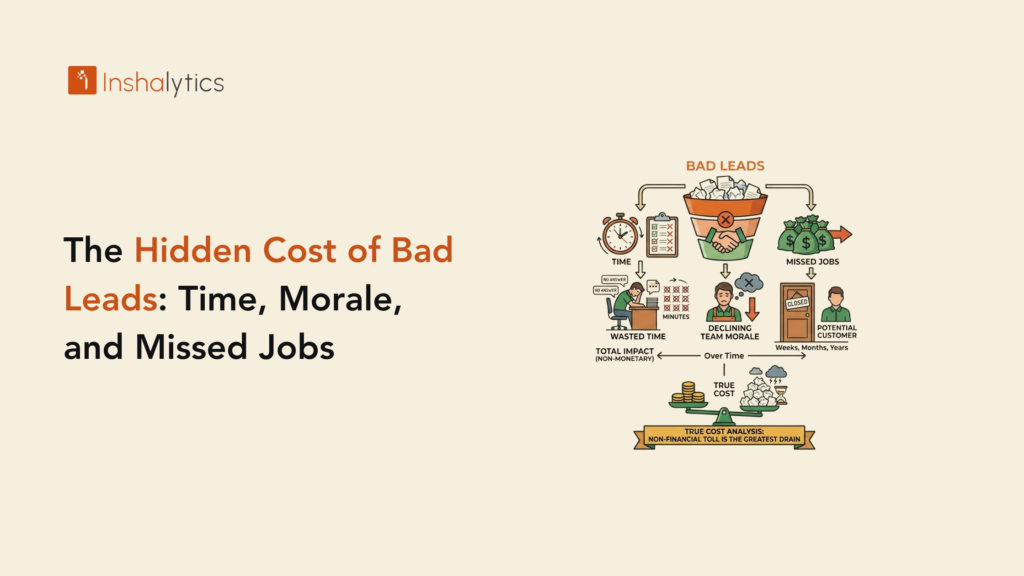
The dollar cost of a bad lead is documented. You paid $35 for the lead. You did not book the job. That is $35 wasted. But handyman business owners who have spent time in the trenches of a platform-dependent lead pipeline know that the $35 is the least of it. The real cost of a bad lead pipeline is the hours you spent calling, texting, and following up on contacts who were never going to hire you. It is the estimate you drove across town to give to a homeowner who was using you to confirm the price they had already decided was too high. It is the impact on your team when the phone rings and nobody wants to answer it because experience has conditioned them to expect another dead lead. The existing true cost of bad leads guide covers the financial damage. This post covers the non-dollar costs that are harder to quantify but often more damaging to a business over time.
The Time Cost: What an Hour of Your Day Is Actually Worth
Every hour spent processing bad leads is an hour not spent on billable work, business development, or rest. For a handyman business owner who charges $85 per hour for their work, an hour on the phone chasing platform leads that do not convert represents $85 in lost billings, not just the time cost. The opportunity cost of bad leads compounds when you factor in that the hours spent on lead processing are typically some of your highest-value hours: you are skilled at your trade, your time on the phone is not your best use, and the mental overhead of managing a high-volume, low-quality pipeline consumes cognitive resources that could go toward pricing strategy, business development, or delivering better work.
How to Calculate Your Monthly Lead Processing Time
Track for one week how many minutes you spend per lead on all processing activities: reading the notification, calling back, leaving voicemails, sending texts, attempting second and third contact, and updating any tracking. Average this per lead. Most handyman business owners spend 18 to 35 minutes per lead across the full processing cycle on shared platform leads that do not convert. On 40 leads per month with a 15% close rate, 34 of those leads will not become jobs. At 25 minutes per non-converting lead, that is 850 minutes, or 14 hours per month spent processing leads that produce no revenue. At your $85 per hour opportunity cost, that is $1,190 in time value destroyed every month by non-converting leads, separate from any platform fee.
Why the Best Hours Go to the Worst Leads
High-urgency shared platform leads arrive during business hours and require immediate callback to maximise conversion probability. This means the highest-converting callback windows (9 AM to 11 AM, 1 PM to 3 PM on weekdays) are often consumed by platform lead processing. These are the same windows when you are most available for productive work, most mentally sharp, and most likely to be in a position to schedule a job efficiently. A morning spent calling back platform leads that do not convert is a morning not spent on the GBP review responses, estimate follow-ups, or customer relationship work that compounds into owned-channel lead growth. Bad leads do not just waste the 25 minutes of the callback. They displace better uses of the same time.
The Morale Cost: What a Bad Lead Pipeline Does to Your Team
The morale cost of a bad lead pipeline is rarely discussed because it is hard to put a number on it. But every handyman business owner who has managed front desk staff or an office manager through a period of high shared platform lead volume knows exactly what it looks like: the reluctance to answer calls from unknown numbers, the cynicism about leads in general, the burnout from repeated “I already hired someone” conversations.
How Repeated Rejection Trains Learned Helplessness
In psychology, learned helplessness is the state that results from repeated exposure to uncontrollable negative outcomes. When a front desk team member makes 15 callbacks in a day and reaches 8 homeowners, of whom 7 either already hired someone, were not serious buyers, or were price-shoppers who treated the call as a negotiation, the team member internalises a narrative that leads do not convert. When a genuine high-intent lead arrives, that team member brings the same low-energy, pre-defeated approach that they developed from processing dozens of bad leads, and the good lead suffers for it. The lead pipeline quality affects every interaction in the pipeline, not just the bad leads themselves.
The Turnover Cost of Bad Lead Pipelines
Front desk and office manager positions at handyman businesses that rely heavily on shared platform leads see higher turnover than those with owned-channel pipelines. The work of processing high-volume shared leads is demoralising: high call activity, low success rate, repeated conversations with uninterested or already-committed homeowners, and no clear metric of progress. Staff who are measured on bookings from this environment cannot succeed regardless of skill because the lead quality, not their performance, is the limiting factor. High turnover in this role produces direct costs (hiring, training) and indirect costs (dropped leads during transition, inconsistent follow-up processes). The morale cost of a bad lead pipeline eventually materialises as a recruiting and retention cost.
The Missed Job Cost: What a Good Lead Looks Like When You Are Too Burned Out to Recognise It
The most expensive consequence of a bad lead pipeline is the good lead that gets treated like a bad one. After processing dozens of low-intent platform leads, a high-intent GBP call that arrives at the same number can receive the same exhausted, skeptical energy as the tenth platform callback of the day. The homeowner who searched specifically for a handyman in your neighbourhood, found your 4.9-star profile, and chose to call your business is not experiencing the same dynamic as a homeowner who submitted a Thumbtack request and is now fielding calls from five contractors. But if your team cannot distinguish between these two caller types by the time the GBP call arrives, the good lead gets processed with the same low energy as the bad ones.
The Accumulated Opportunity Cost of Platform-Sourced Timewasters
Every hour spent on a non-converting shared platform lead is an hour not spent on the activities that build long-term lead quality: responding to GBP reviews, posting on your GBP, following up on pending estimates, building referral relationships with past customers, or improving your website conversion. Each of these activities is an investment in the owned-channel infrastructure that eventually replaces the expensive, demoralising shared lead pipeline. The opportunity cost of bad leads is not just the time they consume. It is the compound future value of the better activities they displace.
The Customer Experience Cost of Distracted Estimates
A handyman who arrives at an estimate coming off a morning of bad leads is less present, less enthusiastic, and less focused on listening to the homeowner than a handyman arriving fresh. The homeowner experience during the estimate is a significant factor in the close rate and in the review content after the job. An estimate that goes well, where the homeowner feels heard, and the handyman projects confidence and professionalism, closes at higher rates and produces better reviews. An estimate that is technically competent but emotionally flat, delivered by someone who has already been through ten unproductive callbacks that day, produces a different experience and a lower close rate. The quality of your lead pipeline affects the quality of every customer interaction, not just the leads that fail to convert.
How to Break the Bad Lead Pipeline Cycle
The cycle of bad leads is self-reinforcing: bad leads create morale damage, morale damage reduces callback quality, reduced callback quality lowers close rates, lower close rates make bad leads look like the ceiling of what is possible, and the belief that leads just do not convert well makes it hard to invest in better lead sources. Breaking the cycle requires recognising the non-dollar costs that have been normalised, making the investment in one or two owned-channel sources, and gradually shifting the proportion of your pipeline from rented shared leads to owned exclusive contacts.
Starting With the Smallest Owned Channel Investment
GBP optimisation costs time, not money. A fully optimised GBP for a handyman business (complete service list, 30 or more photos, 40 or more reviews, weekly posts, prompt review responses) consistently generates exclusive inbound calls at zero per-lead cost. Building this takes 15 hours of initial setup and 3 hours per month of maintenance. The leads it generates come from homeowners who chose your business specifically. Those calls are qualitatively different from shared platform callbacks, and the difference is immediately apparent in close rates, conversation quality, and the energy required to process them. Starting here, before any paid channel investment, changes the character of the lead pipeline without any additional monthly spend. The GBP optimisation guide for handyman businesses covers every element of the build.
Tracking the Non-Dollar Cost Reduction as Owned Channels Grow
As you shift from shared to owned channels, track not just cost per booked job but two non-financial metrics: lead processing time per month (total minutes spent on callbacks and follow-ups) and contact-to-conversion ratio (what percentage of the contacts you reached became booked jobs). Both should improve as the proportion of your pipeline shifts toward exclusive, high-intent leads. A declining lead processing time combined with an improving close rate is the operational signature of a pipeline transitioning from rented to owned. Track these monthly alongside your financial metrics.
How Inshalytics Rebuilds Handyman Lead Pipelines Around Owned Channels
When Inshalytics works with a handyman business that has been heavily platform-dependent, the first deliverable is not a new campaign. It is an audit of where the non-dollar costs are concentrated: which channels are consuming the most processing time per booked job, where the lead rejection rate is highest, and which sources are producing the morale damage that affects every interaction in the pipeline. With that picture clear, we build the owned-channel infrastructure that gradually shifts the pipeline toward exclusive, high-intent contacts. The lead generation system for handyman businesses covers the full architecture of an owned-channel pipeline.
Ready to replace a demoralising shared lead pipeline with one that sends you homeowners who have already chosen you? Talk to Inshalytics about building an owned-channel lead system for your handyman business.