Every HVAC business owner knows the pattern. July and August: the phone doesn’t stop, the board is full three weeks out, and you’re turning down jobs you don’t have capacity for. October: the calls slow. November: you’re filling gaps. December and January: you’re wondering where the revenue went.
The instinct is to treat this as weather-driven and unavoidable. It isn’t. The contractors who run year-round lead flow don’t have better luck; they have better systems. They built maintenance agreement programs that create scheduled revenue during shoulder months. They built database reactivation campaigns that turn past customers into bookings without buying a single new lead. They built SEO content that ranks for the searches homeowners make in every season, not just the ones that happen during peak demand. Flat-rate service and membership plan pricing helps smooth out these slow months.
This guide covers how to build a year-round HVAC lead system one that smooths the seasonal curve without pretending that seasonality doesn’t exist.
Why HVAC Seasonality Is a System Problem, Not a Demand Problem
The feast-or-famine cycle in HVAC revenue is not fundamentally a demand problem. Demand exists year-round: aging equipment needs maintenance, homeowners plan replacements, commercial accounts require consistent service. The cycle exists because most HVAC businesses have only built the channels that capture peak-season emergency demand, and those channels go quiet when emergency call volume drops.
The 250–600% Variance Between Peak and Off-Peak Months and What It Really Means
HVAC services show 250–600% variance between peak and off-peak months. That variance is real and cannot be entirely eliminated; weather-driven emergency demand genuinely spikes during extreme temperature periods and drops during mild ones.
The goal is not to make October look like July. The goal is to reduce the revenue gap between peak and shoulder months from 60%+ to something closer to 30–40%, which is the difference between a business that survives slow periods and a business that thrives through them. That reduction comes from revenue streams that aren’t weather-dependent: maintenance agreements, planned replacements booked during off-peak, commercial accounts, and past-customer reactivation.
Why Most Slow-Season Fixes Are Tactic Substitutes for a Missing System
The typical slow-season playbook looks like this: launch a Facebook ad for a furnace tune-up special in October, send one email to past customers in November, run a “prepare for winter” promotion on Instagram. Each of these tactics can generate some response. None of them address the underlying problem. Our guide to seasonal email marketing for HVAC companies shows how to run these campaigns.
The underlying problem is the absence of infrastructure that generates predictable revenue independently of the weather. A maintenance agreement program generates scheduled, recurring revenue whether or not a homeowner’s system breaks down. A past-customer reactivation sequence generates bookings from people who already trust you without requiring new ad spend. An off-season content strategy generates organic leads from homeowners who are researching planned purchases during mild weather.
Tactics are seasonal. Systems are year-round. The contractors closing the seasonal gap are the ones who built the systems. For context on how the meta ads for HVAC off-season channel fits within the broader approach, that post covers the paid social component specifically; this guide covers the full system architecture.
The Goal: Reduce the Revenue Gap From 60% to 30% With the Right Infrastructure
A realistic target for a well-structured HVAC business: reduce the October-to-July revenue ratio from 40% of peak to 65–70% of peak. That’s not elimination of seasonality it’s smoothing the curve enough that your technicians stay billable, your overhead stays covered, and you don’t lose qualified people to competitors who offer steadier hours.
Getting there requires building three systems simultaneously: maintenance agreements that create scheduled shoulder-season revenue, database reactivation that converts dormant customers into active ones, and organic channels that generate leads from homeowners making planned purchases outside the emergency window.
Maintenance Agreements: The Highest-ROI Slow Season Strategy
There is no single strategy with a higher return on slow-season revenue than a well-executed maintenance agreement program. It generates predictable recurring revenue, creates natural system replacement leads, and produces customers who refer at higher rates than one-time service clients.
How Maintenance Plans Create Scheduled Work During Shoulder Months
A maintenance agreement customer pays an annual or monthly fee in exchange for two scheduled tune-ups per year, typically one in the spring before cooling season and one in the fall before heating season. Both visits happen exactly when your emergency call volume is lowest.
This means every maintenance customer on your program is a scheduled revenue event during October and April, the months that feel emptiest for most HVAC operators. A portfolio of 150 maintenance customers generates 300 scheduled visits per year, with 150 of them landing in the precise shoulder-season window you’re trying to fill.
The revenue is predictable months in advance. Your dispatcher knows it’s coming. Your technicians can be scheduled accordingly. The feast-or-famine pattern exists precisely because this kind of predictable recurring revenue hasn’t been built yet.
Building a Maintenance Program That Converts Emergency Customers Into Recurring Revenue
The highest-leverage moment to sell a maintenance agreement is immediately after an emergency repair. A homeowner who just paid $400 to have their AC fixed in August heat is acutely aware of how much it costs when things break unexpectedly. That awareness is a perfect opening for the maintenance agreement conversation.
Train your technicians to present the maintenance program on every emergency service call: “We got you back up today, but to prevent this from happening again next summer, let me tell you about our maintenance plan.” A service call that produces both a repair invoice and a maintenance agreement enrollment is dramatically more valuable than a service call that produces only the repair.
Convert the emergency customers who are already in front of you before spending a dollar acquiring new ones for the program.
Using Maintenance Visits as Replacement Lead Generators
Maintenance visits are not just recurring revenue events; they’re the most efficient replacement lead generation tool available to an HVAC business. A technician performing a tune-up on a 13-year-old system has a natural and credible opportunity to present a replacement recommendation to a homeowner who is already in a conversation about their system’s health.
The close rate on replacement quotes generated during maintenance visits is significantly higher than the close rate on replacement quotes generated from cold inbound leads. The homeowner already knows you, already trusts you, and is already thinking about their system. You’re not competing against four other contractors; you’re the trusted professional who has been maintaining their equipment.
Maintenance programs that generate replacement leads during visits produce some of the lowest cost-per-replacement-lead figures available in HVAC marketing. The acquisition cost of the maintenance customer is amortized across all future transactions, including the eventual replacement.
Database Reactivation: The Cheapest Leads You Already Own
Your past customer list is one of the most underutilized assets in your business. Research from the Air Conditioning Contractors of America shows that database marketing to past customers returns $8–$12 per dollar invested, compared to $3–$4 for new customer acquisition. Most HVAC businesses have this asset and ignore it entirely.
Why Past-Customer Campaigns Return $8–$12 Per Dollar vs. $3–$4 for New Acquisition
The math behind this return differential is not complicated. Past customers already know you. They’ve experienced your service. They have some level of existing trust that a new customer doesn’t have. The cost of reaching them with a text message, an email, or a phone call is a fraction of the cost of generating a new inbound lead.
When your database reactivation campaign converts a past customer into a maintenance agreement enrollment, a seasonal tune-up booking, or a system inspection, that conversion happened without a Google Ads click, without a shared lead fee, without any paid acquisition cost beyond the cost of sending the message.
The HVAC businesses running year-round on thinner slow-season gaps almost universally have active database reactivation programs. They know which customers haven’t been serviced in 18+ months, and they have a systematic approach to re-engaging those customers before those customers find someone else. Why your HVAC business isn’t growing often comes back to this: the reactivation asset exists but was never activated.
Email and SMS Reactivation Sequences That Fill the Shoulder Season Calendar
A basic reactivation sequence for shoulder season:
Message 1 (Mid-September, for fall heating season): “Hi [Name], it’s been a while since we last serviced your system. Fall is a great time to schedule a furnace tune-up before the cold hits and we’re booking fast. Reply or call to grab a spot.”
Message 2 (One week later, for non-responders): “Just a quick follow-up we have a few spots left this month for fall tune-ups. If your system hasn’t been serviced in the last 12 months, now’s the time. Call us at [number] or reply to this message.”
Message 3 (Two weeks later, final touch): “Last chance for this season’s tune-up promotion. If we don’t hear from you, we’ll check back in the spring. Either way, we’re here if something comes up.”
SMS open rates for home service reminder messages run above 90%. Email open rates are lower but still far above any paid advertising equivalent. The sequence above requires 20 minutes to set up in any basic CRM and generates bookings at near-zero cost per booked job.
What to Offer Past Customers During Slow Months That Actually Converts
Generic discounts “10% off any service” produce lower response rates than specific, time-bound, relevant offers. What converts better:
- Seasonal tune-up offers tied to a specific outcome: “Get your furnace ready for winter; we’ll check all critical components and change your filter. $79, available this month only.”
- Aging system audits: “Is your system more than 8 years old? A free efficiency audit can tell you whether repairs or replacement makes more financial sense.”
- Maintenance agreement enrollment offers: “Lock in your spring and fall tune-ups now at last year’s price; spots fill fast once the season starts.”
The offer that works is specific, timely, and addresses a concern the homeowner already has rather than creating an artificial urgency they can see through.
Off-Season SEO and Content Building Rankings Before Demand Spikes
Organic search rankings take time to build. The content published in October starts building authority that produces leads in March before your competitors start thinking about spring campaigns. This compounding dynamic makes off-season SEO investment one of the most strategically valuable uses of slow-season time and budget.
Publishing Storm and Seasonal Content 30–45 Days Before Peak
The contractor who publishes “How to Prepare Your HVAC System for Summer” in mid-March captures homeowners who start thinking about cooling season in April and May. The contractor who publishes the same content in June is writing for a search audience that’s already in crisis mode not the research mode where content marketing is most effective.
Seasonal content published 30–45 days ahead of peak demand captures the pre-season research window. Homeowners in that window are planning, comparing, and booking proactively; they’re the customers who schedule in advance, pay for maintenance before they need emergency repairs, and close on replacement quotes at higher rates than emergency callers.
Build your content calendar around this lead time. Fall content goes live in late August. Spring content goes live in late February. The local SEO for HVAC contractors playbook covers how to build the authority foundation that makes this content rank when it publishes.
Why Off-Season Is the Best Time to Build Google Business Profile Authority
Your Google Business Profile ranking is built over time through review velocity, post frequency, photo recency, and engagement signals. The work you do in November builds the authority that determines your Map Pack position in June.
Most HVAC operators let their GBP go quiet during slow months. They stop posting. They stop adding photos. Their review velocity drops because they’re doing fewer jobs. Competitors who maintain consistent GBP activity through the slow season are compounding an authority advantage that becomes visible in the Map Pack when peak demand returns.
Off-season GBP maintenance takes 30–60 minutes per week: publish a post about a completed job, add two or three new photos, respond to any outstanding reviews, and add a seasonal service to the Q&A section. That consistent activity signals to Google that your business is active, which is a direct GBP ranking input.
Commercial HVAC as a Slow Season Revenue Bridge
Residential HVAC is heavily seasonal. Commercial HVAC is not; businesses cannot afford HVAC downtime regardless of the weather, and commercial facilities schedule major maintenance work during mild weather precisely because they can plan.
If you have any commercial HVAC capability, the slow season is the time to develop commercial accounts. Target small commercial properties, retail spaces, small offices, and light industrial that need scheduled maintenance contracts rather than emergency-only service. The lower urgency of commercial acquisition is a fair tradeoff for the recurring revenue and shoulder-season scheduling consistency commercial accounts provide.
A single commercial maintenance contract covering a mid-size office building can generate $3,000–$8,000 annually in scheduled visits. Five such contracts produces $15,000–$40,000 in revenue that is booked in advance, scheduled during your slowest months, and not subject to weather conditions.
Paid Strategy During Slow Months: Shift, Don’t Stop
The instinct to pause paid campaigns during slow months is understandable and almost always wrong. Pausing Google Ads during off-peak periods resets the algorithm’s learning, drops your Quality Score, and means you’re starting from scratch when you reactivate, which typically costs 2–4 weeks of suboptimal performance right as demand picks up.
Why Pausing Ads During Slow Season Costs You More Than Running Them
The economics of paid advertising during slow months change, but they don’t disappear. Lower demand means lower CPCs; you pay less per click during October than you do during July. That lower cost per click often produces an acceptable cost per lead even when conversion volume is lower.
More importantly, the campaigns that maintain activity through the slow season have more conversion data, better Quality Scores, and better-calibrated bidding algorithms when peak season returns. The contractor who ran ads consistently through the winter sees better performance in May than the contractor who paused and relaunched.
The industry guidance from several HVAC marketing specialists is consistent: reduce budget during slow months, don’t pause. A $500/month slow-season budget keeps the algorithm active, the Quality Score healthy, and your campaigns ready to scale immediately when demand returns. Going from $0 to $3,000 in March takes weeks to ramp. Going from $500 to $3,000 takes days.
Off-Season Keyword Shifts: From Emergency Repairs to Maintenance and Inspections
The keyword strategy that works in July “AC repair near me,” “emergency HVAC,” “broken air conditioner” has limited volume in October. Shifting your keyword focus to slower-intent, higher-planning terms captures the homeowners who are thinking ahead: “furnace tune-up ,” “HVAC maintenance plan,” “annual HVAC inspection,” “heating system check.”
These are homeowners who are not in crisis. They’re planning. They respond to different ad copy: educational, helpful, focused on prevention rather than urgency, and they convert into maintenance agreement enrollments and planned service visits more often than emergency callers.
The Google Ads for HVAC emergency calls strategy that performs in peak season is a different campaign than the maintenance-focused campaign that generates off-season bookings. Both should exist in your account, with budget weighted toward whichever matches current demand patterns.
Budget Reserves: The 10–15% Buffer Fund Strategy That Keeps the Pipeline Full
Several HVAC marketing strategists recommend a specific budget reserve approach: set aside 10–15% of your peak-season marketing budget into a dedicated reserve fund. When slow months arrive and competitors pull back on spend, deploy those reserves to maintain visibility while your competitors go quiet.
The timing creates an advantage. Peak demand months are auction-competitive: everyone is spending heavily, CPCs are high, and you’re fighting for position. The first two weeks of a cold snap in October see HVAC heating emergency searches spike, but most HVAC operators have reduced their budgets. If you have reserves deployed during those cold snaps, you capture demand at lower cost than you would have in August.
Budget reserves also cover the paid traffic gap while organic channels are building. A new HVAC business investing in local SEO for HVAC contractors will not see meaningful organic lead flow for 4–6 months. Maintaining modest paid spend during that ramp period keeps the pipeline from going completely dry while the organic asset develops.
How Inshalytics Builds Year-Round HVAC Lead Systems
At Inshalytics, we don’t build HVAC marketing programs that run at full capacity in July and coast in October. We build systems designed to produce lead flow across the full calendar, which requires different components than a peak-season-only approach.
Seasonal Campaign Architecture That’s Built Before Each Season, Not During
Every Inshalytics HVAC program includes a 12-month campaign calendar built at the start of the engagement. Fall content goes live in August. Spring content goes live in February. Seasonal keyword shifts happen proactively before search volume changes, not after.
This pre-built architecture means our clients are never scrambling to launch something when the season turns. The fall tune-up campaign is live before competitors realize they need one. The spring pre-season awareness content is ranking before the competition starts thinking about spring.
Campaign architecture built in advance consistently outperforms reactive campaign management. The data is consistent on this across every market we operate in.
HVAC Shoulder Season Marketing: Spring and Fall Plan
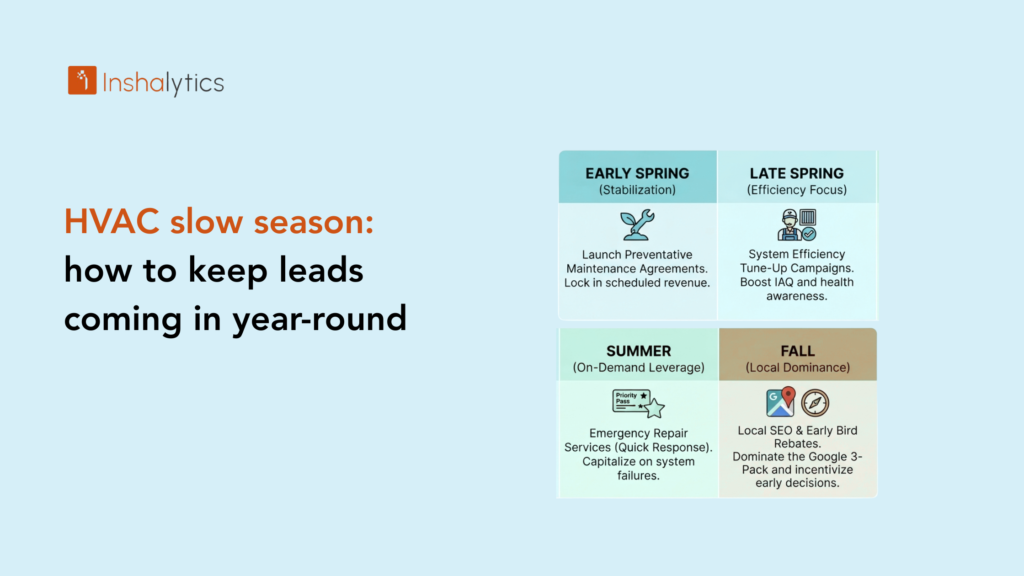
The shoulder seasons, the weeks between heating and cooling demand, are when call volume drops and the right marketing keeps the schedule full. Use them to promote tune-ups and maintenance plans, since homeowners are thinking about the next season and not an emergency. Our guides to seasonal HVAC email campaigns and Meta ads for HVAC in the off-season show how to run both.
The Owned Lead Channels That Keep Generating Calls When Competitors Go Dark
The core of every Inshalytics HVAC program is owned lead channel development the Google Business Profile, organic search rankings, and LSA infrastructure that generates calls at zero or low cost per click once established.
These channels don’t go quiet in October. A GBP ranking in the top three for “HVAC maintenance ” generates calls throughout the slow season from homeowners scheduling proactively. A blog post ranking for “how to prepare my HVAC system for winter” generates leads in September and October from homeowners who are planning rather than responding to emergencies.
Owned channels compound over time. The authority built this month produces leads next month and the month after. Bought leads produce nothing when the invoice stops. This is the fundamental asymmetry that makes owned channel investment the structural answer to HVAC seasonality not just a slow-season tactic, but a year-round lead architecture.
Want to see what a year-round HVAC lead system looks like for your market and your business size? Talk to the Inshalytics team; we’ll show you exactly which channels would produce consistent lead flow in your specific service area and build a 12-month architecture that accounts for every season.
HVAC slow seasons are real. The revenue gap between July and October is not something you can market your way out of completely. But the gap between a business generating 40% of peak revenue in shoulder months and one generating 65–70% is almost entirely explained by the presence or absence of three systems: maintenance agreements creating scheduled revenue, database reactivation turning past customers into bookings, and organic channels generating leads from homeowners planning rather than responding to emergencies.
Build those systems in the next 90 days. Not when October hits before it does. The contractors with full calendars in the slow season started the work in the spring.
Frequently Asked Questions
What is the HVAC slow season?
It is the stretch between peak cooling and peak heating demand, typically spring and fall, when fewer systems fail and call volume drops. Contractors fill it with maintenance plans, tune-ups, replacement campaigns and outreach to past customers.
How do HVAC companies generate demand during slow months?
They stop waiting for emergencies and create demand: email and text campaigns to past customers, maintenance-plan offers, seasonal tune-up promotions and off-season ads. See Meta ads for the HVAC off-season and seasonal email campaigns for HVAC.
How do I re-engage homeowners who haven’t scheduled annual maintenance?
Start with your customer list. Reach out with a short, specific reminder tied to their equipment and the season, make booking one click or one call, and follow up once. Tracking responses in a CRM keeps this from slipping; see HVAC CRM lead follow-up.
How do I keep getting reviews year-round?
Ask after every completed job, not only in busy months, and send the request the same day while the visit is fresh. A steady flow keeps your profile active through the quiet season. More in how reviews affect HVAC map pack rankings.