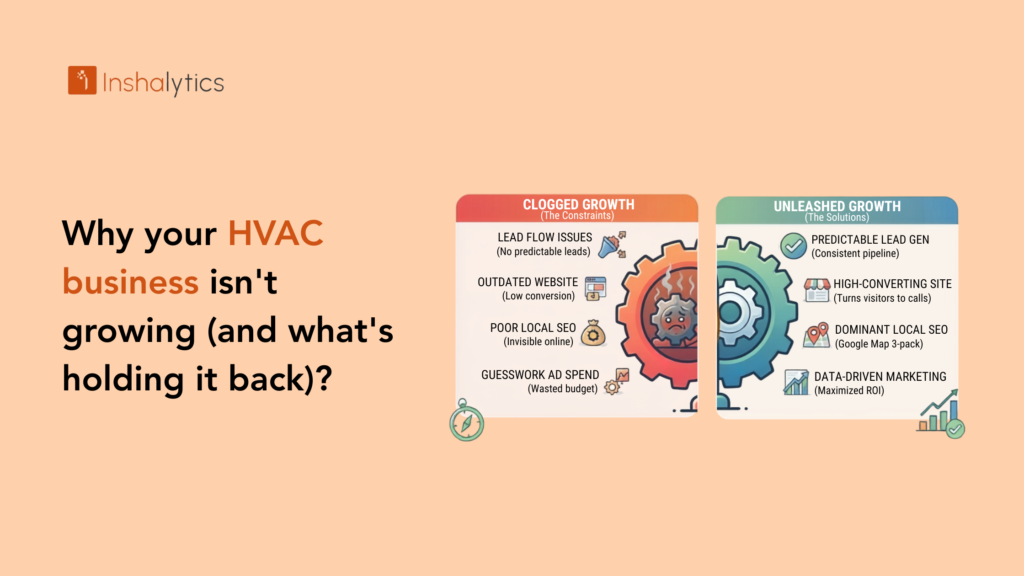
Over 65% of HVAC businesses in the United States never cross $1 million in annual revenue. Not because the demand isn’t there; the HVAC market is growing, equipment is being replaced at record rates, and the technician shortage means skilled operators can charge more than ever. The ceiling isn’t market-driven. It’s internal. The next stage is covered in scaling an HVAC business past owner-operator.
If your revenue has been flat for 12 months or longer, if your schedule swings between completely booked and nearly empty, or if you feel like you’re working harder without the numbers improving, the cause is rarely what it appears to be. It’s rarely a single channel that isn’t working. It’s usually a system or multiple systems that were never built.
This guide diagnoses the specific things that keep HVAC businesses stuck and gives you a framework for identifying which one applies to yours.
The Growth Ceiling: 65% of HVAC Businesses Never Break Through
The 65% statistic is not about bad technicians or poor service quality. Most HVAC contractors who stall below $1M are genuinely skilled and genuinely hardworking. The problem is that skilled trade work and business systems are different disciplines and most HVAC operators are trained in one but not the other.
Why Working Harder Isn’t the Problem
An HVAC owner working 60-hour weeks is almost certainly not underworking. The ceiling is not effort. It’s leverage the difference between working in systems that scale and working in routines that can only grow as fast as the owner can personally expand.
A technician-owner who handles every call, quotes every job, follows up on every lead, manages every schedule, and troubleshoots every customer complaint is operating a one-person business regardless of how many employees are on payroll. Every system that depends on the owner to function is a system that caps at the owner’s personal capacity.
The Three Systems That Determine Whether an HVAC Business Scales
Three interconnected systems separate HVAC businesses that grow from those that stall:
How customers find you. If your primary lead source is word-of-mouth referrals from past customers, you have a lead system that is inconsistent by nature. You can’t forecast it, accelerate it, or scale it. When the referral pipeline slows which it does, randomly and unpredictably you have no lever to pull.
How you keep customers once you have them. Most HVAC businesses have a database of past customers they’ve never systematically marketed to. A one-time repair customer who never heard from you again is a customer who called someone else for their next tune-up and, eventually, their system replacement.
How your operations run day-to-day. Missed calls, slow quote turnaround, technicians without clear upsell protocols, no maintenance agreement program these operational gaps bleed revenue that the marketing side can never compensate for.
How to Diagnose Which System Is Broken in Your Business
Before changing anything, answer these questions with actual data:
- What percentage of inbound calls result in a booked appointment?
- What is your close rate on estimates?
- What percentage of your customers have a maintenance agreement?
- What is your average response time to a new lead?
- What is your revenue per technician per year?
If you can’t answer all five, you have an attribution and tracking problem and that problem is preventing you from diagnosing anything else accurately.
The Marketing Mistakes That Stall HVAC Growth
Marketing is where most HVAC business owners look first when growth stalls. Sometimes they’re right. Often they’re solving the wrong problem.
Disconnected Tactics vs. a Real Lead Generation System
The most common HVAC marketing setup looks like this: some Google Ads managed by the owner or a generalist agency, a Google Business Profile that was set up three years ago and hasn’t been updated since, a Facebook page with occasional posts, and whatever comes in from Angi or HomeAdvisor.
A real lead generation system has every channel feeding the same funnel. Your GBP ranking builds on your review velocity. Your reviews support your LSA ranking. Your LSA generates calls that go to a website built to convert the specific searches you’re targeting. Every element strengthens the others. When one channel underperforms, the others compensate.
Most HVAC businesses that feel like their marketing isn’t working have tactics, not a system. The fix is integration, not addition.
Tracking Clicks Instead of Booked Jobs: Why Vanity Metrics Kill Growth
An agency that reports impressions, clicks, and website sessions is reporting what’s easy to measure, not what matters. If you don’t know your cost per booked job across each marketing channel, you can’t make rational decisions about where to increase or decrease investment.
The true cost of bad HVAC leads is almost always higher than operators realize, because it’s measured in cost per lead rather than cost per acquired customer. A $50 lead that closes at 10% costs $500 per customer. A $90 lead that closes at 40% costs $225 per customer. Without the close-rate data, you’ll cut the channel that’s actually producing your best customers and scale the one that’s burning budget.
Build the tracking infrastructure call tracking by channel, conversion tracking in GA4, a CRM that records lead source before you make any significant marketing investment. You can’t optimize what you can’t measure.
Relying on Shared Leads Instead of Building Owned Channels
Shared lead platforms give you leads today. They don’t build anything for tomorrow. An HVAC business that has been buying from Angi or HomeAdvisor for three years has not built any marketing asset from that investment. They’ve bought three years of contacts from a platform they don’t control, at prices that have risen every year, with close rates that have declined as more contractors compete for the same supply.
Owned channels local SEO for HVAC contractors, a dominant Google Business Profile, and LSA produce leads that compound in value over time. The ranking authority you build this year reduces your cost per lead next year. That dynamic is the opposite of what shared platforms deliver.
The Operations Problems That Marketing Can’t Fix
This is where most HVAC business owners need to look harder. Marketing can fill a broken funnel with more leads it cannot fix the operational issues that lose those leads before they become revenue.
Missed Calls and Slow Follow-Up: The Revenue Leak Nobody Measures
Research consistently shows that 78% of HVAC jobs go to the first contractor who responds to a new lead inquiry. If your business misses 20% of inbound calls because the owner is on a job, the CSR is busy, or the call came in after hours, you’re losing nearly one in five customers before you ever have a conversation.
Calculate what that costs annually. If you generate 200 inbound calls per month and miss 40 of them, and those 40 would have converted at 25%, you’re losing 10 booked jobs per month. At an average ticket of $450, that’s $4,500 in monthly revenue from a problem that has nothing to do with your marketing.
The HVAC website conversion issue is similar a website that doesn’t clearly present your phone number, doesn’t load quickly on mobile, and doesn’t have a form above the fold loses leads that your ads paid to generate.
No Maintenance Agreement Program: Trading Recurring Revenue for One-Off Jobs
HVAC businesses without a maintenance agreement program are leaving recurring revenue on the table every single month. A maintenance customer provides predictable scheduled revenue during shoulder seasons, produces replacement leads at dramatically higher close rates than cold prospects, and refers neighbors at higher rates than one-time service customers.
Top HVAC companies generate 15–25% of annual revenue from maintenance agreements. For a $600K annual revenue business, that’s $90,000–$150,000 in recurring revenue that isn’t dependent on lead generation at all. Building a maintenance program is not a marketing project it’s an operations decision but it has more impact on sustainable growth than most marketing channels.
Underpriced Work: Why Low Margins Make Growth Impossible
The average net margin for HVAC businesses is between 2% and 10%, which means most operators are working extremely hard for very little financial leverage. Healthy HVAC margins run 10–20%, with top performers reaching 20–30% through tight operations and value-based positioning. At a 5% net margin, there is no buffer for a slow season, no capital for a new truck, no ability to hire before revenue justifies it. Growth stalls not because demand is low but because the business cannot afford the investment that growth requires.
Raising prices in HVAC is counterintuitive because most owners fear losing the customers they have. The reality is that customers who are with you primarily because you’re the cheapest option are your most price-sensitive and least loyal segment. Raising prices selectively, leading with value, maintenance agreements, and the convenience of a familiar trusted contractor typically reduces volume slightly and increases margin significantly.
The Customer Retention Problem HVAC Companies Overlook
New customer acquisition is not the only growth lever, and for most HVAC businesses at the $500K–$1M range, it’s not even the highest-ROI lever available.
Why New Customer Acquisition Returns 3–4x vs. 8–12x for Database Marketing
Industry data from the Air Conditioning Contractors of America is direct: marketing to your existing customer database returns $8–$12 per dollar invested. New customer acquisition returns $3–$4 per dollar.
The implication is significant. If you have 800 past customers in your CRM and you send a quarterly maintenance reminder email, a seasonal tune-up offer, and an annual system review invitation, you’re activating a revenue source that costs almost nothing to access. Most HVAC businesses have this asset and ignore it completely.
What It Costs You to Ignore Your Past Customer List
Every customer in your CRM who doesn’t hear from you is a customer who will call whoever comes up on Google next time they need HVAC service. That might be you if your GBP ranking is strong and your reviews are recent. It might just as easily be a competitor who reached them first through consistent communication.
The math: if 800 past customers represent $15,340 in lifetime value each and you convert even 5% of dormant customers through a reactivation campaign, that’s 40 customers worth a combined $613,600 in lifetime value activated by an email sequence that costs almost nothing to run.
Building a Reactivation System That Fills Slow Periods Automatically
A simple reactivation system for HVAC businesses:
- Segment your customer database by last service date; anyone without a service visit in 18+ months is a reactivation target
- Send a three-message sequence: a seasonal check-in, a maintenance offer with a clear deadline, and a final “we miss you” message with a promotional discount
- Set up automated follow-up via SMS for homeowners who open but don’t respond
This system runs once per quarter, requires minimal management, and consistently produces booked appointments from customers who would otherwise have drifted to a competitor. It is one of the highest-ROI activities available to any HVAC business owner, and most of them have never built it.
What HVAC Businesses That Break Through Actually Do Differently
The HVAC businesses growing past $1M and toward $2M+ share specific characteristics. They’re not doing more of the same things; they’re doing different things.
They Treat Marketing as Infrastructure, Not a Monthly Expense
The companies growing fastest in 2026 think about marketing the way they think about their fleet and their tools. Not a monthly expense to minimize, but an infrastructure investment that enables revenue the business couldn’t otherwise generate.
A contractor spending $3,000/month on Google Ads while missing 20% of inbound calls is buying leads and throwing away half of them. The same $3,000 invested in fixing the operational systems that convert leads to booked jobs first would generate more revenue because the infrastructure that converts leads would be in place before the additional volume arrived.
Marketing investment is only productive when the operational infrastructure can convert what it generates.
They Know Their Cost Per Booked Job Across Every Channel
High-growth HVAC operators can tell you their cost per booked job from Google LSA, from Google Search Ads, from their GBP, and from their maintenance program renewal campaigns. They know which channels produce their highest-value customers and which produce high-volume, low-margin work.
This knowledge drives budget allocation. When your data shows that LSA produces booked jobs at $180 and your maintenance program renewals produce booked jobs at $22, the correct budget decision is not to spread money equally. It’s to maximize the cheapest, highest-converting channel first and allocate incremental budget to the next-most-efficient channel.
The HVAC Google Ads budget question is not primarily about how much to spend it’s about understanding what the spend produces at a booked-job level and how that compares to your other options.
They Build Revenue Streams That Don’t Depend on Weather
Emergency HVAC calls are weather-driven and cannot be reliably forecast. Maintenance agreements, planned replacement leads nurtured from aging-system identification, commercial HVAC contracts, and indoor air quality upsells are revenue streams with far more predictability.
The HVAC businesses that sustain growth through slow seasons are the ones with enough non-emergency revenue to keep crews billable even when the phone isn’t ringing from emergency calls. Building those revenue streams, particularly maintenance agreements and commercial accounts, is as important to growth as any marketing channel.
How Inshalytics Diagnoses and Fixes HVAC Growth Problems
Most HVAC marketing conversations start with channel selection. At Inshalytics, we start with diagnosis. Before recommending any channel, we audit what’s actually happening in your business: which lead sources are converting, where leads are being lost, what your cost per booked job looks like across each channel, and where the operational gaps are suppressing the returns from marketing investment.
Where We Start: The Lead Audit That Reveals What’s Actually Broken
The Inshalytics HVAC audit covers five areas: GBP completeness and ranking position, current paid campaign structure and cost per lead by keyword, organic visibility across your service area, review velocity and average rating trend, and lead tracking, whether call tracking is in place, and whether you can currently attribute revenue to marketing channels.
Most businesses we audit have at least two of these areas significantly underperforming. The audit tells us which two and why, which means the program we build is built for your actual situation, not a template.
Frequently Asked Questions
Why isn’t my HVAC business growing?
Usually the problem isn’t effort. It is a system that leaks somewhere: leads that never come in, calls that aren’t answered fast, jobs that are underpriced, or customers who never come back. Diagnose which stage is broken before spending more on ads. Follow-up is a common culprit; see why HVAC leads go cold fast.
How do I get more HVAC business?
Work in this order: make sure you show up locally (local SEO for HVAC contractors), make it easy to call and book, answer every lead quickly with a defined follow-up process (HVAC CRM lead follow-up), and then add paid channels. Collect reviews on every job.
How do maintenance agreements help an HVAC business grow?
They create predictable recurring revenue, keep you in front of customers between emergencies and make repeat work easier to book. Pricing and packaging them well matters; see flat-rate pricing and membership plans.
How can I get more repeat business from past customers?
Treat your customer list as an asset. Send seasonal reminders and offers, follow up after service and ask for reviews. See seasonal email campaigns for HVAC and filling the HVAC slow season.
How We Build Systems That Grow Revenue Without Adding Work Hours
The Inshalytics approach for HVAC businesses combines owned channel development with operational gap identification. We build the marketing infrastructure GBP, LSA, local SEO, and eventually paid search while flagging the operational issues (missed calls, slow follow-up, absence of maintenance program) that are suppressing your current marketing ROI.
An HVAC business that converts more of the leads it already receives through faster response, a maintenance program that builds loyalty, and a retention email system that reactivates past customers grows without spending more on acquisition. That’s the highest-leverage starting point for most businesses in the $400K–$900K range.
Not sure whether your HVAC growth problem is marketing, operations, or both? Talk to the Inshalytics team; we’ll run a diagnostic and tell you honestly where the biggest opportunity is in your business.
If your HVAC business isn’t growing, the cause is almost certainly diagnosable, but it’s probably not what you think. The ceiling is rarely demand. It’s systems. Specifically: a lead generation system that’s inconsistent or inefficient, a retention system that doesn’t exist, operational gaps that bleed revenue before marketing can compensate, and margins too thin to fund the growth that demand would otherwise support.
Fix the systems. Build the owned channels. Close the operational gaps. And measure everything at the booked-job level, not the lead level, not the impression level. That’s the path from $600K to $1.2M, and from $1.2M to $2M+.