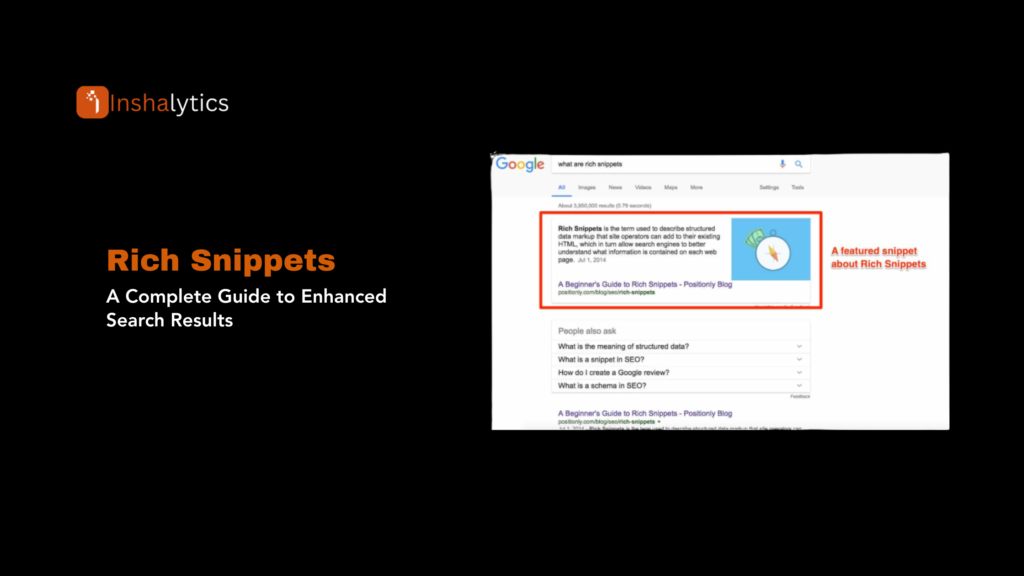
Rich snippets are enhanced search results that display additional information beyond the standard title, URL, and meta description. These visually enriched listings include extra details like star ratings, review counts, product prices, event dates, recipe cooking times, author information, and images directly in the search results. Rich snippets make your listing more prominent, informative, and clickable, helping users quickly determine if your content meets their needs before clicking through.
Rich snippets are generated when search engines extract structured data from your webpage markup specifically Schema.org markup and display it in an enhanced format. While you can’t guarantee your structured data will appear as rich snippets (search engines decide which results merit enhancement), properly implementing schema markup significantly increases your chances of earning these valuable visual enhancements.
Navigate This Post
How Rich Snippets Work
Rich snippets rely on structured data a standardized format that helps search engines understand the specific type of content on your page and its key attributes.
The Rich Snippet Process
- Add structured data – You implement Schema.org markup on your webpage using JSON-LD, Microdata, or RDFa formats.
- Search engines crawl – Google and other search engines discover and parse your structured data during crawling.
- Data validation – Search engines verify the markup is correctly implemented and follows guidelines.
- Eligibility determination – Algorithms decide if your content qualifies for rich snippet display based on quality, relevance, and policy compliance.
- Rich snippet display – Enhanced results appear in search, featuring the additional information from your structured data.
Standard Result vs. Rich Snippet
Standard Search Result:
- Blue title link
- Green URL
- Two-line meta description
- Publication date (sometimes)
Rich Snippet Example (Recipe):
- Blue title link
- Star rating (4.5 stars with review count)
- Image thumbnail of the finished dish
- Cooking time (30 minutes)
- Calorie count (250 calories)
- Green URL
- Meta description
The enhanced result immediately provides users with valuable decision-making information without requiring a click.
Types of Rich Snippets
Search engines support rich snippets for numerous content types, each displaying relevant information for that category.
1. Review and Rating Snippets
Display star ratings, review counts, and aggregate scores for products, services, books, movies, and businesses.
Displays:
- Star ratings (1-5 stars shown visually)
- Number of reviews
- Price ranges
- Availability status
Best for: E-commerce products, local businesses, services, software, books, movies
Example: “Wireless Headphones ★★★★☆ 4.3 (1,247 reviews) · $79.99 · In stock”
2. Recipe Snippets
Show cooking information for food recipes.
Displays:
- Recipe image
- Preparation time
- Cooking time
- Calorie count
- Star ratings
- Review count
Best for: Food blogs, recipe websites, cooking publications
Example: “Chocolate Chip Cookies ★★★★★ 4.9 (892 reviews) · 35 min · 200 cal”
3. Product Snippets
Highlight e-commerce product details.
Displays:
- Product image
- Price
- Availability (in stock, out of stock)
- Star ratings
- Review counts
- Shipping information
Best for: Online stores, product listings, marketplace items
Example: “Samsung Galaxy Phone · $899.99 · In stock · ★★★★☆ 4.4 (3,210 reviews)”
4. Event Snippets
Display event information for performances, conferences, and activities.
Displays:
- Event date and time
- Location/venue
- Ticket availability
- Performer/organizer
- Event image
Best for: Concert venues, conference organizers, theaters, event platforms
Example: “Tech Summit 2024 · Mar 15-17, 2024 · Convention Center · Tickets available”
5. FAQ Snippets
Show question-and-answer pairs directly in search results.
Displays:
- Questions with expandable answers
- Multiple Q&A pairs from one page
- Accordion-style presentation
Best for: Help centers, support pages, informational content, FAQ sections
Example: Expandable questions like “What is SEO?” “How long does SEO take?” with brief answers
6. How-To Snippets
Provide step-by-step instructions for processes.
Displays:
- Step-by-step instructions
- Images for each step
- Materials or tools needed
- Time required
- Video (if available)
Best for: Tutorial content, DIY guides, instructional articles
Example: “How to Change a Tire” with numbered steps, images, and “30 minutes” duration
7. Article Snippets
Enhance news articles and blog posts.
Displays:
- Headline
- Publication date
- Author information
- Publisher logo
- Featured image
Best for: News sites, blogs, magazines, publishers
8. Video Snippets
Highlight video content details.
Displays:
- Video thumbnail
- Video duration
- Publication date
- Video platform
- Description preview
Best for: YouTube videos, embedded video content, video platforms
9. Job Posting Snippets
Show employment opportunity details.
Displays:
- Job title
- Company name
- Location
- Salary range
- Posting date
- Employment type (full-time, part-time, contract)
Best for: Job boards, career pages, recruitment sites
10. Local Business Snippets
Display business information in local searches.
Displays:
- Business name and type
- Address and phone number
- Operating hours
- Star ratings
- Photos
- Price level
Best for: Local businesses, restaurants, service providers, retailers
Benefits of Rich Snippets
1. Increased Click-Through Rates
Rich snippets make your listing stand out visually in search results. Studies show rich snippets can increase CTR by 20-40% compared to standard results by:
- Catching user attention with visual elements
- Providing information that builds confidence
- Answering preliminary questions before the click
- Standing out from competitor listings
2. Better User Experience
Users can quickly assess content relevance without clicking through multiple results, saving time and reducing frustration. This pre-click information helps users make informed decisions.
3. Higher Quality Traffic
Because users see key information upfront, those who click through are better qualified and more likely to engage. If someone clicks a recipe after seeing it takes 2 hours, they’re committed to that time investment.
4. Competitive Advantage
When your listing displays rich snippets and competitors’ don’t, you gain immediate visual superiority in search results, capturing attention and clicks that might otherwise go elsewhere.
5. Improved Brand Credibility
Rich snippets showing positive ratings, reviews, or professional information enhance brand perception and trustworthiness before users even visit your site.
6. Mobile Search Benefits
Rich snippets are particularly valuable on mobile devices where screen space is limited. Enhanced results provide maximum information in minimal space.
7. Voice Search Optimization
Structured data helps voice assistants understand and extract information from your content, increasing chances of being selected for voice search responses.
Implementing Rich Snippets with Schema Markup
Choosing a Markup Format
Schema.org supports three formats, with JSON-LD being Google’s recommended choice:
JSON-LD (Recommended)
- JavaScript notation
- Separate from HTML
- Easiest to implement and maintain
- No impact on page rendering
Microdata
- Embedded in HTML tags
- More tightly integrated with content
- Can be harder to maintain
RDFa
- Resource Description Framework
- HTML5 compatible
- Less commonly used
Example JSON-LD Schema for Product
<script type=”application/ld+json”>
{
“@context”: “https://schema.org/”,
“@type”: “Product”,
“name”: “Wireless Bluetooth Headphones”,
“image”: “https://example.com/headphones.jpg”,
“description”: “Premium noise-canceling wireless headphones”,
“brand”: {
“@type”: “Brand”,
“name”: “AudioPro”
},
“offers”: {
“@type”: “Offer”,
“url”: “https://example.com/headphones”,
“priceCurrency”: “USD”,
“price”: “79.99”,
“availability”: “https://schema.org/InStock”
},
“aggregateRating”: {
“@type”: “AggregateRating”,
“ratingValue”: “4.5”,
“reviewCount”: “247”
}
}
</script>
Implementation Steps
1. Identify Content Types – Determine which pages qualify for structured data (products, recipes, articles, events, etc.)
2. Choose Appropriate Schema Types – Visit Schema.org to find the correct schema type for your content
3. Add Structured Data – Implement JSON-LD markup in your page’s HTML, typically in the <head> section
4. Test Your Markup – Use Google’s Rich Results Test tool to validate implementation
5. Monitor in Search Console – Check Google Search Console’s Enhancement reports for errors or warnings
6. Wait for Indexing – Allow time for search engines to crawl and process your structured data
Testing and Validation Tools
Google Rich Results Test
- Tests individual URLs for structured data
- Shows preview of potential rich results
- Identifies errors and warnings
- Provides debugging information
Schema Markup Validator
- Validates Schema.org markup
- Checks syntax and structure
- Offers detailed error messages
- Monitors rich results performance
- Reports enhancement errors
- Shows impression and click data for rich results
- Alerts you to issues across your site
Best Practices for Rich Snippets
1. Ensure Content Accuracy
Structured data must accurately represent visible page content. Marking up information not present on the page violates guidelines and can result in manual penalties.
2. Follow Schema.org Guidelines
Use proper schema types and required properties. Incomplete or incorrect markup won’t generate rich snippets and may cause issues.
3. Don’t Mark Up Hidden Content
All marked-up content should be visible to users. Hidden content in structured data violates Google’s guidelines.
4. Use Specific Schema Types
Use the most specific schema type available. For a recipe, use “Recipe” not just “Article.”
5. Include All Recommended Properties
While only some properties are required, including recommended properties increases chances of rich snippet display.
6. Keep Markup Updated
When content changes (price updates, new reviews, date changes), update structured data accordingly.
7. Avoid Spammy Practices
Don’t manipulate ratings, use fake reviews, or mark up irrelevant content. These tactics risk penalties.
8. Test Thoroughly
Validate markup before deploying to production. Test on actual search results after deployment.
Common Rich Snippet Mistakes
Marking Up Promotional Content – Don’t use schema for advertisements or sponsored content inappropriately.
Inflating Ratings – Fake or manipulated ratings violate guidelines and harm user trust.
Multiple Identical Schemas – Having duplicate schema markup on one page creates confusion.
Incorrect Schema Types – Using wrong schema types (marking a blog post as a product) prevents proper display.
Missing Required Properties – Incomplete schemas won’t generate rich snippets.
Marking Up User-Generated Content Inappropriately – Not all reviews or ratings qualify for markup.
Rich Snippets vs. Featured Snippets
While often confused, these are distinct:
Rich Snippets:
- Enhanced standard search results
- Appear in regular organic listings
- Generated from structured data markup
- You control implementation
- Multiple results can have rich snippets
Featured Snippets:
- Position zero results above organic listings
- Selected algorithmically by Google
- Don’t require structured data (though it helps)
- You can optimize but can’t guarantee
- Only one featured snippet per query
Conclusion
Rich snippets represent one of the most effective yet underutilized SEO opportunities available. By implementing proper Schema.org markup, you transform ordinary search listings into visually enhanced results that capture attention, communicate value, and drive higher click-through rates without requiring higher rankings.
While rich snippets don’t directly improve rankings, their ability to increase visibility, CTR, and traffic quality makes them invaluable for competitive SEO strategies. The implementation process adding structured data markup to your pages is straightforward, especially with JSON-LD format, and the potential benefits far outweigh the modest technical effort required.
Start by identifying your highest-value pages (products, services, articles, recipes) and implementing appropriate schema markup. Test thoroughly, monitor performance in Search Console, and expand coverage across your site. As more pages display rich snippets, you’ll see cumulative benefits in traffic, engagement, and conversions.
Key Takeaway: Rich snippets are enhanced search results displaying additional information like star ratings, prices, images, cooking times, and event dates directly in search listings. Generated from Schema.org structured data markup, rich snippets increase visibility, improve click-through rates by 20-40%, and provide better user experiences by offering key information before users click, making them essential for modern SEO success.