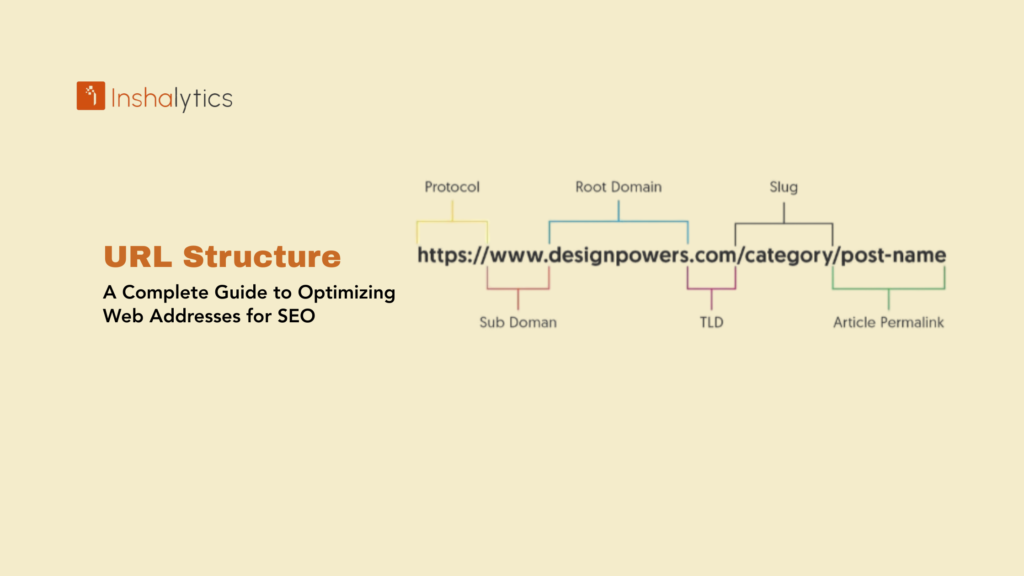
URL structure refers to the format, organization, and hierarchy of web addresses across your website, encompassing how you organize directories, name pages, and create logical pathways that both users and search engines can understand. A well-designed URL structure creates intuitive navigation patterns, clearly communicates content relationships, incorporates relevant keywords naturally, and provides a scalable foundation for site growth. URL structure directly impacts SEO performance, user experience, click-through rates from search results, and overall site usability.
Unlike individual URL optimization, URL structure focuses on site-wide patterns and organizational architecture how product pages are categorized, how blog posts are organized, whether you use flat or hierarchical structures, and how different site sections relate to each other. Strategic URL structure planning during initial site development prevents future restructuring complications, establishes clear content hierarchies, and creates sustainable frameworks that support both current needs and future expansion.
Navigate This Post
Why URL Structure Matters
SEO Impact
Search engines use URL structure to understand content relationships, site hierarchy, and topic relevance. Well-organized URLs help crawlers discover content efficiently, establish topical authority through clear categorization, and provide ranking signals through keyword-rich paths.
User Experience
Descriptive, logical URLs help users understand their location within your site, predict page content before clicking, navigate using URL manipulation, and share links confidently knowing what recipients will find.
Click-Through Rates
Clear, readable URLs in search results increase click-through rates. Users trust and click descriptive URLs over cryptic parameter strings or meaningless numbers.
Site Maintenance
Organized URL structures simplify site management, make troubleshooting easier, facilitate content audits, and reduce broken link risks during site updates or migrations.
Scalability
Good URL structure accommodates growth without requiring major restructuring. Adding new categories, products, or content types fits naturally into established patterns.
URL Structure Types
Flat Structure
All pages exist at the same hierarchy level, directly off the root domain.
Format:
example.com/page-one
example.com/page-two
example.com/page-three
example.com/about
example.com/contact
Advantages:
- Simple to implement
- All pages equally close to homepage (authority distribution)
- Easy to manage for small sites
- Fast to crawl
Disadvantages:
- Doesn’t scale well for large sites
- No content categorization
- Difficult navigation as content grows
- Limited organization for complex sites
Best For:
- Small websites (under 50 pages)
- Single-topic sites
- Portfolio sites
- Simple business websites
Hierarchical Structure
Content organized into categories and subcategories, reflecting parent-child relationships.
Format:
example.com/
example.com/category/
example.com/category/subcategory/
example.com/category/subcategory/page-name
Example E-commerce Structure:
example.com/products/
example.com/products/shoes/
example.com/products/shoes/running/
example.com/products/shoes/running/nike-pegasus-40
Example Blog Structure:
example.com/blog/
example.com/blog/seo/
example.com/blog/seo/keyword-research-guide
example.com/blog/seo/link-building-strategies
Advantages:
- Clear content relationships
- Intuitive navigation
- Scalable for large sites
- Supports logical content grouping
- Helps establish topical authority
Disadvantages:
- Can create very long URLs if too deep
- May dilute authority through many levels
- More complex to maintain
- Restructuring is more complicated
Best For:
- E-commerce sites with product categories
- Large content sites with multiple topics
- Sites with distinct content sections
- Organizations with hierarchical information
Best Practice: Shallow Hierarchy
Keep hierarchical depth to 3-4 levels maximum.
Ideal:
example.com/category/subcategory/page
Too Deep (Avoid):
example.com/region/country/state/city/category/subcategory/type/product
Why: Deep hierarchies create unnecessarily long URLs, dilute link equity through multiple levels, complicate site structure, and suggest poor information architecture.
Elements of Good URL Structure
1. Descriptive and Readable
URLs should clearly describe page content using plain language.
Good:
example.com/blog/email-marketing-tips
example.com/products/wireless-headphones
example.com/services/web-design-london
Poor:
example.com/p?id=12345
example.com/blog/post-789
example.com/category-5/item-234
2. Keyword-Rich (Without Stuffing)
Include relevant keywords naturally without over-optimization.
Good:
example.com/organic-coffee-beans
example.com/guide/content-marketing-strategy
Keyword Stuffing (Avoid):
example.com/coffee-beans-organic-coffee-best-coffee-beans-buy-coffee
3. Short and Concise
Aim for 3-5 words in the final path segment, keeping total URL length under 60-75 characters.
Good:
example.com/seo-guide (30 characters)
example.com/products/running-shoes (38 characters)
Too Long:
example.com/the-complete-comprehensive-ultimate-guide-to-everything-about-seo (78 characters)
4. Hyphen Word Separators
Use hyphens (-) to separate words, never underscores (_) or spaces.
Correct:
example.com/digital-marketing-guide
Incorrect:
example.com/digital_marketing_guide (underscores)
example.com/digitalmarketingguide (no separators)
example.com/digital%20marketing%20guide (spaces encoded)
5. Lowercase Letters Only
Always use lowercase to avoid duplicate content issues and broken links.
Correct:
example.com/about-us
Problematic:
example.com/About-Us (different URL on some servers)
6. Static, Not Dynamic
Prefer clean, static-looking URLs over parameter-heavy dynamic ones.
Static (Preferred):
example.com/products/blue-running-shoes
Dynamic (Less Ideal):
example.com/products.php?id=123&color=blue&category=shoes&size=10
Note: If dynamic URLs are necessary, use URL rewriting to create clean appearances while maintaining dynamic functionality.
7. HTTPS Protocol
Always use HTTPS for security and SEO benefits.
Secure:
Insecure (Avoid):
http://example.com
URL Structure Patterns by Website Type
E-commerce Sites
Recommended Structure:
example.com/
example.com/products/
example.com/products/{category}/
example.com/products/{category}/{product-name}
Example:
example.com/products/laptops/
example.com/products/laptops/macbook-pro-16-inch
example.com/products/headphones/sony-wh-1000xm5
Alternative with Brand:
example.com/products/{brand}/{product-name}
example.com/products/nike/air-max-270
Product Variations: Avoid creating separate URLs for color/size variations. Use parameters or JavaScript to handle on the same page.
Blogs and Content Sites
Recommended Structure:
Option 1: Category-Based
example.com/blog/
example.com/blog/{category}/
example.com/blog/{category}/{post-title}
Example:
example.com/blog/seo/
example.com/blog/seo/keyword-research-guide
example.com/blog/content-marketing/storytelling-techniques
Option 2: Flat Structure (Simpler)
example.com/blog/{post-title}
example.com/blog/email-marketing-tips
example.com/blog/social-media-strategy
Date-Based Structure (Generally Avoid):
example.com/blog/2024/12/10/article-title
Why Avoid Dates: Makes content appear outdated, longer URLs, doesn’t improve SEO, complicates evergreen content management.
Service Businesses
Recommended Structure:
example.com/services/
example.com/services/{service-type}
example.com/services/{service-type}/{location} (for local businesses)
Example:
example.com/services/web-design
example.com/services/web-design/london
example.com/services/seo-consulting
Multilingual Sites
Subdirectories (Recommended):
example.com/en/ (English)
example.com/es/ (Spanish)
example.com/fr/ (French)
example.com/es/productos/zapatos
Advantages: Consolidates domain authority, easier management, clearer for users.
Subdomains (Alternative):
en.example.com
es.example.com
fr.example.com
Country-Code TLDs (For Distinct Markets):
example.com (Global/US)
example.co.uk (UK)
example.de (Germany)
Common URL Structure Mistakes
1. Unnecessary Subdirectories
Problem:
example.com/pages/blog/posts/2024/category/article-title
Solution:
example.com/blog/article-title
Eliminate unnecessary path segments that don’t add value.
2. Inconsistent Patterns
Problem:
example.com/blog/article-one
example.com/posts/article-two
example.com/content/seo/article-three
Solution: Choose one structure and maintain consistency:
example.com/blog/article-one
example.com/blog/article-two
example.com/blog/article-three
3. Using Stop Words
Problem:
example.com/how-to-do-seo-for-your-website
Better:
example.com/seo-guide-websites
Stop words (a, an, the, for, of, to) can be removed for brevity while maintaining clarity.
4. Multiple Parameters
Problem:
example.com/products?category=shoes&color=red&size=10&brand=nike&sort=price
Solution: Use faceted navigation with clean URLs or canonical tags to prevent duplicate content issues.
5. Mixed Subdirectories and Subdomains
Problem:
blog.example.com/posts/
example.com/blog/
shop.example.com/products/
example.com/shop/products/
Solution: Choose one approach (subdirectories preferred) and use consistently.
6. Including File Extensions
Problem:
example.com/about-us.html
example.com/products.php
Better:
example.com/about-us
example.com/products
Extensionless URLs are cleaner, technology-agnostic, and allow backend changes without URL changes.
Implementing URL Structure Changes
Planning Restructuring
Before Making Changes:
- Document current URL structure completely
- Map new structure with every URL change
- Plan 301 redirects from old to new URLs
- Test in staging environment first
- Prepare for temporary ranking fluctuations
301 Redirect Implementation
Apache (.htaccess):
# Individual redirects
Redirect 301 /old-page https://example.com/new-page
# Redirect entire directory
RedirectMatch 301 ^/old-category/(.*)$ https://example.com/new-category/$1
Nginx:
# Redirect old URL to new URL
location /old-page {
return 301 https://example.com/new-page;
}
Post-Change Actions
- Submit updated sitemap to Google Search Console
- Monitor Search Console for crawl errors
- Check analytics for traffic patterns and issues
- Test redirects systematically across the site
- Update internal links to point directly to new URLs
- Monitor rankings for target keywords
URL Structure Best Practices Summary
Do:
- Use clear hierarchical organization
- Keep structures shallow (3-4 levels max)
- Include relevant keywords naturally
- Use hyphens to separate words
- Maintain lowercase consistency
- Make URLs readable and descriptive
- Use HTTPS everywhere
- Plan for scalability
Don’t:
- Create unnecessarily deep hierarchies
- Use cryptic IDs or parameters when avoidable
- Include dates in URLs (usually)
- Keyword stuff
- Use underscores or special characters
- Mix different structural patterns
- Change URLs without proper redirects
- Create duplicate content through URL variations
Conclusion
URL structure represents a foundational element of website architecture that profoundly impacts SEO performance, user experience, and long-term site maintainability. Unlike individual URL optimization focusing on single pages, URL structure requires strategic site-wide planning that establishes clear content hierarchies, creates intuitive navigation patterns, and provides scalable frameworks supporting current needs and future growth.
The most effective URL structures balance simplicity with organization—clear enough for users to understand at a glance, hierarchical enough to show content relationships, shallow enough to avoid excessive depth, and flexible enough to accommodate new content without restructuring. Whether building a new site or restructuring an existing one, invest time in thoughtful URL structure planning. This foundational decision shapes your site’s technical SEO, user experience, and operational efficiency for years to come.
Remember that changing URL structure after launch carries risks and requires meticulous redirect implementation. Establish sound URL structure from the beginning, maintain consistency as your site grows, and restructure only when the long-term benefits clearly outweigh the short-term disruption.
Key Takeaway: URL structure is the site-wide format and organization of web addresses, determining how content is categorized, directories are organized, and page relationships are communicated. Effective structures are hierarchical yet shallow (3-4 levels maximum), descriptive and keyword-rich, consistent across the site, and scalable for growth. Good URL structure improves SEO through clear content relationships, enhances user experience through intuitive navigation, increases click-through rates with readable addresses, and simplifies site management—making it a critical yet often overlooked element of website architecture and digital marketing strategy.