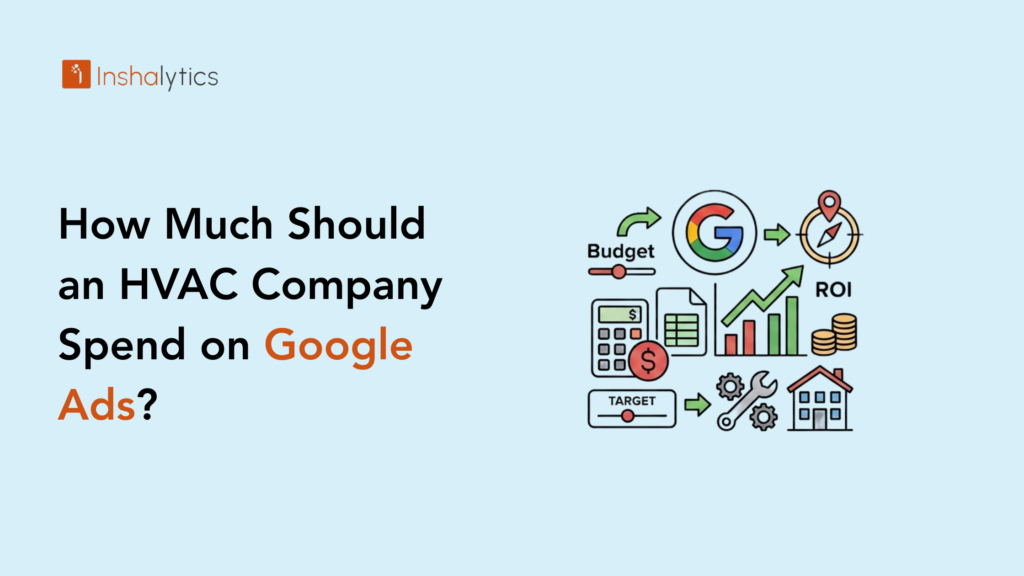
Every HVAC contractor has asked the same question: “How much should I actually spend on Google Ads?” And every marketing agency gives the same useless answer: “It depends on your goals.”
Yes, it depends. But that doesn’t help you decide whether to budget $1,500 or $15,000 next month. You need real numbers, not hedges.
This guide pulls from industry benchmarks tracking $14.9M in HVAC ad spend across 816 contractors, the actual cost-per-click, cost-per-lead, and cost-per-booked-job numbers you need to build a realistic Google Ads budget. We’ll break down what to spend by business size, how to split across campaign types, and the critical moment when you should start shifting budget from paid ads to SEO before your cost-per-lead keeps rising. If spend isn’t turning into booked jobs, read why HVAC Google Ads fail to convert.
The Honest Answer Most HVAC Marketing Agencies Won’t Give You
The right Google Ads budget depends on your market, service mix, and business stage, but there are clear benchmark ranges that work for most HVAC companies. The honest answer most agencies won’t give is that Google Ads alone isn’t a sustainable growth strategy. It’s a lead acceleration tool that needs to be paired with SEO and owned-traffic systems to avoid rising costs and diminishing returns.
Why “It Depends” Is Actually the Right Starting Point
Two HVAC companies in the same metro can have wildly different optimal budgets. One might spend $3,000/month profitably; the other needs $12,000 just to stay visible. The variables that matter: local competition, average job value, close rate, service mix, and seasonality. Your budget has to reflect your specific math, not a generic benchmark. Competition matters too; read how much HVAC competition is too much to advertise in.
The Gap Between Starter Budgets and Scaling Budgets
There’s a critical threshold most HVAC companies hit around $1,500–$2,000/month. Below that, you don’t generate enough click volume for Google’s algorithm to optimize, and your cost-per-lead stays artificially high. Above that threshold, performance typically improves as Google learns which searches convert.
What You’re Really Buying With PPC Spend
Google Ads doesn’t buy you customers; it buys you clicks with intent. The translation from click to customer depends on your ad copy, landing page, phone response time, and close rate. Many HVAC companies blame Google Ads for underperformance when the real problem is a landing page converting at 3% instead of 15%.
HVAC Google Ads Budget Benchmarks by Business Size
Budget ranges vary dramatically by business size and market. Here’s what most HVAC companies actually spend at each stage.
Single-Truck Operators ($1,500–$3,500/month)
Solo HVAC contractors or small two-person operations typically spend $1,500–$3,500/month on Google Ads, primarily through Local Services Ads (LSAs) rather than traditional Search Ads. At this stage, simplicity matters. LSAs require no landing page, charge per lead instead of per click, and carry the Google Guaranteed badge that builds trust. Expect 15–40 leads per month at this budget.
Small-to-Mid Size Companies ($3,000–$8,000/month)
HVAC companies with 3–10 technicians typically spend $3,000–$8,000/month across LSAs, Google Search Ads, and some Performance Max. This budget supports separate campaigns for emergency services, installations, and maintenance, each with dedicated landing pages and call tracking. Expected output: 40–120 leads per month.
Competitive Metro and Suburban Markets ($10,000–$30,000/month)
Established HVAC companies in competitive metros (Phoenix, Houston, Dallas, Atlanta) typically spend $10,000–$30,000/month. This budget supports aggressive bidding on high-value keywords, full Performance Max campaigns, extensive negative keyword lists, and dedicated landing pages for dozens of service-city combinations.
Multi-Location and Private-Equity-Backed ($50,000+/month)
Multi-location HVAC operators and PE-backed franchises often exceed $50,000/month. At this scale, ad management becomes a team effort with dedicated analysts, creative production, and weekly bid optimizations. Cost-per-lead tends to stay favorable due to scale, better data for algorithmic optimization, and negotiated vendor rates.
What Does an HVAC Click and Lead Actually Cost?
Real cost benchmarks from industry data give you starting-point expectations.
Average Cost-per-Click: $8–$50 Depending on the market
HVAC cost-per-click ranges from $8 in small rural markets to $50+ in competitive metros. Emergency keywords like “24-hour AC repair near me” regularly hit $40–$60 in major metros during peak season. The industry-wide average sits around $9–$12, but averages obscure the range your actual CPCs depend heavily on your keywords and location.
Average Cost-per-Lead by Campaign Type (Branded, Non-Branded, PMax)
Cost-per-lead varies dramatically by campaign type:
- Branded search: $30–$40/lead (cheapest searchers already know you)
- Non-branded search: $130–$160/lead (most volume, highest cost)
- Performance Max: $65–$80/lead (AI-optimized across channels)
- Local Services Ads: $45–$85/lead (pay-per-verified-lead)
Blended averages across all campaign types typically fall in the $80–$120 range for HVAC.
Why Emergency Keywords Cost More (and Convert Better)
Emergency keywords carry the highest CPCs because competition is fierce and the stakes are high. A $50 click that produces a booked $600 emergency repair with 40% gross margin still generates $240 of profit after ad cost. The math works as long as you’re tracking close rates and ticket values accurately.
Factors That Move Your HVAC Google Ads Budget Up or Down
Four factors drive the majority of budget variance between HVAC companies.
Market Competition and Metro Population
A contractor in Scranton competing against 12 other HVAC companies faces very different economics than one in Phoenix competing against 200+. Larger metros mean more search volume but also higher CPCs. Smaller markets have lower volume but cheaper clicks. Your budget should reflect market-specific realities, not industry averages.
Seasonality and Weather Events
HVAC search volume doubles or triples during summer and winter peaks. Smart budget allocation increases spending during high-demand windows and pulls back during shoulder seasons. Many HVAC companies run flat budgets year-round, missing the most profitable windows and wasting spend during slow months.
Service Mix: Repair vs. Replacement vs. Maintenance
Different services have different unit economics:
- Emergency repair ($300–$800 avg ticket): Tolerates higher cost-per-lead
- Installation ($6,000–$15,000 avg ticket): Justifies premium bids on high-intent keywords
- Maintenance ($150–$300 avg ticket): Needs lower cost-per-lead to stay profitable
Your budget allocation should weight toward the services with the strongest unit economics in your specific business.
Quality Score, Landing Page Performance, and Wasted Spend
Google rewards relevance with lower costs-per-click. A high Quality Score (Google’s rating of ad relevance, expected CTR, and landing page experience) can reduce your CPC by 30–50% compared to a low Quality Score. Poor landing pages, irrelevant keywords, and generic ad copy all drag Quality Scores down and inflate your budget needs.
How Should You Split Your HVAC Ad Budget Across Campaign Types?
Budget allocation across campaign types typically follows this structure for HVAC companies:
Branded Search (5–10% of budget)
Branded search means bidding on your own company name. This feels wasteful. People searching your name are already looking for you. But competitors bid on your brand too, and a branded campaign keeps them from stealing click-throughs. 5–10% of the budget here protects your brand at the lowest CPCs in your account.
Non-Branded Search (the majority, 60–70%)
Non-branded search is where most HVAC customer acquisition happens: “AC repair ,” “emergency furnace service,” “HVAC contractor near me.” This is the volume driver, and 60–70% of your budget typically lives here.
Performance Max (10–20% as a cost-efficient supplement)
Performance Max uses Google’s AI to serve ads across Search, Display, YouTube, Gmail, and Maps simultaneously. It typically produces leads at a lower cost than non-branded search, though with slightly lower conversion rates. Most HVAC companies should allocate 10–20% of their budget here once their primary search campaigns are dialed in.
Local Services Ads (the top-of-page visibility tool)
LSAs operate separately from the Google Ads platform but should be part of your overall budget allocation. For most HVAC companies, LSAs deserve 20–30% of the total paid search budget because they produce the highest-intent leads at the top of the page with the Google Guaranteed badge.
When HVAC Google Ads Spend Actually Becomes Profitable
Budget ROI isn’t instant. Expect a ramp-up period before campaigns generate consistent, profitable returns.
The Cost-per-Booked-Job Math That Matters
If your average HVAC repair ticket is $500 with a 45% gross margin, you can spend up to $225 to acquire that customer and still break even. Factor in repeat business, referrals, and system replacement over the customer’s lifetime, and the sustainable cost-per-acquisition stretches higher. This is the math that should drive your budget decisions, not what competitors are spending.
Why Month 1 Is About Data, Not Profit
Month one of any new campaign is a data-gathering phase. Google’s algorithm needs volume to optimize, and you need signal to identify winning and losing keywords. Expect cost-per-lead to be 30–50% higher in month one than it will settle at by month three. Pulling the plug after a bad first month is the single most common mistake HVAC companies make with Google Ads.
The 3-Month Rule Before Judging Campaign ROI
Give new campaigns 90 days before making major judgments. Month one gathers data. Month two optimizes based on that data. Month three shows what the steady-state performance looks like. Companies that pull campaigns after six weeks never reach the inflection point where results compound.
The Rented Leads Trap: When to Start Shifting Budget Toward SEO
Google Ads is a rented channel. The moment your card stops being charged, lead flow stops with it. Building owned lead systems through SEO is the escape from that dependency.
Why Google Ads Is a Leaky Bucket Without SEO
HVAC companies relying entirely on Google Ads face rising CPCs year over year, increasing competition for the same keywords, and complete vulnerability to Google algorithm changes. Without SEO, every dollar of lead flow requires another dollar of ad spend. It’s the definition of renting.
The Compound Interest Effect of Owned Traffic
Organic rankings built through SEO produce traffic that compounds. A page that ranks #1 for “AC repair ” generates hundreds of clicks per month without per-click costs, and those clicks continue whether you’re spending on Google Ads or not. Over 24 months, the compounding value of organic traffic typically exceeds the ongoing cost of paid ads by several multiples.
Our Recommended Google Ads-to-SEO Budget Shift Over 24 Months
A sustainable HVAC marketing strategy typically looks like this:
- Months 1–6: 80% Google Ads / 20% SEO (generate cash flow while SEO ramps)
- Months 7–12: 65% Google Ads / 35% SEO (SEO starts producing leads)
- Months 13–24: 50% Google Ads / 50% SEO (balanced portfolio)
- Month 24+: 40% Google Ads / 60% SEO (SEO becomes primary driver)
This isn’t about eliminating Google Ads. It’s about making sure you’re not stuck renting leads forever.
How Much Does HVAC Google Ads Cost?
The cost of HVAC Google Ads has three parts: what you pay Google for clicks, what you pay for management, and what you spend answering and following up on the leads. Click prices vary by city, by season and by the type of job, with emergency repair and replacement searches usually costing more than maintenance. Because of that swing, the right question is not the price of a click but the cost of a booked job. Use your own close rate and average ticket to work backward to a budget, then confirm current click prices in Google Keyword Planner for your market.
How Inshalytics Sets HVAC Google Ads Budgets Based on Your Actual Revenue Goals
We build HVAC ad budgets backward from revenue targets, not forward from arbitrary spend figures.
Our Revenue-First Budget Modeling Framework
Every budget recommendation starts with your revenue goal. From there, we calculate the required lead volume based on your close rate, the ad spend required to produce those leads based on local CPCs, and the landing page and campaign optimization needed to hit the numbers. No guesswork, just math tied to outcomes.
Why We Never Charge Percentage-of-Ad-Spend Fees
Percentage-of-ad-spend pricing creates a perverse incentive for agencies to make more money when you spend more, regardless of results. Inshalytics charges flat monthly management fees, so our recommendations always align with your ROI, not our revenue.
Building a Balanced PPC + SEO Strategy for Long-Term Growth
Our full-stack digital marketing approach integrates PPC and SEO from day one. You get immediate lead flow from ads while organic rankings build the long-term owned-lead foundation.
Get Your Custom HVAC Google Ads Budget Recommendation
Generic benchmarks get you in the ballpark. A custom budget recommendation based on your specific market, service mix, and revenue goals gets you to an actionable plan.
What We Need to Know About Your Market
A proper budget analysis considers your city and competitive landscape, your primary services and average ticket values, your current close rate and lead volume, and your growth targets for the next 12 months. We pull actual CPC and volume data for your keywords and build a budget model from real numbers.
What You’ll Get From a Free Budget Consultation
A free Inshalytics budget consultation includes actual CPC ranges for your top HVAC keywords, estimated lead volume at different budget tiers, a recommended campaign structure and budget split, and a 12-month plan for balancing PPC and SEO investment.
Google Ads can be the fastest way to generate HVAC leads or the fastest way to burn cash; the difference is all in the budget strategy and campaign structure. Benchmark ranges get you started, but sustainable growth comes from building a budget tied to your actual revenue math and pairing paid ads with the SEO foundation that eventually reduces your dependence on rented traffic. If you want a custom budget recommendation built on your market, your margins, and your goals, book a free consultation and let’s build a plan that actually pays for itself.