The average dental practice loses 15–20% of its patient base every year to natural attrition. Without a deliberate marketing and sales system, patient replacement and the capture of higher-value cases stagnate, no matter how good the clinical work is. Yet most practices either underspend on marketing or pour money into tactics that don’t connect to what actually drives production.
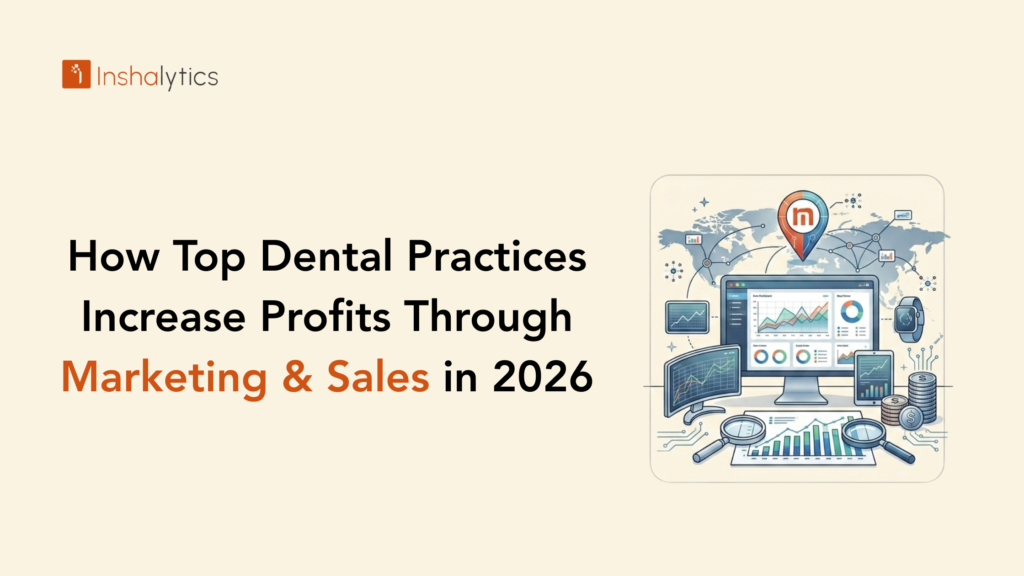
This guide breaks down how top-performing dental practices increase profits through a combination of strategic marketing and a structured sales process. You’ll learn how to connect your marketing channels to measurable growth, build a front-office system that converts leads into patients, and make your marketing budget work as a genuine investment rather than an expense.
Why Most Dental Practices Leave Revenue on the Table
Most dental practice owners are exceptional clinicians. They’re not necessarily trained as marketers or sales professionals, and that gap costs real money every year.
The Gap Between Clinical Excellence and Business Growth
A full schedule doesn’t always mean a profitable practice. Production per patient and new patient acquisition cost determine your true margin far more than raw appointment volume does.
Practices that focus solely on filling chairs often miss the bigger opportunity: attracting higher-value cases, reducing no-shows, and converting more consultations into accepted treatment plans. Clinical skill gets patients in the chair. Marketing and sales systems determine how many of them stay, refer others, and say yes to the care they need.
What Separates High-Growth Practices From Stagnant Ones
High-growth dental practices share three characteristics that stagnant ones don’t:
- They treat marketing as a system, not a series of one-off tactics
- They have a defined process for converting leads into scheduled appointments
- They track the numbers patient acquisition cost, lifetime value, case acceptance rate, and adjust based on data
Practices that rely solely on word of mouth see roughly 20% growth in good years. Practices with active digital marketing and a trained front team can sustain 30–40% year-over-year new-patient growth.
The Compounding Cost of Under-Marketing Your Practice
Every month you under-invest in marketing is a month your competitors are capturing patients you never see. The cost of inaction compounds. A competitor who gains 10 new patients per month on your turf doesn’t just take those patients; they take the referrals, the lifetime value, and the reviews those patients would have generated for you.
What Does a Profitable Dental Marketing System Actually Look Like?
A profitable dental marketing system is a set of coordinated channels and processes that attracts the right patients, converts them to appointments, and keeps them engaged over time. It’s not any single channel; it’s the sum of how those channels work together.
The Marketing Funnel for Dental Practices: From Awareness to Booked Appointment
The dental patient journey typically moves through three stages:
- Awareness: The patient realizes they need a dentist or a specific procedure. They search Google, see an ad, or get a referral.
- Consideration: They compare options. They read reviews, visit your website, and check your Google Business Profile.
- Decision: They book an appointment, call your office, or submit a contact form.
Your marketing system needs to perform at every stage. A beautiful website doesn’t help if no one finds it. Great SEO traffic doesn’t convert if your website doesn’t build trust. Every gap in the funnel is revenue walking out the door.
Channel-by-Channel ROI: SEO, PPC, Social, and Email for Dentists
Different channels serve different stages of the funnel:
- Local SEO captures high-intent searches like “dentist near me,” the highest-converting traffic source for most practices
- Google Ads provides immediate visibility for competitive procedures like implants or Invisalign
- Meta Ads works for cosmetic procedures where visual proof (before-and-afters) drives decision-making
- Email marketing is the highest-ROI channel for patient retention, recall, and reactivation campaigns
The mistake most practices make is choosing one channel and abandoning the others. A patient who found you via Google Ads, then read your blog, then saw a Facebook post about a smile transformation is far more likely to book than one who only saw a single touchpoint.
How to Calculate Your Patient Acquisition Cost and Know If It’s Working
Patient acquisition cost (PAC) is your total marketing spend divided by the number of new patients generated in a given period. If you spend $3,000/month on marketing and bring in 15 new patients, your PAC is $200.
Whether that’s good or bad depends on your patient lifetime value (PLV). A general dentistry patient with regular hygiene visits and occasional restorative work is worth $800–$2,000+ over their relationship with your practice. A full-arch implant patient can represent $30,000–$50,000 in production. A $200 acquisition cost is exceptional for either scenario.
Track PAC monthly. If it’s rising without a corresponding increase in new patients or case value, something in your funnel is leaking.
How to Build a Dental Sales Process That Converts More Leads Into Patients
Marketing gets the phone ringing. Your sales process determines how many of those calls become seated patients and how many of those patients accept the care they need.
Why Your Front Desk Is Your Most Important Sales Asset
The front desk team is the first human touchpoint in your patient acquisition funnel. Studies consistently show that the first 30 seconds of a phone call determine whether a prospect books or hangs up and calls the next practice on their list.
A well-trained coordinator who answers questions confidently, handles objections professionally, and guides the caller toward booking is worth more than any marketing campaign. If your conversion rate from phone inquiry to booked appointment is below 60%, your front team needs training before you scale ad spend.
Phone Scripts and Follow-Up Sequences That Reduce Lead Drop-Off
Most practices have no formal process for leads who don’t book on the first call. Lead drop-off between initial inquiry and booked appointment is where most marketing dollars are wasted.
A basic follow-up sequence looks like this:
- Same-day callback or text if the initial inquiry wasn’t answered live
- 48-hour follow-up call for unclosed inquiries
- Email follow-up with trust-building content (your team, patient testimonials, FAQ)
- 7-day final follow-up before closing the lead in your system
Automating this sequence with your practice management software means no lead falls through the cracks, even when your team is busy.
Case Acceptance Strategies for High-Value Procedures (Implants, Invisalign, Full Arch)
High-value procedures require a more deliberate consultation process. Patients considering a $25,000 full-arch case don’t decide in five minutes. They need:
- A pre-consultation workflow that educates them before they arrive
- A treatment coordinator who understands the emotional, not just clinical, side of the decision
- Clear financing options presented confidently, not as an afterthought
- Follow up that acknowledges their hesitation without applying pressure
The practices generating the most implants and full-arch production aren’t necessarily doing better clinical work; they’re running a more intentional sales process.
What Are the Most Profitable Marketing Strategies for Dental Practices in 2026?
Not every marketing dollar is equal. The channels that deliver the highest ROI depend on your practice type, location, and growth goals, but the data consistently points to a few high-performers.
Local SEO: The Highest-ROI Channel for Most Dental Practices
Local SEO is the process of optimizing your practice to appear in Google’s local search results when someone in your area searches for dental services. It’s the highest-ROI channel for most general dentistry practices because the intent is that someone searching “dentist near me” is ready to book.
Key local SEO components include:
- A fully optimized Google Business Profile with consistent NAP (name, address, phone)
- Regular patient reviews on Google
- A mobile-first, fast-loading website with location-specific content
- Local citations across key directories
Local SEO takes 3–6 months to build momentum, but once established, it generates leads at a fraction of the cost of paid advertising. Learn more about our SEO services for dental practices
Google Ads and Meta Ads: When Paid Traffic Makes Sense
Paid advertising makes sense when:
- You’re a new practice without established organic rankings
- You’re targeting high-value, competitive procedures like implants or orthodontics
- You want to scale quickly in a specific service area
The key is matching your ad spend to realistic patient lifetime value. Spending $150 to acquire a patient worth $2,000+ in lifetime production is an obvious win. Spending $150 to acquire a patient for a single $89 cleaning is a losing proposition.
Reputation Management and Reviews as a Revenue Driver
Online reviews are the new word-of-mouth. A practice with 200 five-star Google reviews and a 4.9 rating consistently outperforms one with 30 reviews and a 4.5 rating, regardless of which practice is clinically superior.
Build a review acquisition system that automatically requests reviews after appointments. Your practice management software likely has this capability. If not, a simple post-visit text sequence does the job.
How to Connect Your Marketing Spend to Measurable Practice Growth
Marketing without measurement is gambling. The practices that grow most predictably are the ones that track the right numbers and make decisions based on data rather than intuition.
The KPIs Every Dental Practice Should Track Monthly
At a minimum, track these metrics monthly:
- New patients from each channel (organic search, paid ads, referral, social)
- Patient acquisition cost by channel
- Call-to-appointment conversion rate
- Case acceptance rate for consultations
- Patient lifetime value (calculated from your practice management data)
These five numbers will tell you more about the health of your marketing system than any agency report ever will.
Setting a Realistic Marketing Budget Based on Your Growth Goals
Industry guidance suggests dental practices allocate 3–8% of gross revenue to marketing, with newer or growth-focused practices investing toward the higher end.
A more useful framework is reverse-engineering from your patient acquisition cost target:
- If you want 20 new patients per month and your target PAC is $150, your budget needs to be at least $3,000/month
- If you want to grow implant production specifically, budget accordingly for the channels that reach implant-intent patients
See our guide on building a dental marketing budget
Using Your Marketing Data to Identify Your Highest-Value Patient Segments
Not all patients are equally valuable. Analyze your patient database to identify:
- Which acquisition channels produce patients who accept the most treatment
- Which zip codes or demographics have the highest lifetime value
- Which procedures have the best margin-to-acquisition-cost ratio
This analysis lets you shift budget toward the campaigns that attract your best patients, not just any patient.
How Inshalytics Helps Dental Practices Build Full-Stack Marketing and Sales Systems
Most dental marketing agencies specialize in one or two channels. They run your Google Ads or build your website, but they don’t connect those pieces into a system that actually converts. That’s the gap Inshalytics fills.
From Website and SEO to Paid Ads and Automation, all in One Strategy
Inshalytics builds complete patient acquisition systems for dental practices. That means:
- A high-converting website designed around patient decision-making psychology
- Local SEO that captures your highest-intent local searches
- Paid advertising for competitive procedures and new patient growth
- Marketing automation that nurtures leads and reduces appointment drop-off
Every channel is connected, tracked, and optimized toward the same goal: more high-value patients at a predictable acquisition cost.
Real Results: What Marketing-First Dental Practices Can Expect
Practices that invest consistently in a connected marketing and sales system see compounding returns. The first six months build the foundation, rankings, reviews, and tracking infrastructure. Months seven through twelve see the system start to perform at scale. By year two, a well-run marketing system typically generates new patient flow at a cost that makes every other growth investment look inefficient.Your practice’s growth ceiling isn’t clinical; it’s marketing and sales. The good news is that it’s entirely fixable. If you’re ready to build a system that turns your marketing spend into predictable patient growth, contact Inshalytics for a free dental practice marketing assessment. We’ll show you exactly where your current system is leaking revenue and what it would take to fix it.