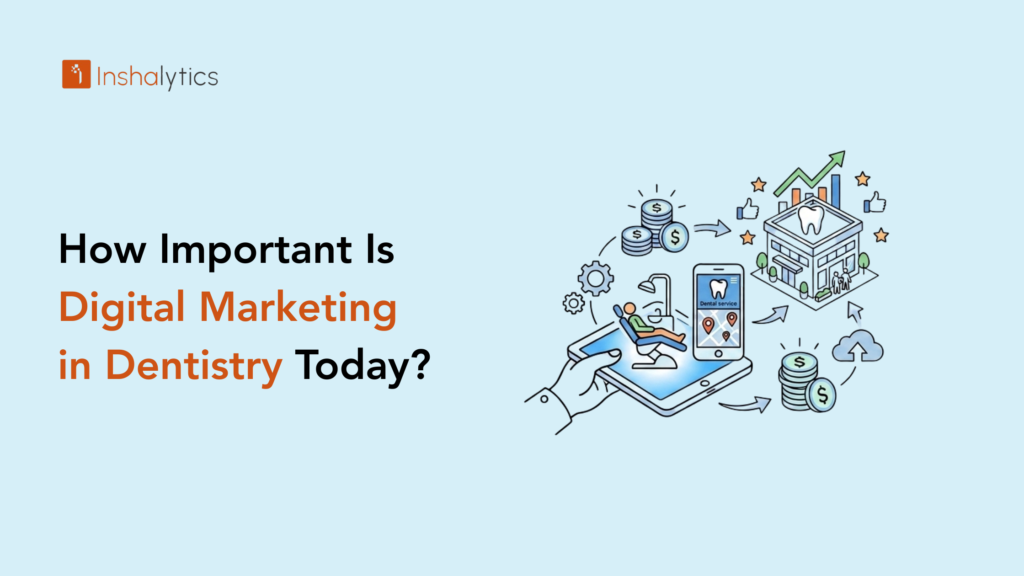
Here’s a number that should get your attention: over 80% of patients now research a dental practice online before booking an appointment. Not some patients, most of them. Even referrals from trusted friends are checking your Google reviews and scanning your website before they pick up the phone. If your digital presence doesn’t pass that five-minute scrutiny, you’re losing patients you never knew you were competing for.
Digital marketing in dentistry is no longer optional or “nice to have.” It’s the primary battleground for patient acquisition in 2026. This article explains exactly why, what channels matter most, and how to make a return on every dollar you invest.
How Patients Find Dentists in 2026 And Why It’s Changed Everything
The way people choose healthcare providers has undergone a fundamental shift in the past decade. Understanding that shift is the first step toward building marketing that actually works.
What Percentage of Patients Research Online Before Choosing a Dentist?
More than 80% of patients use the internet to evaluate healthcare providers before making an appointment. For dental specifically, that number skews even higher for elective and cosmetic procedures.
This doesn’t mean traditional referrals are dead. It means referrals now have a digital checkpoint. Your neighbor recommends their dentist, and you search for that dentist’s name before you call. What you find in those first thirty seconds either confirms or undermines the referral. No digital presence, or a weak one, means the referral evaporates.
Why Word-of-Mouth Alone Is No Longer a Growth Strategy
Word-of-mouth was the dominant acquisition channel in dentistry for decades because information was scarce. Patients couldn’t easily compare practices, verify credentials, or read hundreds of patient experiences. They relied on personal networks.
That scarcity is gone. Today, a patient can evaluate five local dentists in ten minutes without leaving their couch. The practices they choose aren’t necessarily the ones with the best clinical reputation in the community; they’re the ones with the strongest digital presence. Word-of-mouth feeds digital marketing now. Not the other way around.
What Compound Effect Does Ignoring Digital Marketing Create?
Every month without a digital marketing presence widens the gap between you and competitors who are investing. They’re accumulating Google reviews. They’re building local SEO authority. Their website is converting visitors you’re not capturing.
The compound effect cuts both ways. Practices that invest consistently see their digital presence compound, more reviews generate better rankings, better rankings generate more traffic, and more traffic generates more reviews. Practices that wait find themselves further behind every quarter.
What Happens to Dental Practices That Skip Digital Marketing?
This is the question most practice owners don’t ask directly, but should. The cost of not marketing is just as real as the cost of marketing poorly.
The Hidden Revenue Cost of Low Online Visibility
If your practice doesn’t appear in the top three results of the Map Pack for “dentist near me” in your area, you’re missing the majority of high-intent local searches. The Map Pack captures 42–44% of all clicks for local service searches.
Put that in dollar terms: if your service area generates 100 “dentist near me” searches per month and you’re not in the Map Pack, you may be missing 40+ potential patient inquiries every month. At even a 20% conversion rate and a $1,500 average first-year patient value, that’s a $12,000/month opportunity cost.
How Competitor Practices Are Capturing Patients You’re Not Seeing
While you’re relying on existing patients and occasional referrals, competing practices with active SEO, Google Ads, and strong review profiles are systematically capturing the patients who could have been yours. You never see the loss. You just see a flat new patient number each month and assume growth is slow.
The reality is that patient demand in most markets isn’t declining; it’s being captured more efficiently by practices with better marketing systems.
The Compound Effect of Falling Behind on Local Search
Local SEO authority builds over time, and so does the disadvantage of not building it. A practice that has been accumulating Google reviews for three years, building local citations, and publishing relevant content has a structural advantage over one that decides to start today. The head start isn’t impossible to overcome, but it requires more investment to close the gap.
Starting now is always better than starting later.
What Are the Most Important Digital Marketing Channels for Dentists?
Not all channels deserve equal investment. The right mix depends on your practice type, patient demographics, and competitive market, but certain channels deliver strong ROI consistently.
Local SEO Getting Found When It Matters Most
Local SEO is the process of optimizing your online presence so your practice appears prominently when nearby patients search for dental services. It’s the foundation of dental digital marketing because it captures patients at the exact moment they’re ready to act.
Local SEO includes:
- Google Business Profile optimization
- Consistent citations across directories (Yelp, Healthgrades, Zocdoc)
- On-page optimization of your website for local keywords
- Review acquisition and management
- Location-specific content
For most general dentistry practices, local SEO generates the highest-quality leads at the lowest long-term cost per acquisition. our dental SEO services
Google Ads and Meta Ads: Immediate Visibility for High-Value Procedures
SEO builds organic momentum over months. Paid advertising delivers immediate visibility, and for competitive, high-margin procedures like dental implants, Invisalign, and full-arch restoration, that speed can be worth a significant investment.
Google Ads targets patients actively searching for your procedures. Meta Ads targets patients by demographics and interests, working well for cosmetic treatments where seeing results matters.
The right paid strategy depends on your market competition and product mix. A practice in a competitive metro targeting implant patients needs a different budget and creative approach than a rural general practice trying to fill hygiene appointments.
Reviews and Reputation Management: The Conversion Layer Every Practice Needs
Reviews are not just a trust signal; they’re a ranking factor and a conversion mechanism. A practice with 200 five-star Google reviews consistently converts more website visitors than an identical practice with 40 reviews.
The math on review acquisition is simple: patients who had positive experiences are willing to leave reviews; they just need to be asked, at the right moment, with a frictionless process. A post-visit SMS with a direct Google review link, sent within 24 hours, is the most effective method.
Content Marketing and Email Long-Term Patient Retention
Content marketing includes your blog posts, service pages, FAQs, and educational resources. It captures research-phase patients, builds topical authority for SEO, and positions your practice as a trusted expert before any sales conversation happens.
Email marketing is the highest-ROI channel for existing patients. Reactivation campaigns (for patients overdue for hygiene), treatment reminders, and seasonal offers consistently outperform any paid channel on a cost-per-appointment basis.
Is Digital Marketing Cost-Effective for Dental Practices?
The short answer: yes, when done correctly. The longer answer requires comparing the actual cost of digital marketing to the alternative.
Digital vs. Traditional Marketing: A Cost-Per-Lead Comparison
Consider the numbers:
- A full-page newspaper ad: $2,000–$5,000, reaches an untargeted local audience, no tracking
- A TV spot: $10,000+, mass reach, zero intent targeting
- A Google Ads campaign: $1,500–$3,000/month, reaches patients actively searching for your services, fully trackable
Traditional advertising reaches a broad audience with low intent. Digital marketing reaches a narrower audience with high intent, and every dollar is traceable to a result.
For most dental practices, the cost per new patient from local SEO runs $50–$200 once established. From Google Ads, $80–$250 depending on competition and procedure. From newspaper ads? The cost is genuinely unknown because the leads aren’t trackable.
What a Realistic Dental Marketing Budget Looks Like (and What It Returns)
Industry benchmarks suggest dental practices spend 3–8% of gross revenue on marketing, with growth-focused practices trending toward the higher end.
A practice generating $1M/year in production that allocates 5% to marketing ($50,000/year or roughly $4,200/month) and manages it well should expect to generate 20–40 new patients per month from digital channels alone, depending on market, specialty mix, and execution quality.
The return on that investment, calculated against patient lifetime value, is typically positive within 6–12 months and compounds positively thereafter. our digital marketing services for dental practices
How to Measure Marketing ROI as a Dental Practice Owner
The key metrics to track are:
- New patients by channel, where are they coming from?
- Patient acquisition cost: How much did each cost?
- Case acceptance rate? What percentage of consultations convert?
- Patient lifetime value: What is each patient worth over time?
These four numbers will tell you more about your marketing system’s effectiveness than any vanity metric (impressions, clicks, followers).
What’s Changing in Dental Digital Marketing in 2026?
The marketing fundamentals haven’t changed. But the platforms patients use to find healthcare providers are evolving, and practices that adapt early gain a structural advantage.
Google AI Overviews and What They Mean for Dental Search Visibility
Google’s AI Overviews now appear at the top of search results for many dental queries, synthesizing answers from multiple websites. A practice whose content is cited in AI Overviews gains visibility even when the user doesn’t click through to the website.
Optimizing for AI Overviews requires structured content, clear headings, concise answers, FAQ schema, and authoritative information. The practices that get cited are the ones whose content is organized for direct answers, not just keyword density. our guide to technical SEO
The Rise of Voice Search and Conversational Queries in Healthcare
More patients are using voice search to find healthcare providers, especially for urgent needs. Voice queries tend to be conversational: “Who is the best dentist near me?” or “Can I get a same-day dentist appointment?”
Optimizing for voice search means targeting natural-language queries, maintaining an up-to-date Google Business Profile, and ensuring your website answers common patient questions clearly and directly.
Why E-E-A-T Signals Are Now Essential for Dental Websites
Google’s quality guidelines emphasize E-E-A-T Experience, Expertise, Authoritativeness, and Trustworthiness with particular emphasis on health-related content. For dental websites, this means:
- Dentist bios with credentials, certifications, and continuing education
- Author attribution on blog content
- References to clinical research and professional associations
- Genuine patient testimonials and case documentation
Thin, generic website content doesn’t pass Google’s quality filters in 2026. Clinical depth and authentic expertise do.
How Inshalytics Helps Dental Practices Build a Complete Digital Marketing Strategy
Inshalytics specializes in full-stack digital marketing for healthcare practices, including dental. We don’t hand you a website and leave. We build integrated systems where your SEO, paid ads, web presence, and patient communication all work together toward one outcome: more high-value patients at a predictable cost.
Full-Stack Marketing Built Specifically for Healthcare Practices
Our dental marketing services include local SEO, Google Ads management, website design and development, and marketing automation. Every component is designed to work together, and every result is tracked against the metrics that actually matter to a practice: new patient volume, acquisition cost, and production per patient.
Getting Started: What an Inshalytics Dental Marketing Audit Looks Like
We start with a free diagnostic audit of your current digital presence: your GBP, website, review profile, paid ad performance (if applicable), and competitive position in your local market. That audit gives you a clear picture of where you are, where your opportunities are, and what it would take to close the gap.
Digital marketing in dentistry has moved from optional to essential. The practices growing fastest in 2026 are the ones treating their online presence as the primary driver of new patient acquisition, not a supplement to word-of-mouth. If you’re ready to find out exactly where your practice stands, contact Inshalytics for a free digital marketing audit. We’ll show you what’s working, what’s costing you patients, and how to fix it.