Most articles about why you should hire a dental marketing agency are written by dental marketing agencies trying to sell you their services. That’s a conflict of interest worth naming directly. This article takes a different approach: an honest look at what an agency actually does, when it makes financial sense, what you should demand from one, and importantly, the red flags that signal a bad fit before you sign a contract.
If you’re evaluating whether a dental marketing agency is the right move for your practice, this guide gives you the framework to make that decision with clear eyes.
What Does a Dental Marketing Agency Actually Do for Your Practice?
Before evaluating whether to hire an agency, it’s worth being precise about what “dental marketing agency” actually means. The term covers a wide range of service models, price points, and specialties.
Beyond Ads: What Full-Service Dental Marketing Really Covers
A genuine full-service dental marketing agency manages:
- SEO local optimization, Google Business Profile, content strategy, and technical site health
- Paid advertising: Google Ads, Meta Ads, Google Local Services Ads
- Website design and development built for conversion and search performance
- Reputation management systematic review, acquisition, and monitoring
- Marketing automation, patient follow-up, appointment reminders, and reactivation campaigns
- Analytics and reporting, tracking results against real business metrics
Many agencies advertise as “full-service” but specialize in one or two areas and outsource the rest. Know what you’re actually getting and what’s being subcontracted.
In-House vs. Agency: A Realistic Comparison for Most Dental Practices
For most dental practices, hiring a fully in-house marketing team isn’t financially realistic. A competent in-house team would require:
- A marketing manager ($50,000–$80,000/year)
- A graphic designer ($45,000–$65,000/year)
- An SEO specialist ($55,000–$75,000/year)
- A paid ads manager ($55,000–$75,000/year)
That’s $200,000–$300,000 in salary alone before benefits, tools, and management overhead. A full-service agency delivering an equivalent scope typically costs $2,000–$8,000/month.
For practices under $2M in annual production, the economic case for in-house marketing seldom holds up.
What You’re Really Paying for When You Hire an Agency
Agency fees cover more than execution. You’re paying for:
- Accumulated expertise strategies refined across dozens of similar practices
- Tool access to SEO platforms, analytics software, and ad management tools that cost thousands individually
- Speed agencies can execute campaigns in days that would take an in-house hire months to build capacity for
- Accountability a defined service agreement that specifies deliverables and results
The question isn’t whether an agency costs money. It’s whether the revenue it generates exceeds the cost and by how much.
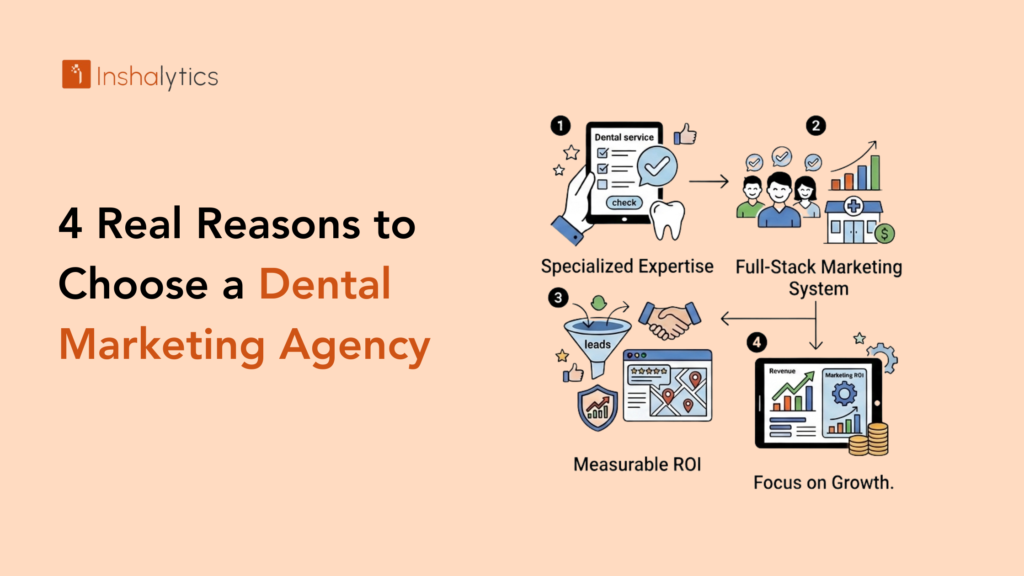
Reason 1: Specialized Expertise That In-House Teams Rarely Have
The dental industry has nuances that generic marketing agencies don’t understand and those nuances matter for compliance, conversion, and results.
Why Dental Marketing Is Not the Same as General Marketing
Dental patients make decisions differently from retail or SaaS customers. They’re making choices about their health, their appearance, and often their finances simultaneously. They’re frequently anxious. They’re sensitive to clinical language that feels cold and to salesy language that feels manipulative.
Effective dental marketing understands this emotional landscape. It builds trust before asking for the appointment. It speaks to the patient’s concerns, not just the dentist’s capabilities. And it knows which visual and verbal cues (real before-and-afters, genuine team photos, specific rather than generic testimonials) convert better than which alternatives.
HIPAA Compliance, Local SEO, and Healthcare-Specific Ad Restrictions
Dental marketing operates under constraints that don’t apply to other industries:
- HIPAA restricts how you can use patient data in advertising and remarketing
- Google and Meta’s ad policies for healthcare have specific restrictions on targeting and claims
- Review platforms have healthcare-specific guidelines around what can and can’t be incentivized
An agency unfamiliar with healthcare marketing will make mistakes that expose your practice to compliance risk or get your ad account suspended. A specialized agency navigates these constraints as a matter of course.
The Learning Curve Cost When You Go It Alone
If you or a staff member manages your own digital marketing, there’s a real cost to the learning curve. Google Ads campaigns run by inexperienced managers typically waste 30–40% of the budget on irrelevant clicks before optimization. Local SEO mistakes, such as duplicate listings, inconsistent NAP, and thin content, can take months to recover from.
The time spent learning is also time not spent on clinical care. For a dentist billing at $300–$500/hour of chair time, an hour spent on marketing has a very high opportunity cost.
Reason 2: A Full-Stack Marketing System, Not Just One Channel
The most common reason dental practices get poor results from marketing is channel isolation; they invest in one tactic without connecting it to the others.
Why Single-Channel Marketing Falls Short for Dental Practices
A Google Ads campaign without a high-converting landing page wastes budget. A great website without local SEO gets no traffic. A strong SEO presence without systematic review acquisition loses the conversion fight to competitors with better reputation profiles.
Each channel amplifies the others. The practices with the best patient acquisition costs aren’t necessarily outspending competitors; they’re connecting channels into a system where every piece supports the whole.
How SEO, PPC, Web Design, and Automation Work Together as a System
A connected dental marketing system looks like this:
- Local SEO drives high-intent organic traffic
- The website converts that traffic into appointment requests or calls
- Google Ads fills gaps where organic rankings haven’t yet caught up
- Reputation management feeds reviews back into SEO and conversion
- Marketing automation catches leads who didn’t book immediately and nurtures them toward an appointment
An agency managing all of these components can optimize across the system. An agency managing only ads can only optimize the ads, even when the real problem is the website or the follow-up process.
What Happens When Channels Aren’t Coordinated
Common symptoms of disconnected channels:
- High ad spend but low new patient volume (ads sending traffic to a weak website)
- Good organic traffic but low conversion rate (SEO working, website failing)
- High inquiry volume but low booked appointment rate (weak follow-up system)
- New patients arriving but not scheduling treatment plans (front desk process gap)
A full-stack agency diagnoses these problems across the whole system, not just within its own channel. our full-stack digital marketing services
Reason 3: Faster Results and Measurable ROI
The financial case for a dental marketing agency is straightforward when you’re measuring the right things.
How to Calculate Whether Agency Fees Make Sense for Your Practice
The break-even analysis is simple:
- Agency monthly fee: $3,000
- Average patient lifetime value: $2,500
- New patients needed to cover agency fee: 1.2 patients/month
- Realistic new patients generated by a good agency: 15–30+/month
If a $3,000/month agency investment generates even 8 additional new patients per month, well below what a competent agency should deliver, you’re looking at $20,000/month in lifetime patient value against a $3,000 cost. That’s a 6:1 ROI before accounting for the referrals those patients generate.
The math works. The question is whether the execution is competent enough to realize the opportunity.
Timeline Expectations: What Good Agencies Actually Promise
Be wary of agencies that promise specific result timelines upfront. The honest answer is:
- Local SEO: 3–6 months to meaningful ranking movement, compounding thereafter
- Google Ads: 30–60 days to initial lead flow, 90 days to optimization
- Content marketing: 6–12 months to meaningful organic traffic growth
- Reviews: 30–90 days to a noticeable increase with a systematic process
Any agency guaranteeing “#1 on Google in 30 days” or “50 new patients in your first month” is overpromising. Sustainable results take time and compound with consistency.
The Metrics That Matter (And the Vanity Metrics to Ignore)
Good agencies report on:
- New patients generated by the channel
- Patient acquisition cost
- Website conversion rate
- Call tracking and lead source attribution
Bad agencies report on:
- Impressions
- Social media followers
- “Keyword rankings” without traffic data
- Click volume without conversion data
If your monthly agency report is full of numbers that don’t connect to patients walking through your door, that’s a red flag.
Reason 4: You Focus on Dentistry. They Focus on Growth.
The most underappreciated reason to hire a dental marketing agency has nothing to do with marketing expertise. It’s about where you put your cognitive energy.
The Opportunity Cost of Marketing Your Own Practice
Every hour you spend reviewing ad campaigns, writing blog posts, or managing your Google Business Profile is an hour you’re not spending with patients. For a dentist, that’s a direct revenue cost.
If you’re billing $350/hour in chair time and you spend 5 hours per week on marketing tasks, that’s $1,750/week in production capacity you’re diverting, $91,000/year. A competent agency costs a fraction of that.
How Delegation Frees Chair Time and Reduces Overhead
Delegating marketing to an agency doesn’t just reclaim your time it typically produces better results than DIY, because the agency’s only job is marketing. They stay current on platform changes, algorithm updates, and industry best practices that a busy clinician simply cannot track.
What a Good Agency Partnership Actually Looks Like Day-to-Day
A well-run agency relationship includes:
- A dedicated account manager you can actually reach
- Monthly reporting tied to patient acquisition, not vanity metrics
- Proactive recommendations, not just reactive execution
- Transparent pricing with no hidden fees or automatic renewals
The relationship should feel like a business partnership, not a vendor service you set and forget.
What Should You Ask Before Hiring a Dental Marketing Agency?
The final section is the most important. Use these questions to separate capable partners from expensive disappointments.
6 Red Flags That Signal the Wrong Fit
Watch for these warning signs:
- Guaranteed rankings or patient volume, no ethical agency can guarantee search rankings
- Long-term lock-in contracts, 12+ month agreements with no performance exit clauses
- Vague reporting, “we’re working on it,” without specific metrics
- No dental or healthcare experience, generic agencies that apply the same strategy across all industries
- Black-hat SEO tactics, such as buying links, keyword stuffing, and fake reviews
- Pressure tactics during the sales process, such as the “limited time discount” that appears every week
The Questions Every Dentist Should Ask Before Signing a Contract
Ask any prospective agency:
- What dental practices have you worked with, and can I speak to them?
- How do you track and report on new patient acquisition specifically?
- Who manages my account day-to-day, and how do I reach them?
- What does your onboarding process look like?
- What are your contract terms, and what happens if I want to exit?
An agency that answers these questions with confidence and specificity is worth evaluating further. One that deflects or answers vaguely should be disqualified.
Why Inshalytics Does Things Differently
Inshalytics operates as a full-stack marketing partner for dental and healthcare practices, not a vendor running one channel in isolation. Our reporting connects every marketing activity to patient acquisition data. Our contracts don’t lock clients into long-term agreements without performance accountability. And our team stays invested in your practice’s results, not just the execution of a fixed scope.
Choosing a dental marketing agency is a meaningful business decision. Done right, it compounds your practice’s growth faster than almost any other investment. Done wrong, it costs you time, money, and the opportunity to build a system that actually works. If you want a straightforward conversation about what Inshalytics can do for your practice with honest timelines and realistic expectations, contact us for a free consultation.