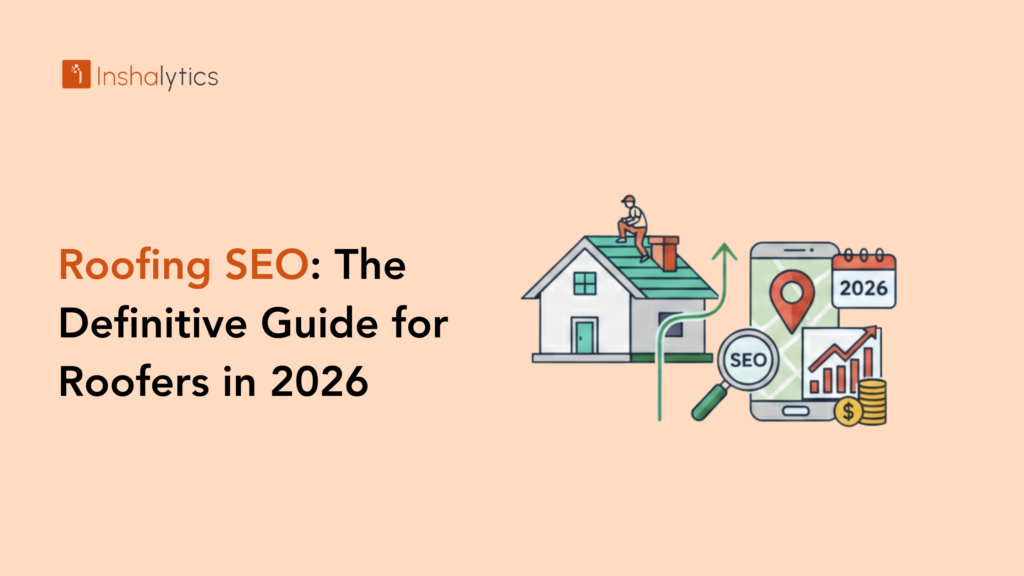
A roofer in Houston generates an average of $12,000–$20,000 per job. A single organic search ranking for “roof replacement Houston” can deliver 5–15 qualified inquiries per month. Do the math, and you quickly understand why roofing SEO is one of the highest-leverage investments a roofing company can make and why the contractors who build a strong search presence consistently outgrow those who depend on bought leads and word-of-mouth alone.
This guide covers everything you need to know about roofing SEO in 2026: how Google ranks local roofing companies, which tactics actually move the needle, and how to adapt your strategy for AI-driven search that’s already changing how homeowners find contractors.
What Is Roofing SEO and Why Does It Matter More Than Ever?
Roofing SEO is the process of optimizing your roofing company’s online presence, website, Google Business Profile, content, and off-site signals to rank higher in search engine results when homeowners search for roofing services in your area. It’s not a single tactic. It’s a coordinated strategy across multiple disciplines.
How Homeowners Now Find Roofing Contractors: The Search-First Journey
The roofing customer journey has changed dramatically. In the past, homeowners relied on yard signs, door-to-door canvassing, and referrals. Today, 97% of consumers go online to find local service providers. For roofing specifically, most searches are driven by urgency: a damaged roof, a recent storm, or the recognition that a roof is aging past its useful life.
When that urgency hits, homeowners open Google. They search “roofer near me,” “roof replacement cost,” or “storm damage roof repair .” The three companies that appear in the Map Pack at the top of those results capture the majority of calls. Contractors outside the Map Pack and the first page of organic results are effectively invisible to those searches.
The ROI Case for Roofing SEO: What One Additional Job Per Month Is Worth
At an average roofing job value of $10,000–$15,000, one additional job per month from organic search translates to $120,000–$180,000 in additional annual revenue. Most professional roofing SEO services cost $1,500–$4,000/month.
The ROI calculation is straightforward: even at the higher end of service costs, a single additional job per month more than covers the investment. And the compounding nature of SEO means that as rankings improve, lead volume continues to grow without a proportional increase in cost.
Google SEO vs. Paid Ads vs. Lead Marketplaces: How They Compare for Roofers
Every roofing lead source has trade-offs:
- Google Ads: Fast but expensive ($200–$300/lead average for roofing), stops generating leads the moment you stop paying
- Lead marketplaces (Angi, Thumbtack): Shared leads sold to multiple contractors, low exclusivity, competitive close rates
- Organic SEO: Takes 3–6 months to build momentum, but generates exclusive leads at a long-term cost far below paid channels
The strongest roofing companies run SEO as their long-term foundation and layer paid ads on top for immediate volume. Relying exclusively on lead purchases or ads is an operating expense, not an asset. SEO is an asset that compounds.
How Does Google Rank Roofing Companies in 2026?
Google’s local ranking algorithm evaluates hundreds of signals. Understanding the most important ones lets you prioritize your investment correctly.
The Three Core Ranking Signals: Relevance, Distance, and Prominence
For local search results (Map Pack), Google evaluates:
- Relevance: Does your business match what the searcher is looking for? Are your services clearly described?
- Distance: How close is your business to the searcher’s location?
- Prominence: How well-known and authoritative is your business online and off?
Distance is the one factor you can’t control directly. Relevance and prominence are where your SEO investment goes.
How Google’s AI Overviews and AI Mode Are Changing Local Search for Roofers
Google’s AI Overviews now appear at the top of many roofing-related searches, synthesizing answers from multiple sources. These AI-generated responses sometimes include local business recommendations, and the companies cited are those with strong entity signals: consistent NAP across the web, authoritative website content, and high-quality reviews.
Optimizing for AI visibility requires the same foundation as traditional SEO, with additional emphasis on structured content (FAQ sections, schema markup, direct-answer headings) that AI systems can parse and cite. learn how AI search is changing local SEO
E-E-A-T for Roofers: Why Google Now Cares About Proof of Real Work
Google’s E-E-A-T guidelines (Experience, Expertise, Authoritativeness, Trustworthiness) apply directly to roofing websites. Google wants to see that the content on your site comes from a real company with real experience, not a generic template.
Signals that build E-E-A-T for roofers:
- Original job photos with geo-tagged metadata
- Detailed case studies of completed projects
- Certifications and manufacturer authorizations displayed prominently
- Genuine customer reviews with specific project details
- An author bio (or “About Us” page) that describes real credentials
Keyword Research for Roofing Companies: How to Find the Terms That Drive Calls
Before optimizing anything, you need to know what your customers are actually searching for.
High-Intent Roofing Keywords vs. Research-Phase Keywords
Not all keywords lead to the same type of visitor. Segment your target keywords by intent:
High-intent (ready to hire):
- “Roofing contractor “
- “Roof replacement cost “
- “Emergency roofer near me”
- “Roof repair “
Research-phase (building awareness):
- “How long does a roof last?”
- “Signs you need a new roof.”
- “Metal roof vs asphalt shingles”
High-intent keywords should anchor your service pages and Google Ads. Research-phase keywords drive blog content that captures homeowners early in the decision journey and builds brand familiarity before they’re ready to get estimates.
Local Keyword Variations and the “Near Me” Opportunity
“Near me” searches have grown dramatically and represent high-intent local demand. Your website and GBP need to signal your service area clearly through city pages, service area descriptions, and geo-tagged content.
Beyond “near me,” target city-specific and neighborhood-specific variations: “ roofer,” “roof replacement [suburb],” “commercial roofing [metro area].” Each geographic variation is a separate ranking opportunity.
Storm and Emergency Keywords Capturing Urgent, High-Value Traffic
Storm damage and emergency roofing searches represent some of the highest-converting traffic in the industry. Homeowners searching “storm damage roof repair” or “emergency roofer today” are not browsing, they’re choosing right now.
Create dedicated service pages for emergency roofing and storm damage restoration. These pages should include immediate call-to-action elements (click-to-call, live chat), response time guarantees, and content that speaks directly to the urgency of the situation.
On-Page SEO for Roofing Websites: What Actually Moves the Needle
On-page SEO is the optimization of individual pages on your website for specific keywords and user intent.
Website Architecture and URL Structure for Roofing Companies
Your website structure should make it easy for both Google and users to navigate. A clean architecture looks like:
- Homepage: Overall roofing services and service area
- Service pages: Roof replacement, roof repair, storm damage, commercial roofing, gutters
- City/area pages: One page per major service area you cover
- Blog: Educational content targeting research-phase queries
URLs should be clean and descriptive: /roof-replacement-houston/ rather than /services/page?id=3.
Optimizing Service Pages, City Pages, and Your Homepage
Every service page and city page needs:
- A unique title tag containing the primary keyword and location (under 60 characters)
- An H1 matching the page’s target keyword
- Body content (minimum 500 words) that genuinely answers what a homeowner wants to know about that service
- A local schema markup identifying your business, service area, and contact information
- Customer reviews or testimonials specific to that service or location
- A clear CTA phone number, contact form, or quote request button
Title Tags, Meta Descriptions, Schema Markup, and Core Web Vitals
Technical on-page elements that matter:
- Title tags: 50–60 characters, keyword + city + brand
- Meta descriptions: 140–155 characters, include a keyword and a compelling reason to click
- LocalBusiness schema: Structured data that tells Google exactly who you are, where you operate, and what services you offer
- Core Web Vitals: Google’s page experience signals, Largest Contentful Paint, Cumulative Layout Shift, and First Input Delay, must be in the “Good” range to compete in 2026
Local SEO for Roofers Dominating the Map Pack
The Map Pack is where the highest-intent local searches land. Getting into it requires a sustained, multi-signal optimization strategy.
Google Business Profile Optimization: The Complete 2026 Checklist
Your Google Business Profile is your most important local SEO asset. Optimize it with:
- Correct primary category: “Roofing Contractor.”
- Complete service list with individual service descriptions
- Service area defined accurately (cities/regions you serve)
- Business description using natural language with key services and locations
- Photos added project photos, team photos, and equipment consistently
- Google Posts are published weekly
- Q&A section answered thoroughly
- Reviews responded to within 24–48 hours
our SEO services for home service businesses
NAP Consistency, Citations, and Local Directory Strategy
NAP (Name, Address, Phone number) consistency across every online directory, citation, and listing is a foundational local SEO signal. Inconsistencies, even minor variations like “St.” vs. “Street,” dilute your local authority.
Priority citation sources for roofers:
- Google Business Profile (primary)
- Bing Places
- Yelp, HomeAdvisor, Angi
- BBB, Chamber of Commerce
- Industry directories: Roofing Contractor, Remodeling Magazine
Use a citation management tool or manual audit to ensure consistency across your top 30–40 listings.
Reviews: How to Get More 5-Star Reviews and What to Do With Them
Google weighs review quantity, recency, and sentiment. A roofer with 150 Google reviews and a 4.8 rating consistently outranks one with 25 reviews, regardless of which practice is technically superior.
Build a systematic review process:
- Request a review by SMS within 24 hours of job completion
- Include a direct link to your Google review form
- Respond to every review, positive and negative, within 48 hours
- Never offer incentives for reviews (violates Google policy)
Negative reviews responded to professionally often convert skeptical searchers better than having no negative reviews at all.
Link Building for Roofing Companies: Building Authority Without Getting Penalized
Backlinks, links from other websites to yours, remain a significant ranking factor. But not all links are equal, and some actively harm rankings.
What Types of Backlinks Actually Help Roofing Sites Rank
Quality matters more than quantity. Valuable links for roofers include:
- Local business citations (directories, chamber of commerce, associations)
- Supplier/manufacturer websites (many manufacturer programs include dealer directory listings with links)
- Local press (home improvement features, storm recovery stories, community involvement coverage)
- Industry publications (roofing trade press, home improvement blogs)
- Contractor association listings (NRCA, local contractor associations)
Local Link Building Suppliers, Associations, and Community Sponsorships
Community sponsorships are an underutilized link source for roofers. Sponsoring a local Little League team, school event, or charity run often results in a link from the organization’s website, which is a genuine local link with meaningful authority.
Similarly, partnering with complementary contractors (plumbers, HVAC, solar installers) for cross-referral arrangements often produces informal website mentions and links.
Content-Driven Link Acquisition for Roofers
Creating genuinely useful content, such as storm damage guides, cost calculators, and material comparison tools, attracts natural links from home improvement blogs, local news sites, and real estate professionals who reference the content for their own audiences.
The key is creating content that other websites want to link to, not content created solely for the purpose of link acquisition.
Technical SEO for Roofing Websites: The Foundation That Holds Everything Up
Technical SEO ensures that search engines can crawl, index, and understand your website correctly. Without it, even excellent content and strong links won’t reach their full ranking potential.
Site Speed, Mobile-First Design, and Core Web Vitals for Roofers
Over 70% of roofing searches happen on mobile devices. A website that loads slowly on a phone or displays poorly on a small screen is actively losing leads.
Optimize for:
- Page load time under 3 seconds on mobile
- Images compressed without quality loss
- No render-blocking scripts
- A mobile-responsive layout that prioritizes the phone number and contact form
Crawlability, Indexing, and Sitemap Structure
Google needs to be able to find and index your pages. Ensure:
- An XML sitemap is submitted to Google Search Console
- Your robots.txt file doesn’t block important pages
- No orphaned pages (pages with no internal links pointing to them)
- Canonical tags are set correctly to prevent duplicate content issues
Schema Markup for Local Roofing Businesses
Schema markup is structured data code that tells Google explicit information about your business. For roofers, implement:
- LocalBusiness schema with NAP, hours, and service area
- Service schema for each roofing service you offer
- Review schema to display star ratings in search results
- FAQPage schema for FAQ sections (helps with AI Overviews and featured snippets)
AI SEO for Roofers Getting Cited in Google AI Overviews and ChatGPT
Traditional SEO gets you ranking in the blue links. AI SEO gets your business cited when a homeowner asks ChatGPT, Perplexity, or Google Gemini to recommend a roofer.
How AI Search Engines Decide Which Roofers to Recommend
AI search tools pull from a combination of indexed web content, structured data signals, and entity recognition. They tend to cite businesses that:
- Have clear, structured information on their website (who they are, what they do, where they operate)
- Appear consistently across multiple authoritative platforms (GBP, Yelp, BBB, directory listings)
- Have positive review sentiment across platforms
- Produce content that directly answers the questions users ask AI tools
The Content and Entity Signals That Drive AI Visibility
To improve AI search visibility:
- Write FAQ sections on your service pages using natural-language questions homeowners actually ask
- Add FAQ schema markup to these sections
- Maintain consistent business information across every platform where you appear
- Publish project documentation (real photos, locations, project descriptions) that AI systems can reference as proof of experience
Answer Engine Optimization (AEO) Basics for Roofing Companies
Answer Engine Optimization is the emerging discipline of structuring content so AI tools choose your business as their answer to a question. For roofers, this means:
- Writing content that answers specific roofing questions directly and concisely
- Organizing content with clear headings that match the format of questions homeowners ask
- Building topical authority by covering your service area comprehensively, not just ranking for a few head terms
How Inshalytics Builds Roofing SEO Systems That Generate Consistent Leads
Roofing SEO is not a one-time project. It’s an ongoing system of technical maintenance, content production, local signal management, and link acquisition. Practices that approach it that way consistently outperform those that treat it as a set-and-forget setup.
Full-Stack SEO Technical, On-Page, Local, and Off-Page Working Together
Inshalytics builds roofing SEO strategies that integrate every dimension: a technically sound website, optimized service and city pages, a local signal management system for GBP and citations, content that builds topical authority, and link acquisition that builds domain authority over time.
Every element is tracked so you know exactly which ranking improvements are driving call volume and revenue.
What Roofing Companies Can Expect From a Dedicated SEO Partnership
In months 1–3, the focus is on technical foundation and local signal optimization. In months 4–6, content and city page expansion begin generating organic traffic. By month 9–12, a well-executed roofing SEO strategy should be generating consistent organic leads at a cost per acquisition well below any paid channel. Roofing SEO in 2026 is more than ranking for keywords. It’s about building the full digital authority that makes your company the obvious choice in Google search, in the Map Pack, and increasingly, in AI-generated answers that homeowners are beginning to trust. If you’re ready to build that authority, contact Inshalytics for a free roofing SEO audit.