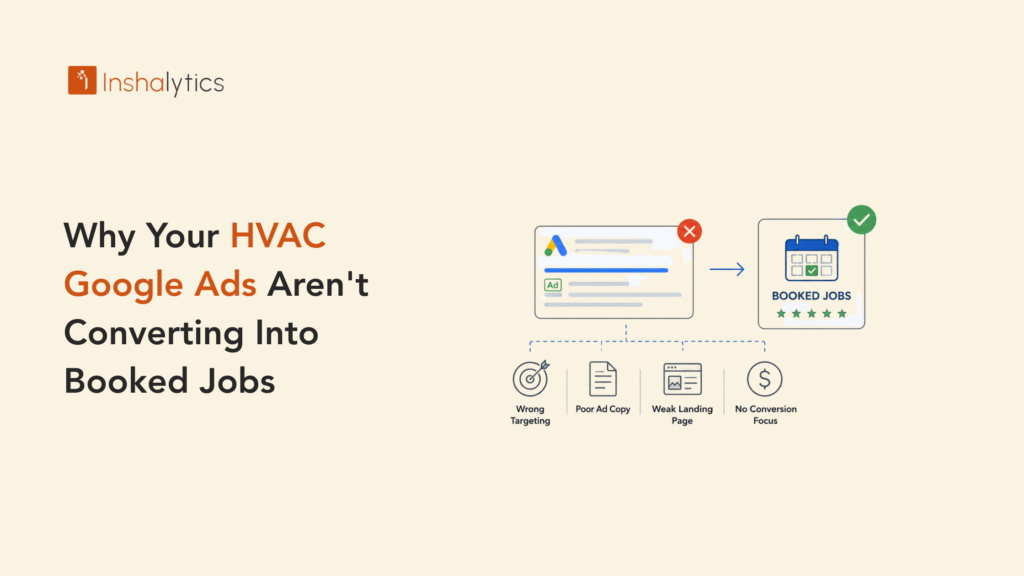
The dashboard looks fine. Impressions are up, clicks are coming in, budget is being spent right on schedule. The job board tells a different story, because it’s still empty. This is one of the most common and most misdiagnosed problems in HVAC advertising, and it almost never means the ads themselves are broken.
It usually means the wrong number is being optimized, or the campaign is losing people at a step nobody’s watching closely. This guide walks through why HVAC Google Ads stop converting into actual booked jobs, starting with the metric most accounts get wrong from day one, and ending with what a genuinely healthy account looks like.
You’re Optimizing the Wrong Number
The most common reason HVAC Google Ads look fine on paper and fail in practice is that the account is being judged on the wrong metric entirely. Cost-per-lead can look great while cost-per-booked-job quietly bleeds the business dry, and most owners never see the second number at all.
Cost-Per-Lead vs. Cost-Per-Booked-Job
A cheap lead that never books is worthless, and an expensive lead that books immediately can be one of the best-performing dollars in the account. Cost-per-booked-job is the only number that actually reflects whether a campaign is profitable, because it accounts for the full path from click to completed work, not just the click itself.
Two campaigns can show identical cost-per-lead and produce wildly different actual revenue, simply because one attracts callers who are ready to book and the other attracts people still comparing quotes from five different companies.
Picture two campaigns each generating leads at forty dollars apiece. One closes at fifty percent, the other at fifteen percent. On a cost-per-lead report, they look identical. Once measured by cost-per-booked-job, one is more than three times more expensive than the other, and that gap is invisible until someone actually tracks it through to the finish line.
The Three Conversion Events Hiding Inside Your Campaign
A click-to-call, a form submission, and an actual booked appointment are three completely different events, and most HVAC accounts only track the first two. Without tracking the third, it’s impossible to know which keywords, ads, or campaigns are producing revenue rather than just activity.
Setting up tracking that follows a lead all the way to a booked appointment, not just a form fill, is usually the single most valuable change an underperforming account can make, since it’s what finally reveals where the real problem sits.
Intent Mismatch Is Draining Your Budget
A click is not the same thing as interest in booking a job, and broad campaigns routinely confuse the two, spending real money on searches that were never going to convert.
Broad Match Keywords Bringing in Research Clicks
Searches like “how does a heat pump work” or “HVAC certification” generate clicks but never generate customers, since the person searching has zero intent to hire anyone today. Broad match keyword settings, left unmanaged, quietly funnel budget toward exactly this kind of traffic without ever showing up as an obvious red flag on the dashboard.
This is especially costly in HVAC, where cost per click already runs high. Paying premium click prices for someone doing homework rather than someone ready to book compounds the waste.
A search terms report left unreviewed for a month can accumulate dozens of these irrelevant queries, each one a small leak that adds up to a meaningful share of wasted spend by the time anyone notices.
Building a Negative Keyword List That Actually Works
A strong negative keyword list, covering terms like school, parts, salary, DIY, and certification, is one of the highest-leverage and most neglected levers in HVAC PPC. Reviewing the search terms report weekly and adding new negatives as they appear keeps budget concentrated on people who are actually ready to book.
This isn’t a one-time setup task. New irrelevant search terms surface constantly as Google’s matching broadens over time, which means the negative list needs ongoing maintenance, not a single pass at campaign launch.
Response Friction Is Killing Clicks Before They Become Calls
Even a perfectly targeted click can fail to convert if what happens after the click creates friction, and this is often where the real money leaks out.
Mobile Click-to-Call and Landing Page Speed
The large majority of HVAC searches happen on mobile, many of them during an active emergency. If the landing page is slow to load or the phone number isn’t a tappable link, a frustrated searcher taps back and calls the next result instead. Call extensions and a large, clickable phone number are non-negotiable basics, not nice-to-haves.
A page that takes more than a few seconds to load on a phone loses a meaningful share of visitors before they even see the offer, regardless of how good the ad that brought them there was.
Testing the actual mobile experience on a real phone, not just a desktop preview, catches problems that are easy to miss otherwise, like a phone number that displays but isn’t actually clickable.
Landing Pages That Match the Ad, Not the Homepage
Sending paid traffic to a general homepage instead of a page built around the exact service advertised adds friction at the worst possible moment. If the landing page itself isn’t converting, no amount of targeting precision upstream will fix the leak.
A visitor who clicked an ad for emergency AC repair and lands on a generic services page has to do extra work to confirm they’re in the right place, and that extra friction is exactly where conversions quietly disappear.
Building even a handful of dedicated landing pages, one for AC repair, one for furnace repair, one for installations, tends to lift conversion rate noticeably compared to funneling every campaign to the same general page.
Fixing the Leak: A Campaign Audit Framework
Once intent and friction issues are addressed, the remaining gains come from how the account itself is structured and measured, not from writing punchier ad copy.
Segmenting Campaigns by Type and Tracking Cost-Per-Booked-Job for Each
Branded search, non-branded search, Performance Max, and Local Services Ads behave completely differently and deserve separate tracking rather than one blended number. A campaign type that looks cheap on cost-per-lead can carry a much worse cost-per-booked-job once actual close rate is factored in, and segmenting the data is the only way to see that clearly.
Reviewing current Google Ads budget allocation against this segmented view often reveals spend that should shift between campaign types entirely, sometimes moving a meaningful share of budget away from a channel that looked fine in aggregate.
It’s common to find that branded search, often the cheapest channel per click, is quietly propping up the average performance of a blended report while a more expensive non-branded campaign is actually the one struggling.
Adjusting Ad Schedule to When Your Phone Actually Rings
Call volume by hour rarely matches assumptions. Pulling actual call data by time of day and shifting budget weight toward the hours that convert, which for many HVAC businesses includes early mornings, evenings, and weekends, often produces a meaningful lift without spending an extra dollar.
Most default ad schedules assume standard business hours matter most, but HVAC emergencies don’t respect a nine-to-five, and the accounts that adjust for this consistently outperform ones running on autopilot.
This adjustment costs nothing beyond the time it takes to review the data and reset the schedule, which makes it one of the highest-return fixes available to an account that’s already spending its full budget.
What Does a Healthy HVAC Google Ads Account Look Like?
A healthy account has clean conversion tracking down to booked jobs, a negative keyword list maintained weekly, dedicated landing pages per service, and campaigns segmented by type with cost-per-booked-job visible for each. If most of that checklist is missing, that’s usually where the real gap is, not the ad copy itself.
Benchmarks Worth Comparing Yourself Against
[STAT NEEDED: pull current HVAC industry benchmark conversion rate from a verified source, such as an agency benchmark report, before publishing] Comparing your account’s conversion rate against a credible industry benchmark, not just against last month’s own numbers, is the fastest way to know whether the gap is normal seasonal variation or an actual structural problem.
A single month’s dip during a slow season can look identical to a genuine conversion problem without this outside reference point, which is why benchmarking against the industry, not just your own history, matters.
When to Get a Full PPC Audit
If tracking is clean, negatives are current, and landing pages match the ads, and the numbers still don’t add up, the issue is likely something structural in the account that a full audit will catch faster than continued trial and error.
At this point, continuing to tweak individual ads rarely moves the needle. A full account audit looks at the structure as a whole, which is usually where the real problem is hiding.
Clicks and impressions were never the goal. Booked jobs are, and an HVAC Google Ads account that isn’t converting is almost always solvable by fixing intent mismatch, cutting response friction, and finally tracking the metric that actually reflects profitability. Most of these fixes take days, not months, once the real problem is identified instead of assumed.
Curious what your account looks like once it’s measured by cost-per-booked-job instead of cost-per-lead? Get a free PPC audit and see exactly where the leak is.