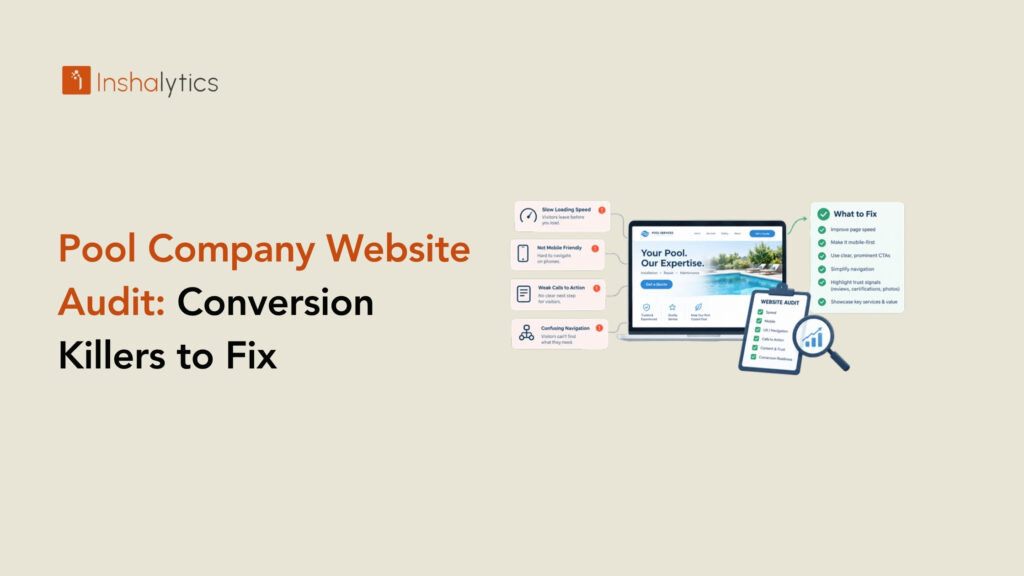
Your website gets visitors, but the phone barely rings. That gap is behind most weak lead flow in the pool business, and it rarely means you need more traffic. It usually means something on the site stops homeowners from calling or sending a request. A pool company website audit is a structured check that finds those problems so you fix what actually costs you jobs instead of guessing. In this guide, you will learn the biggest conversion killers, a step-by-step test you can finish in about 30 minutes, and a simple framework for deciding whether to fix, refresh, or rebuild. Grab your phone and let’s get started.
Why Run a Pool Company Website Audit Now
Most owners only look at their site when something breaks, but a regular audit catches the quiet problems that never trigger an alert. Pool customers search with urgency, compare a few companies fast, and contact the one that feels easiest to reach. Your site has seconds to earn that contact.
Traffic Without Calls: The Real Cost
Every visitor who leaves without contacting you is a lead you paid for, whether through ads, SEO work, or years of reputation building. The money is already spent. The only question is whether the site turns that attention into a conversation.
Say 400 homeowners visit your site in a month, and only a handful reach out. Doubling your ad budget would double the waste. Fixing the page those visitors land on raises the return on everything you already do. That is why pool website conversion rate is the first number to understand before you spend more on marketing.
Why Slow Season Is the Best Time to Audit
Fall and winter give you something spring never will: breathing room. Phones are quieter, crews have more flexibility, and you are not racing to answer opening-season demand. Any change you make now gets tested and settled before the rush.
Timing matters on the search side too. Homeowners start researching openings, resurfacing, and new builds weeks before they call. A site that is fixed and indexed before that wave arrives catches early shoppers, while a site fixed in May catches only the leftovers. Treat the slow months as your build window.
What an Audit Should Measure
A useful audit measures outcomes, not opinions. You are looking for how easily a visitor can act, how fast the site responds, how much trust it builds, and whether search engines can read it. Track these five areas:
- Contact actions: calls, form submissions, and text or chat requests
- Mobile speed and usability on a real phone
- Trust signals: reviews, photos, licensing, and guarantees
- Service and location page coverage
- Tracking: whether every lead source is recorded
If you want a broader template, our website conversion audit checklist covers the general version for any local business.
What Are the Biggest Conversion Killers on Pool Company Websites?
Conversion killers on pool company websites are design, speed, or content problems that prevent a ready-to-buy homeowner from contacting you. They are usually simple, fixable, and invisible to owners who view the site on a desktop. Four problems show up again and again.
Buried or Missing Phone Number and CTA
Pool problems are often urgent. A green pool before a party, a pump that stopped running, or a leak that keeps growing makes people want to call now. If they have to hunt for your number, many will simply try the next company.
Your phone number should sit at the top of every page and be a tappable link on mobile. Add one clear call to action above the fold, such as “Get a Free Quote” or “Call Today,” and repeat it after each major section. Check your home page, your service pages, and your contact page. Every one of them needs a visible next step without any scrolling or searching.
Long, Confusing Quote Forms
A form that asks for eleven fields, a full address, and a project budget feels like homework. Homeowners abandon it, and you never even see the lost lead. The goal of the first form is a conversation, not a complete project file.
Ask for name, phone number, service needed, and ZIP code. That is enough for you to call back and gather the rest. Use a dropdown for service type, so people do not have to describe the job from scratch. If you offer both cleaning and construction, give each its own short path, since those buyers want very different things.
Slow Mobile Load Times
Most pool searches happen on a phone, often outdoors, often on a weaker connection. Heavy photo galleries, autoplay videos, and bloated plugins can make a page crawl. A visitor staring at a blank screen does not wait around.
Test your home page on mobile data, not office Wi-Fi. If it takes noticeably long before you can read or tap anything, you have a problem. Compress images, remove unused plugins, and delay anything that is not needed immediately. Google also scores page speed directly, so slow pages hurt your visibility as well as your calls.
No Proof (Reviews, Photos, Licensing)
A pool is a large investment, and homeowners do not hand over money or backyard access to a company they cannot verify. A site with stock photos and no reviews asks them to take your word for it. Most will not.
Show real proof near every call to action: recent Google reviews, photos of your own work, your license and insurance details, and any manufacturer certifications you hold. Name the neighborhoods you have served. Specific, local, verifiable details beat polished slogans every time.
How Do You Audit a Pool Company Website Step by Step?
A pool company website audit step by step involves testing your site the way a homeowner uses it: on a phone, searching for a service, and trying to make contact. The three checks below fit into about 30 minutes, and you only need a phone, a laptop, and your analytics login.
Mobile Test: Call Button, Speed, Readability
Start with ten minutes on your own phone, on cellular data. Work through this list:
- Open your home page. Can you see a phone number and a button without scrolling?
- Tap the number. Does it dial?
- Read the first paragraph without zooming. Is the text large enough?
- Scroll to the bottom. Does anything jump, overlap, or cover the content?
- Open a service page and submit your own form. Does it feel quick?
Write down every point of friction. If you want to go deeper, see our guide to mobile optimization.
Service and Location Page Review
Next, spend ten minutes on page coverage. List every service you sell: weekly cleaning, openings and closings, equipment repair, resurfacing, remodeling, and new construction. Then check whether each one has its own page with unique copy, pricing expectations, photos, and a call to action.
Repeat the exercise for your service areas. A single “areas we serve” paragraph with a list of towns is not enough. Each major city or town you want work from deserves a page that proves you know that area. Note which services and locations are missing entirely.
Form, Call Tracking and Analytics Check
Finish with ten minutes on tracking. Submit a test form and confirm the notification email arrives within a minute. Check whether the confirmation message tells the visitor what happens next. Then open your analytics and confirm that calls, form submissions, and button taps are recorded as conversions.
If you cannot answer “how many leads did the website produce last month and from which source,” you are flying blind. Call tracking numbers and conversion events fix that, and they make every later decision easier.
Trust and Messaging Mistakes That Cost You Pool Leads
Once the mechanics work, the next question is whether your words and proof convince someone to choose you. Our post on how homeowners choose a pool service company shows how much weight trust carries in that decision.
Generic Copy That Sounds Like Every Competitor
“Quality service at a fair price” appears on nearly every pool website, which means it tells the visitor nothing. Homeowners compare three or four tabs at once, and identical promises make the decision about price alone.
Replace vague claims with specifics. How soon do you respond to a request? What is included in a weekly visit? What kind of pools do you specialize in? Which problems do you solve fastest? Concrete answers separate you from the crowd and filter out customers who are a poor fit.
Unclear Service Areas and Pricing Expectations
Visitors leave when they cannot tell whether you work in their town or whether they can afford you. You do not need to publish a full price list, but you do need to set expectations.
State clearly which cities and counties you serve. Explain what drives cost on each service, such as pool size, condition, and frequency, and offer a starting range or a typical process where it makes sense. When a homeowner knows roughly what to expect, the call you receive is warmer and the quote conversation is shorter.
Weak Reviews and Before-and-After Presentation
Having great reviews is not the same as showing them. Many sites bury a single testimonial in the footer or load a photo gallery of tiny, unlabeled images. That wastes your strongest asset.
Pull your best reviews onto the service pages they relate to. Pair before-and-after photos with a short caption: the problem, the work done, and the town. For pool resurfacing or remodeling, photo evidence does much of the selling for you. Keep your Google reviews growing, as well, since they feed both your site and your map listing. Our guide to ranking on Google Maps goes deeper on that side.
SEO and Technical Issues Hiding Inside Your Pool Website
A site can look polished and still be invisible to search engines. These technical problems often sit behind the scenes, so an owner would never notice them without checking.
Missing or Thin Service Pages
If one page tries to cover cleaning, repair, resurfacing, and construction, it ranks for none of them. Search engines match specific searches to specific pages, and a homeowner searching for pool resurfacing wants a page about resurfacing.
Give each core service its own page with real depth: what the service is, who it is for, how the process works, common questions, and proof. Aim for useful content, not padding. This pool service website design approach also helps visitors, since each page speaks directly to the problem they searched for.
Local Schema and Google Business Profile Alignment
Your website and your Google Business Profile should tell the same story. Check that your business name, address, phone number, hours, and service areas match exactly across both. Mismatches confuse search engines and customers alike.
Then add local business schema, a type of code that labels your details for search engines. Our explainer on what schema markup is walks through how it works. For the broader search picture, see our guide to local SEO for pool service companies.
Indexing, Speed and Site Structure Problems
Open Google Search Console and look at which pages are indexed. Important service pages missing from that list are invisible in search. Look for accidental “noindex” settings, broken links, duplicate pages, and redirect chains left over from earlier site versions.
Check your structure as well. Every service page should be reachable within a few clicks from the home page, and related pages should link to one another. A clean, logical structure helps both visitors and crawlers find what matters. Fix indexing first, then speed, then structure.
When a Pool Company Website Audit Means It’s Time for a Redesign
Sometimes the audit shows a handful of small fixes. Other times it shows a site whose foundation cannot support what you need. Knowing the difference saves you from either overspending or patching a dead end.
Fix, Refresh or Rebuild: A Decision Framework
Use three questions to decide. First, can you solve most of the problems with edits to existing pages? If yes, fix. Second, is the design dated, but the platform sound? Then refresh: new layout, new content, same foundation. Third, is the site slow no matter what you do, hard to edit, or built on a template that blocks proper service pages? That points to a rebuild.
Be cautious about redesigns that start with looks alone. A new coat of paint on a broken structure just repeats the problem. Our list of website redesign red flags helps you spot a bad project before it begins.
What Inshalytics Web Development Delivers for Pool Companies
When a rebuild is the right call, we design and develop sites around the way pool customers actually buy. That means mobile-first layouts, fast load times, tappable calls to action, short forms, dedicated service and location pages, and local schema built in from the start.
We also connect the site to tracking, so you can see calls and booked jobs rather than just page views. If you want to see how this fits into the bigger picture for your trade, visit our pool maintenance industry page.
Conversion Rate Optimization After Launch
A launch is the start of improvement, not the end. Conversion rate optimization means testing headlines, button placement, form length, and proof placement, then keeping what wins. Small changes compound over months.
We review call and form data, find the pages where visitors drop off, and test one improvement at a time. That steady process keeps your site working harder as your marketing grows, instead of aging quietly until the next costly redesign.
Next Steps: Turn Audit Findings Into a Fix List
You now know where pool websites lose leads: hidden contact options, heavy forms, slow phones, thin proof, and gaps that keep search engines from finding your services. The audit’s value comes from what you do with the findings, so turn your notes into a ranked list this week.
Prioritizing Quick Wins Versus Big Projects
Sort every finding into two groups. Quick wins take a few hours and no new design: a tappable phone number, a shorter form, compressed images, better review placement, and a corrected Google Business Profile. Do these first.
Big projects take weeks: new service pages, location pages, schema, and a rebuild. Rank them by how directly they affect calls. A missing page for your most profitable service beats a cosmetic redesign every time. Assign an owner and a date to each item so nothing stalls.
Re-Auditing Every Quarter
Websites drift. Plugins update, pages change, forms break, and tracking quietly stops working. Put a quarterly reminder on your calendar and repeat the 30-minute test, then compare results against the last round.
If you would rather have an expert run a deeper review, request a free website audit for your pool company and we will walk you through what we find, with no pressure to commit. Start with one fix this week, and your website becomes your most reliable salesperson before the season returns.