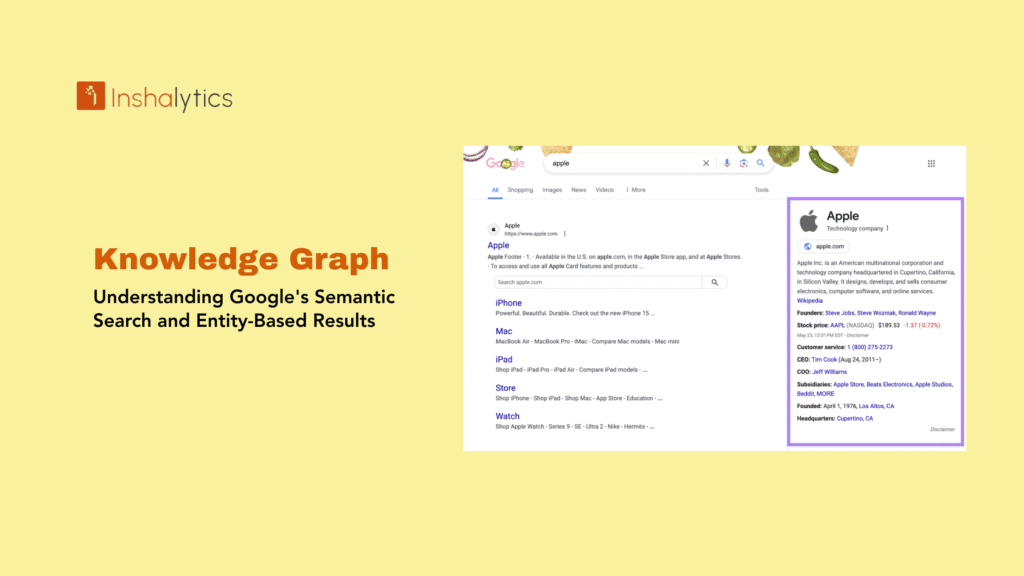
When you search for famous people, places, organizations, or other well-known entities on Google, you often see an information-rich panel on the right side of search results containing facts, images, and related information. This isn’t a random feature, it’s the visible manifestation of Google’s Knowledge Graph, a massive semantic network connecting billions of entities and their relationships. Understanding how the Knowledge Graph works and how to optimize for it represents a crucial evolution in SEO from keyword-based optimization to entity-based search strategy, fundamentally changing how brands establish online authority and visibility.
Navigate This Post
What Is Google’s Knowledge Graph?
Google’s Knowledge Graph is Google’s knowledge base displaying structured information about entities in a box on search results, typically appearing as a knowledge panel on the right side of desktop results or at the top of mobile results. Launched in 2012, the Knowledge Graph represents Google’s ambitious attempt to understand the real world of things, people, places, and facts, what Google calls “entities” and the connections between them.
An entity is anything that exists distinctly and independently: a person (Albert Einstein), a place (Eiffel Tower), an organization (Harvard University), a concept (quantum physics), a creative work (Mona Lisa), or any other specific thing with unique identity. The Knowledge Graph contains information about billions of entities and trillions of connections between them, forming a vast semantic network that helps Google understand meaning rather than just matching keywords.
The Knowledge Graph draws information from multiple sources including Wikipedia, Wikidata, CIA World Factbook, publisher partnerships, and data Google has verified across the web. This aggregated information powers various search features including knowledge panels showing entity facts and images, answer boxes providing direct answers to questions, rich results with enhanced search listings, and the foundation for voice search responses from Google Assistant.
Google’s shift toward entity-based search represents a fundamental evolution. Traditional search matched keyword strings in queries to keyword strings in documents. Knowledge Graph-powered search understands what entities queries reference and what relationships exist between entities, enabling more sophisticated relevance determination and direct answers to complex questions.
Knowledge Graph vs. Knowledge Panel
Understanding the distinction between these related concepts clarifies how the system works.
The Knowledge Graph is the underlying database—a massive network of entities and their relationships that exists behind the scenes. Users never see the Knowledge Graph directly; they see its results.
Knowledge Panels are the visible information boxes displaying Knowledge Graph data in search results. These panels show facts, images, related entities, and other structured information about the entity you searched for.
Think of the Knowledge Graph as a vast library’s catalog system, while knowledge panels are the specific information cards displayed when someone requests information about a particular topic.
How the Knowledge Graph Works
The Knowledge Graph operates through sophisticated processes that gather, verify, and connect information.
Entity identification begins when Google’s algorithms determine what entities exist in the world and which ones warrant inclusion in the Knowledge Graph. This involves processing massive amounts of structured and unstructured data to identify distinct, verifiable entities.
Information aggregation pulls facts about entities from authoritative sources including Wikipedia’s structured data, Wikidata’s collaborative knowledge base, official websites and databases, verified publisher partnerships, and patterns Google identifies across trusted web sources.
Relationship mapping connects entities through various relationship types including category membership (Paris → European Cities), associated people (Tesla → Elon Musk), locations (Louvre Museum → Paris), owned properties (Google → YouTube), and countless other relationship types that form the graph’s semantic network.
Confidence scoring evaluates information reliability by assessing source authority, consistency across multiple sources, verification against official records, and user feedback on knowledge panel accuracy.
Continuous updating keeps the Knowledge Graph current through automated processes that discover new entities, update facts as information changes, add newly verified relationships, and incorporate user feedback suggesting corrections.
Types of Knowledge Panels
Knowledge Graph information appears in several distinct formats optimized for different entity types and queries.
Standard knowledge panels display for well-known entities including people, places, organizations, and creative works. These panels typically show an image, brief description, key facts (birth date, location, founder, etc.), and links to official websites and social profiles.
Local business panels appear for businesses with Google Business Profile listings, showing address, hours, phone number, reviews, photos, and direct action buttons for calling, getting directions, or visiting websites.
Entity carousels display for broader category searches like “science fiction authors” or “Italian restaurants,” showing multiple related entities users can explore.
Information boxes provide direct answers to factual questions, drawing from Knowledge Graph data but formatted as simple answer boxes rather than full entity panels.
Comparison panels appear for “vs” queries comparing two entities, showing side-by-side information highlighting similarities and differences.
Benefits of Knowledge Graph Presence
Appearing in the Knowledge Graph and associated knowledge panels provides multiple advantages.
Enhanced visibility and credibility comes from occupying premium real estate in search results with rich, authoritative information. Knowledge panels establish entities as notable and verified, building trust with searchers.
Zero-click brand awareness occurs when users see your knowledge panel and gain information without clicking through to any website. While this might seem to reduce traffic, it builds brand recognition and authority that influences later conversions.
Voice search prominence gives Knowledge Graph entities significant advantages. Voice assistants like Google Assistant primarily source answers from Knowledge Graph data, making Knowledge Graph presence crucial for voice search visibility.
Rich information presentation allows showcasing facts, images, social profiles, and related information more comprehensively than standard search listings permit.
Competitive differentiation emerges when your entity has a knowledge panel but competitors don’t, establishing you as more notable and authoritative in your space.
Connection to related entities through the Knowledge Graph creates association with other relevant entities, potentially introducing your brand to users exploring related topics.
How to Get into the Knowledge Graph
While Google doesn’t accept direct submissions, several strategies increase your likelihood of Knowledge Graph inclusion.
Establish entity status by becoming notable enough that you exist as a distinct entity worthy of inclusion. This typically requires significant recognition, coverage, or authority in your field—you need to be notable enough that people specifically search for you.
Create and optimize your Wikipedia page since Wikipedia serves as a primary Knowledge Graph source. However, Wikipedia requires meeting specific notability guidelines and prohibits promotional content. Legitimate Wikipedia presence based on third-party coverage significantly increases Knowledge Graph likelihood.
Claim and optimize Google Business Profile for local businesses, which feeds directly into Knowledge Graph and ensures accurate business information appears.
Implement structured data markup using Schema.org vocabulary on your website, particularly Organization, Person, LocalBusiness, or other relevant entity types. While structured data doesn’t guarantee Knowledge Graph inclusion, it helps Google understand your entity and verify information.
Establish official web presence through a well-maintained official website clearly identifying as your entity’s authoritative source. Consistent NAP (Name, Address, Phone) information across the web reinforces entity identity.
Build authoritative citations through coverage in notable publications, news sources, and authoritative websites. The more high-quality sources mention and describe your entity, the more likely Google considers you Knowledge Graph-worthy.
Maintain active social media profiles on major platforms, particularly those Google recognizes (Facebook, Twitter, Instagram, LinkedIn, YouTube). Verified accounts add authority signals.
Earn recognition and awards that establish notability in your field. Recognition from authoritative organizations strengthens your case as a notable entity.
Ensure consistency across sources regarding basic facts like founding dates, locations, key people, and descriptions. Inconsistent information confuses Knowledge Graph algorithms.
Managing Your Knowledge Panel
Once you have a knowledge panel, maintaining and optimizing it requires ongoing attention.
Claim your knowledge panel through Google’s feedback mechanism by clicking “Claim this knowledge panel” if you’re authorized to represent the entity. Verification typically requires proving you control the entity’s official website or social media accounts.
Suggest edits for inaccurate information using the feedback option in knowledge panels. Google reviews suggestions and updates information if verified through authoritative sources.
Update official sources including Wikipedia, Wikidata, and your official website when facts change. Knowledge Graph updates often follow changes to these authoritative sources.
Monitor for accuracy by regularly checking your knowledge panel for incorrect information, outdated facts, or missing important details. Early detection prevents misinformation from spreading.
Optimize your official website with clear, structured information about your entity. Use Schema.org markup to explicitly identify entity properties.
Maintain active social profiles as Knowledge Graph often pulls information from verified social media accounts for inclusion in panels.
Respond to suggested edits if you’ve claimed your panel, as Google may request verification when users suggest changes.
Knowledge Graph and SEO Strategy
The Knowledge Graph influences SEO strategy beyond just knowledge panels.
Entity-based optimization replaces pure keyword targeting with building your brand as a recognized entity. This involves consistent branding across platforms, authoritative content establishing expertise, and becoming a source that other sites reference.
Topical authority building through comprehensive content coverage helps Google associate your site with specific topic entities. Creating content hubs around core topics strengthens entity associations.
Brand mentions and citations even without links contribute to entity recognition. Unlinked mentions across authoritative sites help establish your entity identity and authority.
Co-occurrence patterns matter as Google notes which entities frequently appear together, forming relationship connections. Strategic partnerships and associations with established entities can help newer entities gain recognition.
Structured data implementation helps Google understand entity information on your site, potentially contributing to Knowledge Graph data and definitely improving rich results eligibility.
Common Knowledge Graph Misconceptions
Several myths about the Knowledge Graph and knowledge panels persist.
Myth: Anyone can get a knowledge panel. Reality: Knowledge Graph inclusion requires achieving sufficient notability and entity status. Most small businesses won’t qualify for traditional knowledge panels, though local businesses can appear through Google Business Profile.
Myth: You can buy Knowledge Graph inclusion. Reality: No legitimate path exists for purchasing Knowledge Graph inclusion. Scams claiming to guarantee knowledge panels typically create nothing of value.
Myth: Having a knowledge panel guarantees high rankings. Reality: Knowledge panels and organic rankings are separate. Many entities with knowledge panels don’t rank #1 organically for their own names if other pages better satisfy certain intents.
Myth: Knowledge panels hurt website traffic. Reality: While some zero-click searches may reduce traffic, knowledge panels typically build brand authority that increases overall visibility and trust.
Myth: Wikipedia is required for knowledge panels. Reality: Wikipedia significantly helps but isn’t absolutely required. Many entities appear without Wikipedia pages, though having one dramatically increases likelihood.
Knowledge Graph and Voice Search
The relationship between Knowledge Graph and voice search makes entity presence increasingly important.
Voice assistant answers primarily source from Knowledge Graph data. When users ask Google Assistant questions, responses typically draw directly from Knowledge Graph entities and verified information.
Featured snippet prioritization often favors Knowledge Graph entities for voice responses, giving entities with knowledge panels advantages in voice search visibility.
Contextual understanding in voice search relies heavily on entity relationships in the Knowledge Graph, helping assistants understand follow-up questions and complex queries.
Local voice queries particularly benefit from Knowledge Graph data combined with Google Business Profile information, making entity optimization crucial for local businesses targeting voice search.
The Future of Knowledge Graph
Google continues expanding and evolving the Knowledge Graph in ways that increase its importance.
Expanding coverage includes more entities across more categories, particularly local businesses, niche topics, and emerging entities.
Deeper relationships add more sophisticated connections between entities, enabling more complex query understanding.
Enhanced multimedia incorporates more videos, 3D models, and interactive elements in knowledge panels.
Personalization tailors knowledge panel content based on user history and preferences, showing information most relevant to individual users.
Integration with other features deepens as Knowledge Graph powers more search features including rich results, answer boxes, and enhanced image search.
Conclusion
Google’s Knowledge Graph represents a fundamental shift in how search engines understand and organize information about the world. Rather than simply matching keywords, modern search increasingly operates around entities—distinct things with verifiable attributes and relationships. The Knowledge Graph contains information about billions of these entities and trillions of connections between them, powering knowledge panels and numerous other search features that provide direct, structured answers.
For brands, organizations, and individuals, Knowledge Graph presence establishes authority, enhances visibility, and becomes increasingly important as voice search and direct answer features grow. While not everyone can or should pursue Knowledge Graph inclusion, those who achieve sufficient notability benefit from enhanced search presence, voice search advantages, and the credibility that comes from Google’s verification.
Optimizing for the Knowledge Graph requires thinking beyond traditional keyword SEO toward entity-based optimization—establishing your brand as a notable entity, building consistent information across authoritative sources, implementing structured data, and creating the kind of comprehensive authority that merits Knowledge Graph inclusion. As search continues evolving toward semantic understanding and direct answers, the Knowledge Graph will only grow more central to search visibility and online authority.